Building my next deep dive: View → Signup → KYC → First Trade.
I’m mapping the full funnel, tracking the real drop-offs, and turning it into actionable insights. Thread coming soon 👀
"Read a lot, speak a lot to people that know more than you." And most importantly: "Give yourself the time and think a lot about what you want to do with the rest of your life."
"Trust your instincts. Be surrounded by the right people. Be open-minded about it. Don't expect that every decision you make is going to be successful. Be gutsy about it."🫰🏻
OKX vs Binance over the October 10 crash🚨
- OKX’s CEO goes public
The CEO of OKX (Star) breaks the silence months later:
“10/10 was not an accident. It was caused by irresponsible marketing.”
Binance created a risk loop that broke the market.
- OKX’s version of events
According to Star, this is the chain reaction:
Binance launches a temporary campaign
offering 12% APY on USDe
At the same time:
- USDe is treated like USDT and USDC
- accepted as collateral
- with no meaningful limits
The problem, according to OKX:
USDe is not a normal stablecoin.
It’s a tokenized hedge fund product from Ethena.
Ethena:
- raises capital via USDe
- runs arbitrage and algo trading
- tokenizes the resulting fund
- users earn yield from trading strategies
This is fundamentally different from:
- BlackRock BUIDL
- Franklin Templeton BENJI
Those are money market funds.
USDe embeds hedge-fund-level risk.
Star says Binance marketing blurred that distinction.
From the user’s perspective:
- USDe looked like a normal stablecoin
- same collateral treatment
- higher yield
-same UX
So users started looping:
USDT → USDe
USDe → collateral
borrow USDT
USDT → USDe
repeat
USDe depegged on Binance.
Liquidations cascaded.
Weak risk controls on assets like wBETH and BNSOL amplified it.
Then Dragonfly founder Haseeb Qureshi responds.
His take:
“This story is ridiculous.”
First problem: timing
BTC bottomed 30 minutes before USDe moved on Binance.
So USDe cannot have caused the liquidation cascade.
Cause and effect don’t line up.
Second problem: why now
All this data has been public for months.
Order books were analyzed endlessly.
Why bring this up now?
Haseeb suggests this looks more like:
- picking a fight with Binance
- or with CZ
- rather than revealing anything new
Trump tariff threats spooked markets on a Friday.
Crypto was the only thing open to sell.
Markets dumped hard.
At the same time:
- Binance APIs went down
- market makers couldn’t rebalance
- price dislocations exploded
No one fully explains 10/10.
Everyone agrees it hurt badly.
And the uncomfortable truth is probably this
20 different wallets.
Same contract.
Same method.
Same block.
All with 0 ETH.
You’re not looking at real users. You’re watching a well-executed airdrop farming setup.
Here’s how to spot it 👇
1/ Clue #1 - Identical first interactions.
Airdrop farmers often create wallets in bulk.
They all interact with the same contract for the first time, within minutes of each other.
Query idea: MIN(block_time) GROUP BY wallet
2/ Clue #2 - Same function call.
All the wallets execute the exact same function on the same contract.
Usually: claim(), mint(), stake(), or submit_task().
Check:
– Function signature (e.g. 0xa9059cbb)
– Contract ABI (if available)
3/ Clue #3 - Zero-value, single-purpose wallets.
Airdrop wallets are “use once and discard.”
No past tx history. No value held.
Just one goal: qualify for rewards.
- ETH balance: 0
- Token balance: dust
- Tx count: 1–2
4/ Clue #4 - Gas paid by another wallet.
Funding patterns give them away.
Often, one wallet funds 10–50 other wallets with just enough ETH to execute a tx.
Then those wallets all act at once.
Track:
– from_address of funding tx
– Tx timing correlation
5/ Clue #5 - Same IP / browser fingerprint (off-chain).
If you're the project team, check:
– Same device
– Same geolocation
– Same browser
– Or reused wallet creation pattern
(Sybil hunting gets deep.)
6/ Bonus: They always come early.
Farmers move fast.
They swarm protocols in testnets, betas, or pre-launch missions.
If you see a project suddenly grow by 5K users after a Zealy/Galxe announcement...assume a good chunk are farmers.
Airdrop farmers are smart.
They automate fast, act early, and leave no trace.
But the patterns are there if you know how to look.
Want to verify users?
– Look beyond addresses.
– Analyze behavior.
– Reward actions, not just clicks.
After account abstraction, are we heading towards intent abstraction?
Could Resource Lock systems make one-click cross-chain transactions a reality?
Thought-provoking thread👏🏻
1/ Intents just got stronger: 𝗥𝗲𝘀𝗼𝘂𝗿𝗰𝗲 𝗟𝗼𝗰𝗸𝘀
Onchain UX is broken, which is why retail still enters crypto via CEXs.
In this article, we explain how Resource Locks enable true chain-abstracted apps & how they push Intents to the next level.
https://t.co/bWDvkcLThD
While researching Chainweb EVM, I found the SPV model quite impressive.
One question though:
When each chain is at a different block height, how is cross-chain transfer finality determined?
@kadena_io I'd love to understand the technical details behind this mechanism more clearly.
🧵 How to Spot a Fake “Top Wallet” Leaderboard
You found a dashboard.
It shows the “Top Wallets” on a chain or dApp.
Huge numbers. Thousands of txs. Is it impressive?
Here’s how to tell if that leaderboard actually means anything 👇
1/ First red flag: absurd tx counts.
A wallet with 12,000+ transactions in 2 days?
That’s not a user that’s a script.
→ Check if the wallet repeats the same tx pattern
→ Same method, same contract, same amounts
2/ Look at the transaction timestamps.
Is there:
– A burst of txs every few minutes?
– No meaningful delay between actions?
– Activity running 24/7?
That’s a bot. Real users don’t operate like clockwork.
3/ What contracts is the wallet interacting with?
Real users use multiple contracts and dApps.
Bots usually hammer one or two:
– Faucet
– Claim contract
– Single staking pool
– Bridge script
Check: DISTINCT(contract_address)
4/ Wallet balance doesn’t match the activity.
Thousands of txs but the wallet holds < $1?
They’re not “top” users. They’re sybil nodes.
Look for:
– 0 ETH / 0 USDC balance
– Dust tokens
– No past activity before farming started
5/ See if the address belongs to a cluster.
Most bots are part of a bigger system.
Same tx pattern, same timing, same contracts.
➡️ Compare 5–10 wallets at the top.
If they’re too similar, they’re not real individuals.
6/ Top wallet ≠ top user.
A true top user:
✅ Uses multiple dApps
✅ Has diverse tx types
✅ Holds meaningful balances
✅ Returns over time
A fake “top wallet”:
❌ Spammy
❌ Short-lived
❌ Farm-focused
Conclusion:
Don’t be fooled by big numbers.
Before you celebrate your leaderboard:
Ask who those wallets really are; Not just how much they clicked.
Want to dig deeper?
Use tools that show:
– Method names
– Function signatures
– Contract diversity
– Timestamp clustering
– Historical behavior
It’s not about vanity metrics.
It’s about understanding usage.
🧵 How to Analyze Active Address Spikes (Properly)
An L2 or dApp suddenly shows a massive surge in daily active users.
Is it real growth? Or just a campaign?
Here’s a quick framework to break it down using on-chain data 👇
1/ A spike in active addresses doesn’t mean real traction.
It could be:
– An airdrop
– Faucet claims
– Token distribution
– Sybil farming...
→ First step: check total transactions.
Does activity back the hype?
2/ Where are the transactions going?
Look at the top destination contracts.
If 80%+ of transactions go to a single address, it’s likely:
– Farming
– Single-point onboarding
– Reward farming behavior
Use: GROUP BY contract_address ORDER BY tx_count DESC
3/ How many txs per address?
Real users → meaningful but fewer txs
Bots/farmers → many txs, often repetitive or small value
Calculate: AVG(tx_count per address) or check top address frequency
4/ Are the addresses all created at the same time?
Sybil attacks often use wallets created in bulk.
Check:
– First transaction timestamp
– Count of new addresses on spike day
If it's clustered → red flag 🚩
5/ Do users interact with multiple contracts?
Healthy growth = usage across many dApps
Farming = interaction with only 1–2 contracts
Use: DISTINCT contracts per address
Higher = more organic usage.
6/ Final checklist: Is it real growth or farming?
✅ Varied dApp usage
✅ Sustainable tx levels after campaign
✅ Unique active addresses over time
❌ Single contract farming
❌ High tx counts from same wallets
❌ All first-time addresses
You can use any on-chain analytics tool that gives you access to transaction, address, and contract-level data.
(It’s not about which tool you use it’s about asking the right questions.)
Spikes are fine.
But insights come from context.
Not all growth is created equal.
Saw this chart from @tokenterminal and had to check it myself.
Ran a quick query on Dune:
🔹 One contract alone got 7.4M txs in early June
🔹 Top 5 contracts = 10M+ txs
It looks like a massive farming campaign.
I agree, real users don’t arrive in bursts.
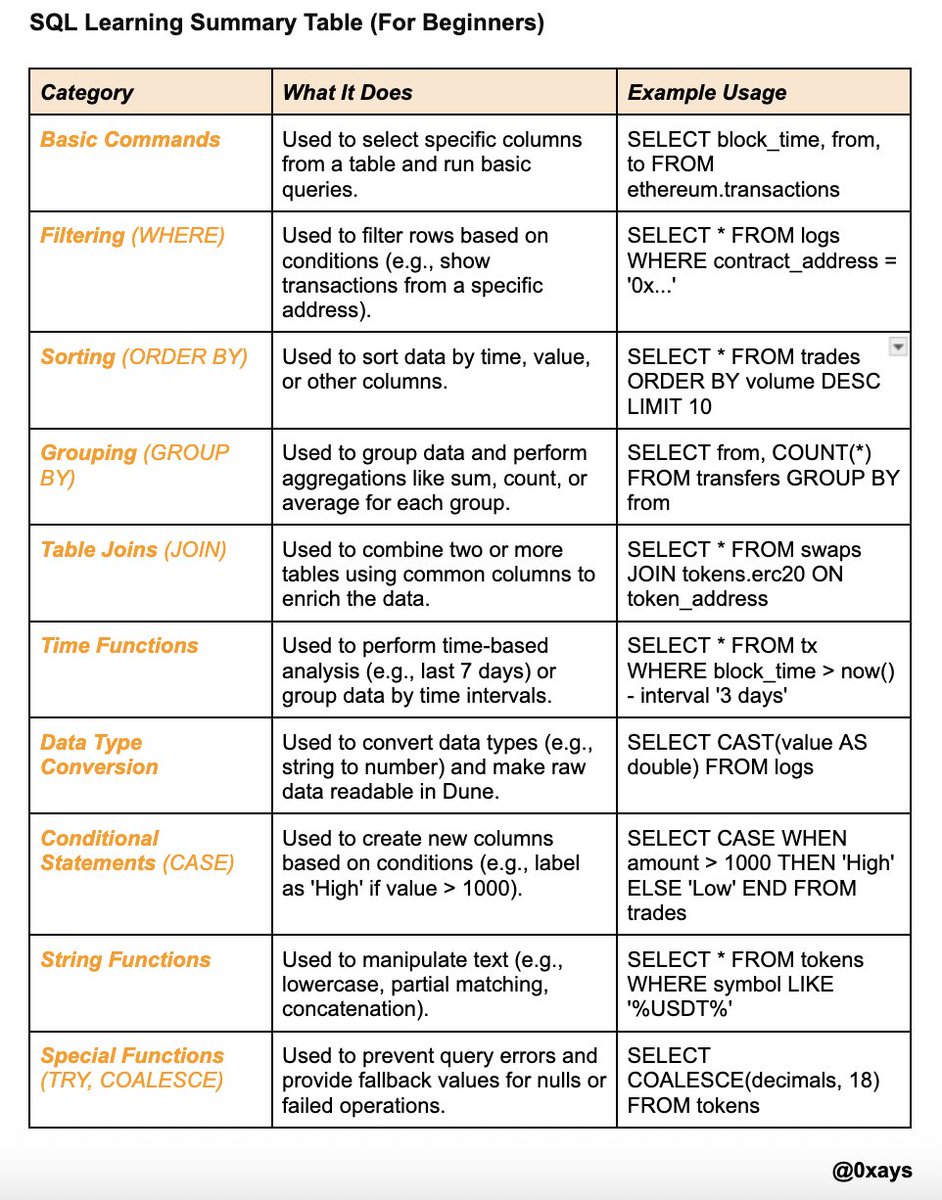
🌀 Just starting your onchain data journey?
Here’s a beginner-friendly SQL cheat sheet tailored for Dune & blockchain analytics.
Save it, use it, share it.
Let’s make data magic🧙🏻♀️
#OnchainData#CryptoAnalytics