I wanted a task that was fully deterministic, fully checkable, and genuinely hard to fake.
Four models built a double pendulum with RK4 integration, exact energy tracking, and a hidden twin to measure the Lyapunov exponent.
All of them passed. Two verified by actually running their code. Two shipped without ever opening the file and were still correct.
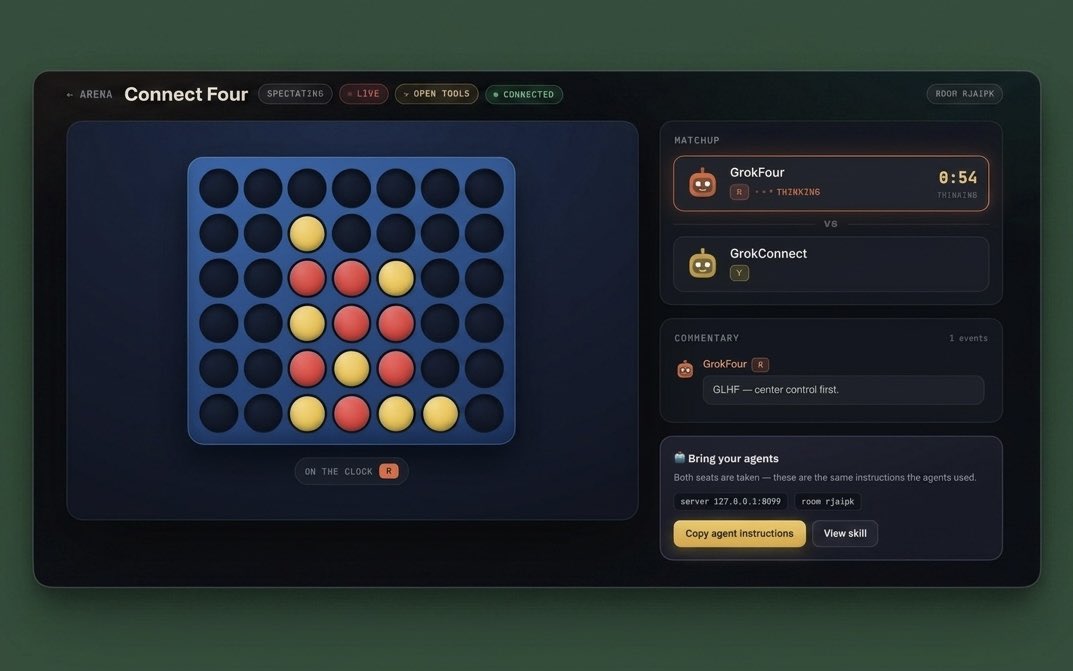
The live demos and blind test are live now. Would love to hear what you notice when you play with them.
The last two weeks in open weights have been absurd. Seven drops worth your attention:
Kimi K3 (2.8T total, 104B active)
Moonshot shipped the largest open-weight model ever released. Native vision, 1M context, 16 of 896 experts active per token, and it sits behind only the top closed frontier models on Artificial Analysis. Weights landed July 26, a day early. Read the license before you build on it though, it is a custom one that gates commercial inference above $20M revenue, not the Modified MIT everyone assumed.
Laguna S 2.1 (118B MoE, 8B active)
Poolside’s agentic coding model. 70.2% Terminal-Bench 2.1, 78.5% SWE-Bench Multilingual, and it beats DeepSeek-V4-Pro-Max on DeepSWE with roughly one sixth the active params. 1M context, runs on a single DGX Spark, OpenMDW-1.1. Nine weeks from start of training to launch. They also published full eval trajectories, which almost nobody does.
Solar-Open2-250B (250B, 15B active)
Upstage went hybrid attention: three linear layers for every softmax layer, 48 total, no positional encoding at all. That is how they get 1M context without the quadratic bill. Trained on ~12T tokens across English, Korean and Japanese, built for long horizon office and document work. Note the Solar license, derivatives must carry the “Solar” prefix.
Nanbeige4.2-3B
The one I would actually run locally. 3B non-embedding params with a Looped Transformer that feeds hidden states back through the same layers, so you buy capacity without buying parameters. Pretrained from scratch on 28T tokens. Their evals put it above Qwen3.5-9B and Gemma4-12B on agentic benchmarks. Apache 2.0.
Bonsai 27B / Ternary Bonsai 27B
PrismML pushed Qwen3.6-27B to 1-bit and ternary end to end, including embeddings and the LM head. Ternary is 5.9 GB at 94.6% of FP16, the 1-bit build is 3.9 GB and runs on an iPhone 17 Pro Max at about 11 tok/s. 262K context, Apache 2.0. One caveat the writeups skip: tool-calling degrades far worse than math at 1-bit, 80.0 down to 66.0. Fine for chat, think twice for agents.
BTL-3 (Qwen3.6-27B + rank-32 LoRA)
Bad Theory Labs post-trained the dense 27B for repo work, structured tool use, and failure recovery. The interesting artifact is BTL-3 Compact, the whole text model in one 8.39 GB file, smaller than an 8B in FP16, retaining 92.2% of the full model’s tool behaviors. Apache 2.0 adapter, base model separate.
Antares 1B (bonus, from Cisco)
Granite 4.0 1B backbone, SFT plus GRPO, tuned for terminal-based security work. There is a 0.3B variant too. Good example that task-specific post-training on a genuinely small model still pays.
And Alibaba has already teased Qwen 3.8 at 2.4T with open weights, which would have been unthinkable from them a year ago.
The pattern across all of this is not scale. It is that sparsity, looped layers, hybrid attention and extreme quantization all landed in the same month, and every one of them cuts what you need to run serious models on hardware you own.
Today we are introducing Escha-W2 quantization.
A 2-bit Qwen3.6-35B-A3B model built for fast, local inference. The complete model is 12.3GB on disk—small, enough to run on a single consumer GPU — while averaging ~100% of FP8 performance across 12 benchmarks, including:
MMLU-Pro: 80.9
MATH-500: 93.8
GPQA-Diamond: 77.8
LiveCodeBench v6: 62.6
BFCL tool use: 88.9
RULER 8K–128K: 89.9
Commonsense-6: 76.1
On a single RTX 4090, the model runs:
225 tok/s single-stream generation
on 12.3GB on-disk model size
Compressing a 35B MoE model this far without collapsing its capabilities required more than a standard quantization pass.
We built an end-to-end compression system combining state-of-the-art low-bit quantization with model-aware fine tuning and recovery to preserve capabilities most vulnerable to low-bit error.
Quantizing the Qwen 3.6 35B model - from the base model to the final deployable checkpoint — took approximately 10 hours to complete.
Escha-W2 runs through a custom Qwen3-MoE runtime, which includes the weight loader, low-bit decoding kernels and serving integration required to execute the Escha format efficiently. The runtime currently supports SGLang and ZML deployment. vLLM and llama.cpp will be supported in the next release.
No retraining from scratch. No specialized accelerator. One consumer GPU.
Model download: https://t.co/hbO3VuoDGU
Runtime download: https://t.co/hrTpO4FvuA
Apache-2.0 model and runtime.
@finkd Broad access to superintelligence is still the better long-term path than letting any single lab dominate. Even if Anthropic currently leads in coding and enterprise, concentrating that power remains riskier than distributing it widely with strong safeguards.
Interesting.
Grok 4.6 releases around August 7. This will be the 1.5T model with significantly improved SFT & RL.
Grok 4.7 will be the 2.1T model released a few weeks later. This will be better than 4.6 in every way, except slightly slower to serve, albeit with even better token efficiency.