1/ 🚨Tokenomist 2025 Annual Report is LIVE🚨
Static tokenomics are dead. Real usage, real incentives, real market conditions now drive redesigns.
📊 Don’t guess the future, understand it!
👉 Read the full report now!
People lose money in crypto because they don’t know these tools.
Price alone doesn’t tell you whether a crypto asset is cheap or expensive.
Understanding these valuation metrics is how professionals avoid this mistake.
**Full explanation in the video ↓
✅ Real case studies
✅ Charts & visuals
✅ Step-by-step analysis
✅ How to find unlock data
https://t.co/2Gf2dyjETo
Join us and @Tokenomist_ai's CEO/Founder @ApeWAGMI to explore how projects and investors are modeling emissions, supply, and unlocks, with tools now available to Nansen Points holders.
📅 Dec 2
⏰ 12PM UTC
🔗 https://t.co/s27Eulysd7
1/📊 Deep Dive: $ASTER Tokenomics Analysis
@aster_dex launched their $ASTER token on September 17, 2025, backed by @yzilabs with an initial market cap of $116M, surging to $1B in 24 hours.
👥 Community-focused allocation
🔥 Protocol revenue buybacks
📈 Competitive emission schedule
Let's break it down 🧵
The crypto industry deserves clear tokenomics. Not ambiguity that challenges their supporters.
As Tokenomist gears toward higher transparency within the industry, here's how projects can easily publish their token details via our self listing portal.
Grateful to the pioneering participants below for helping set new standards
@DeLoreanlabs@Hivemapper@KUBChain@NolusProtocol
BIG Tokenomist Pro update 🎉
Token Fundraising with Unlocks Analytics is now Live!
✅ FDV, Fundraising, Raised Amount WITH Investor token allocations
✅ Clean data, ready-to-use analytics. Save months of manual research
✅ 190+ tokens tracked, including large cap tokens that matter
👉 https://t.co/4NhFbk6bPZ
See More: https://t.co/jk79v7wZFp
Data can drive good decisions, including TGE's decisions.
I had the opposite view to the article "The Right way to TGE".
Respectfully, I believe @jakelynch and I share the same goal: to drive innovation and net positive value for token launches and the crypto industry. View this as a professional critique of the study
Here are my arguments for 3 misconceptions concluded from the empirical study follow by deeper review:
Misconception #1:
"How and when you launch your token is critical for the success of the token."
Empirical Claim Counter-Argument 1:
The study uses only 45 tokens—a small and heterogenous sample that introduces significant noise and variability, such as project size, category, and market conditions. This weakens its conclusions. While "why" (fundamentals) is undoubtedly critical, dismissing "how" and "when" is misleading. The "how" directly affects incentive alignment and stakeholder engagement (e.g., comparable to equity structuring in traditional startups). Similarly, "when" is not just about bull or bear cycles, but involves aligning liquidity and narratives with user adoption and funding opportunities—crucial for early momentum and sustained growth.
Misconception #2:
"Timing the market is important."
Empirical Claim Counter-Argument 2:
The empirical research provided offers insufficient evidence to broadly claim market timing as irrelevant or simplistic (bull vs. bear). Each crypto cycle differs significantly—token categories and narratives evolve. For instance, memes dominated the 2024 bull cycle, while Layer-1s and DeFi thrived in 2021. Moreover, dismissing competition as inherently negative ignores the market validation it provides; competition often signals proven demand, allowing projects that can endure to eventually stand out distinctly. Future studies can factor in these parameters
Misconception #3:
"The percent you allocate to investors, the team, or the airdrop is important."
Empirical Claim Counter-Argument 3:
While the study’s limited sample did not demonstrate strong correlation between allocation percentages and price, it would be incorrect to conclude allocation itself doesn't matter. Token allocations serve critical roles in stakeholder incentive alignment and resource distribution—key components to project success. Empirical analysis overlooking category-specific best practices and established guidelines (e.g., community allocations in memes or governance-focused funding in Layer-1s) misses nuanced but crucial dynamics shaping token performance.
Two analytic principles that support my argument:
1. Correlation does not imply causation
2. The Simpson Paradox
Deeper review and suggestions:
1. Methodological Gaps and Data Noise
- Empirical Approach: Right Intent, Limited Focus
The empirical method is valuable but must measure relevant indicators. Focusing predominantly on short-term price performance introduces noise, obscuring meaningful internal design effects due to macroeconomic factors and market sentiment.
- Price ≠ Comprehensive Success Metric
Price alone does not fully encapsulate success. Tokens serving key ecosystem roles, such as stablecoins or governance tokens, may demonstrate minimal price volatility by design yet achieve significant ecosystem value.
- Correlation vs. Causation Complexity
Low correlations observed between token design and price don’t imply irrelevance. Complex, multi-factor crypto environments often result in weak correlations, influenced by token category variability and limited sample size. Acknowledging categorical differences—such as meme, Layer-1, or DeFi tokens—could greatly clarify the analysis.
A recommended improvement is to qualitatively categorize projects and statistically compare token allocations within those contexts, leveraging our https://t.co/uZ45Kjum86's allocation screening for richer insights.
- Short Analysis Horizon
Evaluating token performance over only 1–2 years misses long-term impacts of design choices. Ethereum’s tokenomics evolution (PoW to PoS, EIP-1559) demonstrates token design effects unfold over multiple years, indicating longer-term studies are necessary.
2. Token Categories: Mixing Apples with Oranges
The current dataset merges vastly different token categories without accounting for distinct economic and incentive structures. Combining Layer-1, DeFi, and NFT tokens dilutes meaningful insights, akin to comparing companies across unrelated sectors directly.
Suggested Improvement:
Segmenting tokens by type and controlling for specific use cases would better surface the nuances in token design effectiveness. @Tokenomist_ai offer this via API Tier
3. Scale Matters: Percentages vs. Absolute Values
Token allocation percentages alone oversimplify complexities. A 20% allocation in vastly different market-cap scenarios results in fundamentally different incentives and market dynamics. Distribution mechanics—vesting, cliffs, unlock schedules—also critically shape market behavior beyond mere percentages.
In short, both absolute scale and mechanics behind allocations must be considered to truly understand tokenomics effects. suggest to add dollar term value along with percentage to the study
4. Timing: Beyond Luck and Into Strategic Considerations
Though precise market timing isn't fully achievable, entirely disregarding macro conditions is impractical. Historical patterns clearly demonstrate favorable market conditions significantly enhance liquidity, visibility, and adoption. Strategic launch timing, aligned with market narratives, is crucial for optimal outcomes.
5. Token Design Importance: Incentives and Alignment
Token design primarily ensures incentive alignment, stakeholder engagement, and long-term ecosystem sustainability. Thoughtful design strategies, as demonstrated by successful protocols like Compound and Uniswap, directly influence user adoption and long-term community health.
Proper allocations mitigate adverse incentives and promote sustainability, whereas poor allocations erode trust and stakeholder commitment.
6. Best Practices Exist Despite No Single Template
Although copying tokenomics directly isn't advisable, valuable lessons from historical successes and failures should inform new projects. Understanding nuanced best practices in yield incentives, airdrops, and initial token distribution helps projects craft effective, tailored strategies aligned with their goals and community expectations.
7. Advancing Data-Driven Token Design
The primary takeaway shouldn't dismiss allocation and timing impacts but highlight the need for improved analytical frameworks. Future studies should include more comprehensive samples, refined categorization, extended analysis horizons (3–5 years), and qualitative insights.
While current empirical limitations exist, straightforward statistical comparisons with appropriate categorization offer immediate, actionable insights. Understanding support precisely this kind of nuanced analysis.
Conclusion :
TGEs and tokenomics are indeed not magical fixes; they can neither compensate for weak fundamentals nor guarantee success on their own. However, dismissing token design and timing outright oversimplifies their proven strategic value. Effective tokenomics fundamentally enhances stakeholder alignment, trust, sustainable growth, and project scalability.
Both the "why" (fundamental value) and the "how" (token design and strategic timing) matter significantly.
Continued empirical refinement and informed analysis will help the industry move forward, setting higher standards for successful token launches.
Recommended Methodological Improvement:
To enhance clarity and derive practical insights, the methodology from the seminal book "Built to Last" is recommended. This involves studying comparable entities ("apples-to-apples") with clearly defined controlling factors such as timing, industry category, and context-specific business dynamics. This refined approach better isolates factors influencing long-term success, making it superior to generalized, high-noise empirical analyses.
Ever wondered where a project’s tokens are going, who holds how much, or when big unlocks are coming?
We’ve partnered with @tokenomist_ai to bring tokenomics intelligence for 400+ high cap tokens.
Now you can:
✅ View token allocation charts
✅ Track supply emission schedules
We got question about one token unlock data being wrong at @Tokenomist_ai because we report it differently than other 3 platforms.
Turn out we are the only one who reaching out, verify and report the correct data.
More people saying the same thing doesn’t mean it is correct, similar product but different quality.
Few understand this
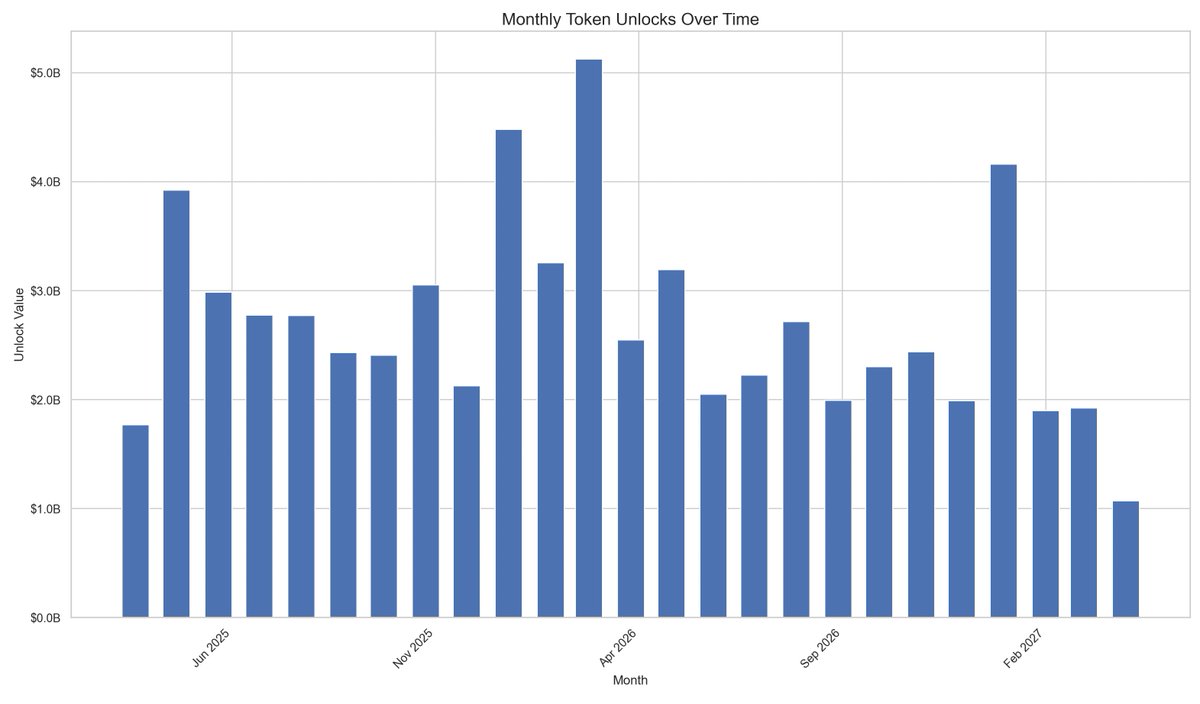
Over the next 24 months, at current prices there won't be a single month with less than $1B worth of altcoins being unlocked
sustainable market structure for sure.
🎙️ Thrilled to have Tanawat Chiewhawan @ApeWAGMI at #SEABW2025!
As CEO & Founder of @Tokenomist_ai, Tanawat is revolutionizing tokenomics with AI-driven insights. With 8 years in crypto, 4 in AI, and two best research awards from the Stock Exchange of Thailand, he’s an expert in DeFi and token design.
🎟️ No VC, no problem—discover the latest trends in tokenomics:
https://t.co/Dns1cKSDf0
Fast, efficient, insightful. 💪
Tokenomist Essential and Pro subscriptions now available on @solana and @base chains!
Grab your Tokenomist accounts now:
https://t.co/wvPVzRIRXO
Our focus has always been on delivering high-quality tokenomics data, with a structured and comparable format.
Seeing our data play a key role in training a co-pilot designed for streamlining workflow for traders is a testament to the evolving landscape of DeFAI.
Stay tune for more details on our partnership🫡