Didn't plan this honestly. Was out, got hungry, ended up at KFC.
Ordered the usual, fries, a burger, something to drink. Bill landed around $15.
Only difference this time, I paid with my Binance Card instead of pulling out cash or a regular card.
And that's kind of it, that's the whole story. Tapped, paid, got my food. No extra app switching, no "wait let me convert this first" moment.
Which is honestly the part worth talking about. Everyone's default image of using crypto is some complicated multi-step process, but this wasn't that. It was just... paying for lunch.
Sometimes the most interesting thing about a piece of tech isn't a big dramatic use case, it's how unremarkable it feels once you're actually doing it.
$15, one meal, zero friction.
Anyone else tried paying for something this basic with crypto?
Curious what your experience looked like. 👀
Educational content only. Not financial advice. Always DYOR.
#Binance #BinanceAcademy #BinanceCard
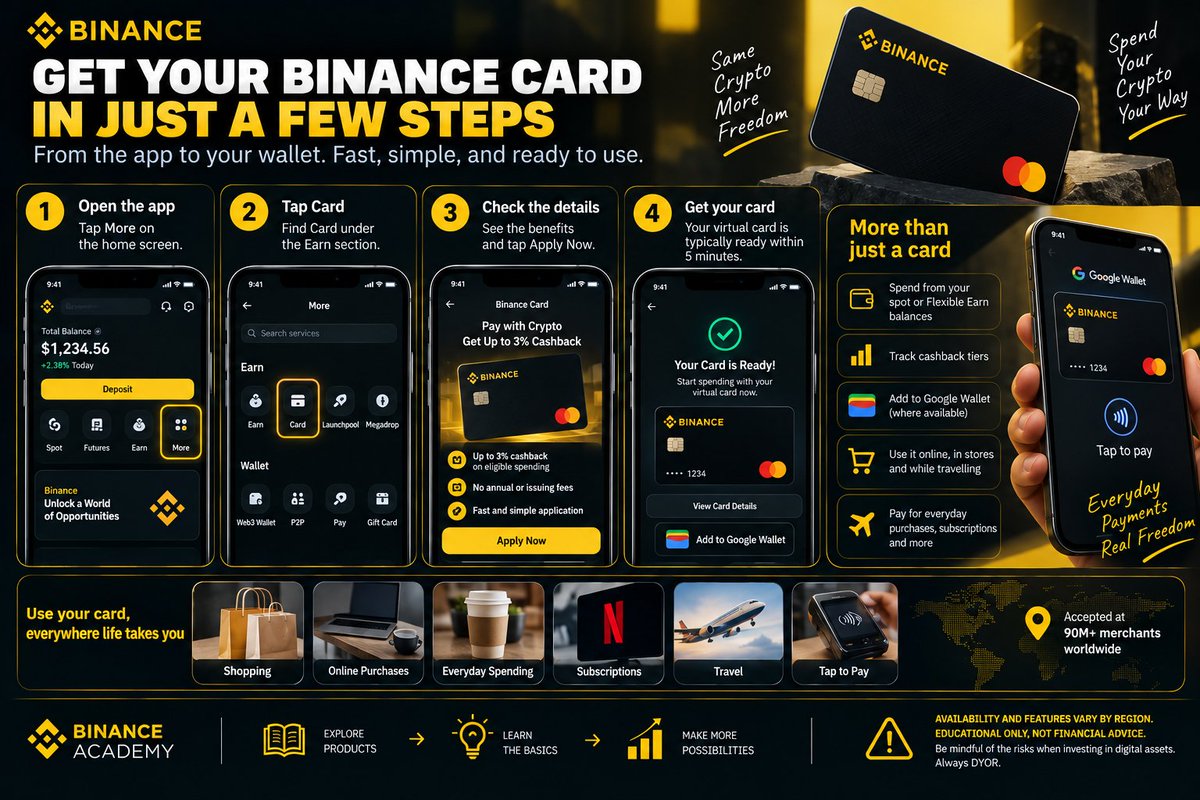
Getting a Binance Card is simpler than most people expect. Here's the actual flow, start to finish.
Open the app and tap More. From there, tap Card, it's sitting right under the Earn section alongside things like Wallet and Launchpool.
Once you're in, you'll see the pitch clearly laid out, pay with crypto, get up to 3% cashback, no annual or issuing fees. Tap Apply Now and the process moves fast, your virtual card is typically ready within 5 minutes, meaning you can start spending almost immediately after.
From there the card connects directly to what you're already holding. You can pull from Flexible Earn balances, track cashback tiers based on monthly spending, and even add it to Google Wallet for tap-to-pay where available.
It covers more ground than people assume too, online purchases, everyday spending, subscriptions, travel, tap-to-pay where supported. Not a niche tool, a genuinely everyday one.
Availability and features depend on region, eligibility, and applicable terms. Educational only, not financial advice. Be mindful of the risks when investing in digital assets. Always DYOR.
#Binance #BinanceAcademy #BinanceCard
FOMC is the main event I’m watching this week.
The Fed decision on Sep 16 could bring a sharp volatility spike across stocks, crypto, and commodities, so I’m not looking to chase the first move.
My plan:
• Wait for the initial FOMC reaction
• Watch how price holds after the first volatility spike
• Look for confirmation before entering
• Keep invalidation clear instead of forcing a trade
Oil is also on my radar with crude back above $100 and Middle East tensions still adding to volatility.
For this kind of market, liquidity matters. I prefer @bitget because I can trade stocks and commodities 24/7, access themed stocks in one buy, and trade with deeper liquidity across major markets.
This is the start of my KCGI 2026 trade journal. I’ll share the setup first, then the result honestly.
#KCGI2026
Crypto cards aren't new anymore, but actually seeing one used for something ordinary still catches people off guard.
Binance Card lets eligible users in supported markets spend crypto the way you'd use any regular card, online and offline. Not a separate wallet you have to manage, it draws from balances you're already holding, including funds sitting in Flexible Earn.
The scale is what makes it interesting. We're talking 90 million plus merchants worldwide accepting it, subject to applicable terms, which means it's not some niche use case limited to a handful of crypto-friendly stores.
It's virtual-first too, eligible users can add it to Google Wallet where available, meaning tap-to-pay without needing the physical card in hand every time.
There's also cashback involved, up to 3% on eligible monthly spending, subject to applicable terms. Worth checking the specifics rather than assuming a flat number applies across the board.
What actually stands out here isn't the novelty of "paying with crypto." It's that it removes an extra step, no converting to cash first, no separate app, just spending from a balance you already hold, where eligibility and availability allow it.
Be mindful of the risks that come with holding digital assets generally, this isn't a reason to change how much exposure feels right for you.
Availability, eligibility, and features vary depending on your market. Always check official Binance sources for what applies to you.
#BinanceCard #BinanceAcademy #LearnWithBinance
Not all yield carries the same risk. That line sounds obvious until you actually look at how wide the gap is across Binance Earn's product range.
Start at the low end. Flexible savings keeps your funds liquid, lowest risk in the lineup, basically the entry point for anyone easing into this. Move up and you hit staking, ETH and SOL specifically, where your position stays exposed to the underlying asset's price movement, medium risk, still fairly straightforward to understand.
Then things shift. Dual Investment is market-linked, meaning your return depends on how two different assets move relative to each other, and that outcome is never guaranteed. Smart Arbitrage runs as an automated strategy chasing price differences across markets, built with experienced users in mind, not a beginner's first Earn product. On-Chain Yields opens up DeFi opportunities through Binance directly, which sounds appealing until you factor in that it carries both smart contract risk and market risk stacked together.
Here's the part that actually matters. Higher potential reward almost always sits next to higher risk, and none of it comes with a guaranteed outcome. An advanced product being wrapped in a friendly interface doesn't make it a savings account. Treating it like one is exactly how people end up surprised later.
Where you sit on this range should come down to how much volatility you can actually handle, how experienced you are with the mechanics involved, and how much you can afford to have tied up if things move against you. Not what looked appealing in a five-second scroll.
Also worth remembering, availability and eligibility for these products shift depending on your region, so what applies to someone else might not apply to you.
Explore the full range here:
https://t.co/GaJ2sRGIw9
Educational only, not financial advice. Product availability varies by region. Always DYOR.
#Binance #BinanceAcademy #DeFi #Crypto
Staking usually forces a trade-off nobody loves. Lock your assets, earn rewards, but lose the ability to actually use them for anything else in the meantime. Liquid staking exists to remove that trade-off.
Here's the mechanic. You stake ETH or SOL, and instead of your assets just sitting frozen, you receive a token back that represents your staked position, WBETH for ETH, BNSOL for SOL. That token stays usable, meaning you can move it around in DeFi while the original staking rewards keep accruing in the background. You're not choosing between earning and flexibility anymore, you're getting both at once.
Worth understanding what these tokens actually are though. They're not the same thing as holding raw ETH or SOL. Their value tracks the staked position plus accumulated rewards, and like the underlying asset itself, that value still moves with the market. Staking doesn't remove exposure to price swings, it just changes how you interact with your position while holding it.
This setup tends to make more sense for people already planning to hold ETH or SOL long-term anyway. If you're staking purely to chase a short-term move, the mechanics here don't really solve for that, this is built around patience, not speed.
One more thing worth knowing, depending on how you participate, Simple Earn involvement can also open the door to things like Launchpool or Megadrop rewards, extra layers on top of the base staking reward, though eligibility and availability shift depending on the product and your region.
Explore staking options here:
https://t.co/GaJ2sRGIw9
Educational only, not financial advice. Product availability varies by region. Always DYOR.
#Binance #BinanceAcademy #ETH #Staking
Your crypto shouldn't just sit there doing nothing. That's basically the whole idea behind Simple Earn.
There are two ways into it, and they work on opposite logic.
Flexible is the low-commitment option. You deposit supported crypto, rewards start accruing daily, and you can withdraw whenever you actually need the funds. No minimum deposit either, which makes it an easy starting point if you're new to any of this, or if you just don't want your money tied up while you figure out what you're doing.
Locked flips that logic. You commit your crypto for a fixed term, options usually run 7, 14, 30, 60, 90, or 120 days, in exchange for a rate higher than what Flexible offers. That higher rate is essentially the reward for giving up access during the term. The trade-off is real though, pull out before the term ends and you can end up forfeiting the rewards you'd already accumulated, sometimes losing most of what made Locked worth choosing in the first place.
Both support a wide range of assets too, stablecoins like USDT and USDC, along with BTC, ETH, BNB, SOL, and hundreds of others depending on availability.
Here's a simple way to think about which fits you. If you might need the funds unexpectedly, or you're still getting comfortable with the platform, Flexible keeps things low-pressure. If you're holding an asset long-term anyway and don't need liquidity in the near future, Locked lets that holding period actually work for you instead of just sitting idle.
One thing to be clear on either way, rates aren't fixed, they're variable and can shift. Never treat a quoted number as guaranteed.
Explore Simple Earn here:
https://t.co/GaJ2sRGaGB
Educational only, not financial advice. Product availability varies by region. Always DYOR.
#Binance #BinanceAcademy #Staking #Crypto
You fund your account, you're verified, and then you're just staring at buttons labeled Market, Limit, and Convert like they're a different language.
That's usually the exact moment people either freeze or click randomly and hope for the best. Neither is necessary once you know what each one actually does.
Spot trading is the direct route, buying and selling crypto assets outright. Within that, a market order executes immediately at whatever the current price is, no waiting, no guessing. A limit order lets you set the exact price you're willing to buy or sell at, and it only fires once the market actually reaches that number.
Binance Convert skips both of those decisions entirely, it just swaps one supported asset for another without touching order books or setting prices.
Before placing anything, actually read the trading pair and details in front of you. Crypto prices can move within minutes, and the wider market doesn't always give much warning before shifting. Some people manage that by spreading purchases out over time instead of going all in at once, commonly called dollar-cost averaging, though that's a personal strategy choice, not a rule anyone has to follow.
None of these tools are complicated on their own. Understanding what you're clicking, and why, is the part that actually matters.
Start here:
https://t.co/bdIlfGvuUm
Educational only, not financial advice. Always DYOR.
#Binance #BinanceAcademy #LearnWithBinance