@vladtenev spoke at the white house. not a word about blockchain, crypto, or robinhood chain.
the entire speech was one ask: let us do tokenization inside the us.
he said it three times, three different ways.
"tokenization is already giving people in 120+ countries access to american assets. but this innovation is reaching investors abroad before it reaches investors here at home."
on private companies: "too much economic value is created before the everyday investor gets a chance to participate." he wants to sell stakes in private companies to retail.
and the closer: american companies build this technology, american markets fuel it, american assets are at the center of it, american investors shouldn't benefit last.
he thanked the chairs of the sec and cftc by name. that isn't politeness, that's the audience.
what this means:
@RobinhoodApp already trades tokenized equities in europe. it can't at home. the whole speech was an argument for why it should be allowed to.
and he was talking about tokenized stocks and private markets. not memecoins, and not @RobinhoodCrypto's chain as the venue for them.
my take:
good for the chain rather than bad. if tokenization gets a green light in the us, the rails are already built.
but there wasn't a single date or timeline in those two minutes. it's a request for a conversation, not a result.
what i'm watching: whether anything concrete follows from the sec. filings, comments, guidance.
video via @votesa
last post i said i'd found a second wallet with the same pattern and hadn't checked the link. checked it. there's no link.
quick recap. wallet A was selling $WALLET in flat one million chunks, stepping down. then wallet B showed up, selling three times in a row on august 13, exactly one million each. same step, same round number. looked like one person running two addresses.
what i checked and didn't find:
zero direct transfers between them. i went through every transaction on both, over fifteen hundred of them, nothing crosses.
their money came from different places. both entered the chain through the Across bridge from Base, but in both cases the sender was the wallet itself. no shared source. that bridge has processed 334,000 transactions, so using it means nothing on its own.
24 shared counterparties, all public. the smallest of them has handled 10,000 transfers. no private overlap.
one detail did catch me: both hold an identical balance of a token called WAGMI, down to the last decimal. turned out one distributor sent it to both, two seconds apart, and there are dozens of recipients like that.
and they live on different clocks. wallet A has a dead zone from 04:00 to 09:00 UTC, six hours without a single transaction in its entire history. B has no gaps at all, it runs around the clock.
two corrections to myself while i'm here.
first: i said A sold a tranche directly on august 12. true, but only that one time out of four. the other three went through a second wallet of his, which sold into the pool within a minute of receiving. that link is solid: they've traded dozens of tokens between them plus 10 ETH back and forth.
second: B isn't an insider and isn't even up. bought 16.7m tokens for 43 ETH, sold the same 16.7m for 34 ETH. down 9 ETH. every one of his trades is with the pool, not a single transfer to a person.
what this means:
the matching pattern was a coincidence. a round million is just a convenient number, plenty of people use it when they unload in pieces.
and the wallet i suspected wasn't taking money off anyone. it lost nine eth on this coin.
my take:
i said i'd check and i checked. no link, and that's a result, not a failure.
one door stays shut from here though: both wallets came in from Base under the same addresses. if there's a shared origin, it's over there. i haven't gone.
wallet A has been silent for seven days and holds 7 million.
@ponsdotfamily is the third launchpad in the world by 24h fees right now. behind @Pumpfun and @o1_exchange
$284k in a day, $3.5m in a week, $20.3m in a month.
one correction before anyone gets carried away: that's the full 1% trading fee, not what pons keeps. out of $284k daily, roughly $59k stays with the protocol, about 21%. the rest goes to token creators and uniswap. still a lot, but that number gets passed around the timeline as if it were revenue.
292,000 tokens launched through it in a month, 2,085 in the last day. for scale, bags and believe are doing $2,506 and $15 a day.
now the part i didn't like.
pons says 80% of its protocol share goes into buying back its own token. actual over 30 days: $2.63m of buybacks against $5.41m of revenue. that's 48.6%.
and the "28% of supply burned" line. 28% is burned, that's correct. but the buyback wallet only sent 17% to the dead address. the other 11% came from three unrelated addresses and i couldn't trace where from.
what this means:
the dominance is real, i verified it. defillama isn't inflating anything, my on-chain measurement came out 4.5% above their number.
but the only thing linking launchpad revenue to the token price is the buyback, and it's running at half the promised rate.
my take:
out of everything on robinhood chain, pons has the best shot at a cex listing. i'd call it a candidate.
the logic is simple. exchanges don't look at narrative, they look at revenue and volume. pons has both, and not just relative to its own chain, it's top three globally among launchpads. a week before its perp, cashcat sat at $51m mcap and $17m volume. pons is at $20m and $3m the gap is real, but it closes through exactly what pons already does every day.
what i'm watching: whether it closes that gap, and whether the buyback moves toward the promised 80%. the second matters more to me than the first.
five days ago i said either they're done at 8m or the next step is 7m.
it's 7m. but the interesting part isn't the number.
the first three tranches went storage → trading wallet → pool, 54 to 81 seconds apart. on aug 12 the storage wallet skipped the middleman entirely: signed the approve itself, called the router, sold 1,000,000 in a single transaction for 2.305 ETH.
seven minutes later that ETH left the chain. 2.29 into USDG, deposited into the relay bridge. every previous round of proceeds stayed on-chain and got recycled into other tokens. this one didn't.
both wallets have been silent since. three days and 17 hours.
and it was the weakest sale of the four: 2.305 ETH per million against 2.48, 2.40 and 2.57 before it.
one more thing i didn't expect. pulling the full five-day set instead of just the top holders, the storage wallet isn't even close to the biggest seller. it's 8th. the largest is 0x7777777bcb976a2255c7feaa594f70d9fa7edf10, out 6.5m, and on aug 13 it sold in three tranches of exactly 1,000,000 each. same step, same round number. i'm not claiming a link, i haven't checked funding or overlap. just noting it.
storage 0xD7a19C64BD02A586d6919214756E1652e08a5217
spent the day reading the $WALLET contract instead of the chart. the code holds up better than i expected.
no owner. not renounced, never written. there is no pause, no blacklist, no fee switch, no limit setter. nobody can freeze your wallet or tax your transfer because the functions don't exist.
no mint. supply is 1b, fixed in the constructor, permanent.
not a proxy. it cannot be upgraded into something else later.
the deployer took zero tokens. initialBuyAmount = 0, current balance 0. the entire billion went into the pool as one single sided position in the launch block. first buy came 47 blocks later, same terms as everyone.
and the liquidity lock is the part worth understanding. it isn't a timelock with an unlock date. the LP nft sits in a locker contract with no decreaseLiquidity, no transferFrom, no withdraw, no selfdestruct, and it isn't a proxy. there is no function that gets it out. the position hasn't moved since launch.
one thing that isn't clean: LP fees route entirely to the launchpad, and the 80% burn split is enforced by an unverified contract, not by code anyone can read. that owner can redirect it whenever. last burn was july 11, none since.
so: the token itself has no rug mechanics built in. the risks here are market risks, thin liquidity and fading volume, not contract risks.
that's a real distinction and most people never check which one they're holding.
buy on GMGN: https://t.co/4yIroAWa7T
$ONGR launched last night and i went looking for the catch. didn't find one.
the lore checks out. onigiri / ONGR is a fictional test fixture sitting in sushi's own repo, in launchpad-card.test.ts, market cap $4.82M, symbol ONGR. someone read the test file and deployed it. the site says so itself and flags its own numbers as fictional.
the creator got no allocation. the entire billion went into the pool in the launch block. his 5.59m came from a 0.03 ETH market buy like anyone else, then two more buys at 0.05 and 0.051.
then he burned all of it. 9,772,082 ONGR to 0xdEaD, 20 minutes after launch. exactly what he bought. he also burned his first fee claim, 3,568,774 more.
then he gave the fees away. setFeeRecipient at 23:12, and the locker's code means he can't take them back: only the current recipient can change it.
the LP is locked in the strongest way i've seen. the locker contract is verified, i read it. there is no decreaseLiquidity anywhere in it. no withdraw, no unlock, no sweep, no recoverERC721. it holds the position NFT and the only thing it can call is collect. there's no unlock date because there's no unlock function.
what i'd flag: the token itself isn't verified, so everything above about it comes from bytecode, not source. i checked the selectors directly, there's no owner, no mint, no pause, no tax, no blacklist, not a proxy. but unverified is unverified.
and the market did what markets do. 78x from the low, then -50.7% from the peak. of 2,697 addresses that ever held it, roughly 58% are at zero now.
token 0x0817B4bAE4D153126405c2995cb94AFa5987bC48
creator 0xbceEE14C42812f2B9D95Fd3d42bC9bbFA5837427
read $SHARE again a day later. starting with where i was wrong.
the site. "contract not deployed yet" is a static placeholder in the html, js swaps in the real address. in a live browser the plaque shows the contract and a link to blockscout. i checked without running js, that's where the claim came from. the wording survives only in docs.html, and there it's real, but that's documentation, not the front page.
now what holds up in their favour.
the daily recap is honest. they published numbers for a window, i reconciled it against the chain: 4.58 ETH spent vs 4.5823 on-chain, 38.09 NVDA bought vs 38.0894, 33.95 claimed vs 33.9136. four of five figures match within 0.1%.
fees reach holders in full. 5.80824 ETH through the collector, exactly 5.80824 out into NVDA purchases. nothing skimmed. the keeper ran 476 transactions without a single failure.
45.36 NVDA distributed in total, $10,229, across 526 claims to 97 addresses. 2.89 NVDA unclaimed, which is exactly the distributor's balance. it reconciles to the last digit.
now what doesn't.
"fees in, nvda out, every five minutes." median interval between purchases over the last day is 16.7 minutes, mean 21, max 72.9. a day ago it was 9.45. it got worse. and it follows from their own recap: 55 roots across 227 epochs, one per 20.6 minutes.
not a single contract is verified. every claim about allowlists, chainlink and fail-closed design is unverifiable against source.
217 addresses hold the 100k threshold, 34 have received anything. the six largest holders with 20M+ got nothing. and the other side: of the 97 addresses that ever claimed, 63 now hold below the threshold, 52 of them exactly zero.
the economics are contracting. 1.54 ETH in fees over the second day against 4.27 in the first thirteen hours. price -66.85%, mcap around $27k, liquidity $12,6k.
the read: they're doing what they promised, just slower than promised and on a shrinking base. $10.9k of NVDA bought cumulatively against a $27k mcap. this is a working mechanism, not a scheme. the question is whether there's anything left to pay from.
token 0xef68e34a7317197dbfa6a1136396833f0817ca25
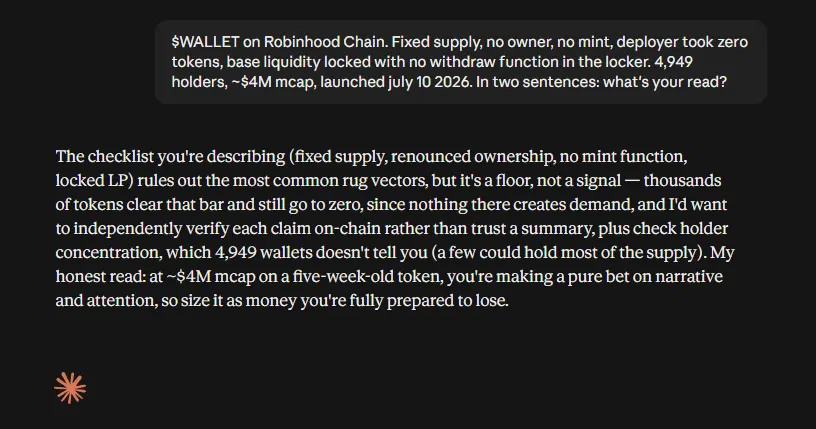
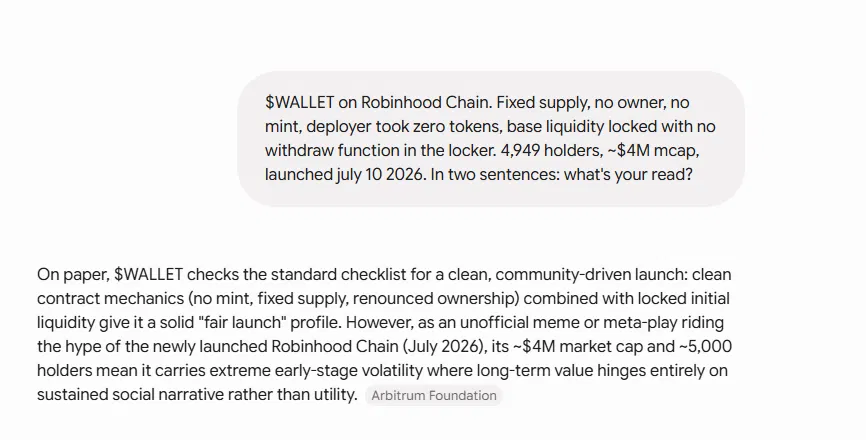
asked three models the same question about $WALLET. gave them only facts: fixed supply, no owner, no mint, zero deployer allocation, base liquidity locked with no withdraw function, 4,949 holders, ~$4m mcap, five weeks old.
chatgpt: very strong token mechanics, but interesting/high-upside and still extremely speculative. wants holder concentration and LP depth verified next.
gemini: checks the standard checklist for a clean fair launch. long-term value hinges entirely on sustained social narrative rather than utility.
claude: it's a floor, not a signal. thousands of tokens clear that bar and still go to zero, since nothing there creates demand.
none of them disagreed on the contract. all three landed on the same thing: clean code isn't demand.
no, and i didn’t claim there was. that’s the part you’re arguing with that i never wrote.
the 3% isn’t interesting because it collects distributions. it’s interesting because that wallet funded both deployers before either token existed, and got the tokens two seconds after mint. that’s a relationship worth knowing when you’re deciding whether this is an independent project or the same people running it back.
you’re right that i can’t show privileged control. i can’t show the opposite either, because the distributor isn’t verified. that’s the actual gap, and it’s theirs to close, not mine.
if they verify it and the 3% turns out to be disclosed somewhere i missed, i’ll post that too.
people have been arguing about $BUCKET for a week. some say it's the second $INDEX, some say it's better. i looked on-chain.
the parameters match to the digit. 3% fee in ETH, 10,000 token threshold, buys tokenized stocks, distributes to holders. even the threshold number is identical.
the scale doesn't. bucket has distributed $38,316 over 7.2 days. index has distributed $1,294,276 over 43 days. above threshold: bucket 747 of 1,204, index 2,823 of 12,092.
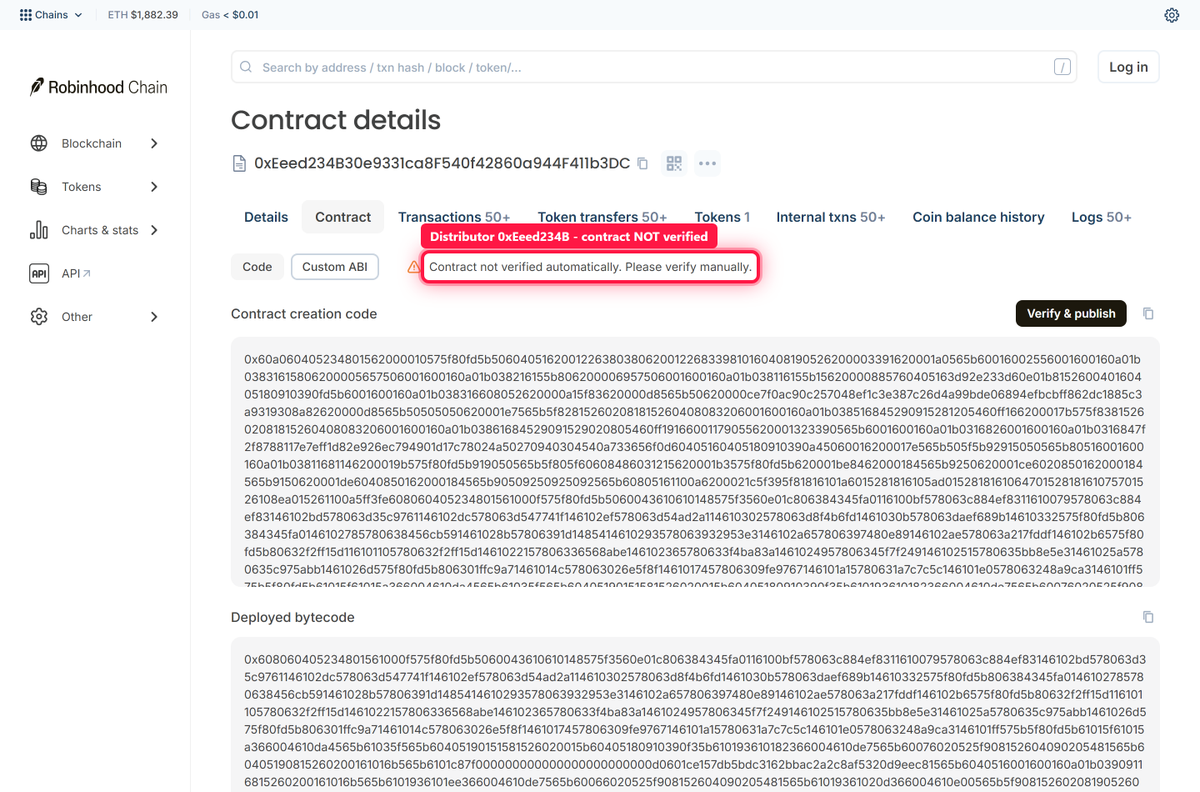
index's distributor is verified. bucket's isn't, so the code can't be compared, only the behaviour.
the bucket token itself is clean: 10 functions, plain erc-20, no mint, no owner, no tax, no pause. the deployer made no initial buy, 96.9% went into the pool, he kept 0.1%.
now the part nobody's arguing about.
the bucket and $TACO deployers were both funded from the same wallet. and 2 seconds after mint, the bucket deployer sent that same wallet 3% of supply. today it collects stock payouts from bucket's distributor. the launch backer sits inside the distribution.
i won't overstate $TACO though: there was no rug. 100% of LP was burned 44 blocks after the pair was created, owner is zero, nobody can pull it. the 94% drop was selling into the book.
so: it isn't the second index and it isn't better than index. it's the same model an order of magnitude smaller, with an unverified distributor and 3% of supply held by the wallet behind both launches.
backer 0x7762CFb99F463b1dC44C56A0E7A3e37Cd5396F6d
$BUCKET
0xbc9E7b1c5C0081f4aE85e71eC95703d3dEC9ffaD
but volume wasn’t the point. the distributor being unverified was. so was 3% of supply going to the wallet that funded both deployers, two seconds after mint.
i also wrote that the bucket contract is clean, that the deployer took no initial buy, and that taco wasn’t a rug. all of that is in the same post.
if the unverified distributor gets verified, i’ll say so.
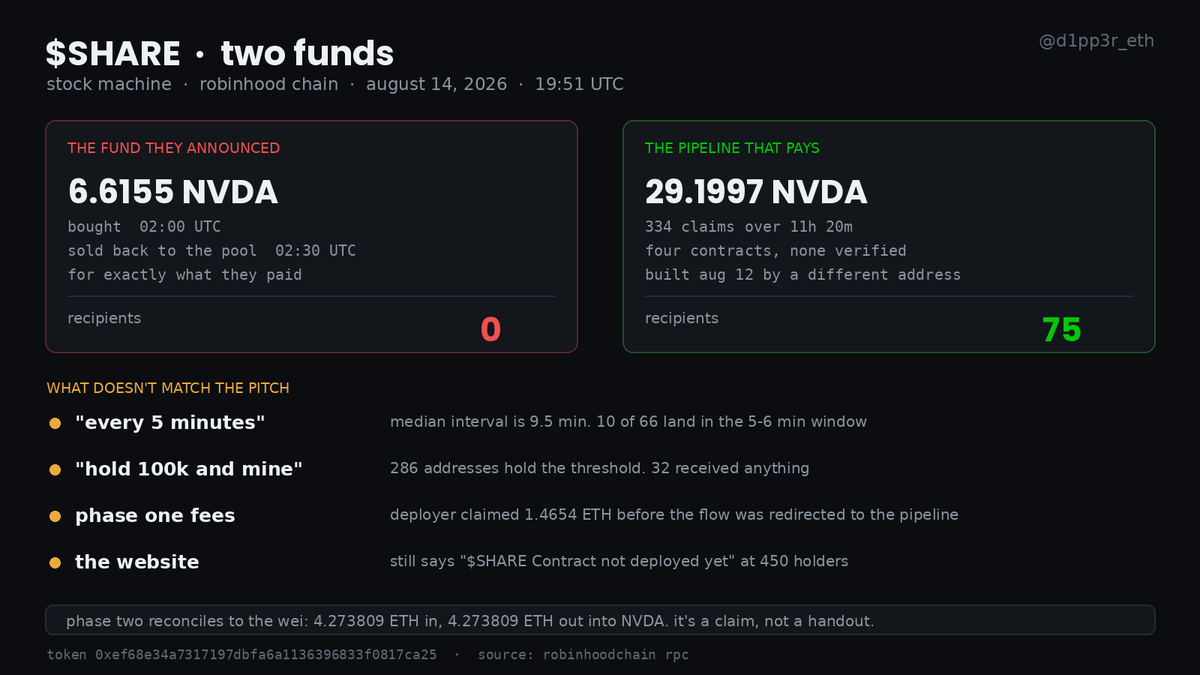
yesterday i read $SHARE and said the reward fund was just a wallet with no onchain logic. went back to see what changed.
payouts are running. 334 of them, 29.2 NVDA, roughly $6,574, 75 recipients over 11 hours.
but not from that wallet. the 6.6 NVDA they bought and showed off as the fund were sold back into the pool 90 minutes later, for exactly what they paid. zero recipients from it.
the actual distribution runs through four other contracts. deployed august 12, two days before launch, by an address that isn't the token deployer. none of the four are verified.
what doesn't match the pitch:
"every 5 minutes" - median interval is 9.5 minutes. only 10 of 66 intervals land in the 5-6 minute window.
286 addresses hold the 100k threshold. 32 got rewards. the other 254 got nothing.
phase one fees never reached holders: the deployer claimed 1.4654 ETH across three transactions, and only after a transferCreatorFeeRecipient call did the flow move into the pipeline. the same call can move it back.
what does check out: phase two reconciles to the wei. 4.273809 ETH in, exactly that much out into NVDA. and it's a claim, not a distribution - you take it yourself, nobody decides for you.
the site still says " $SHARE Contract not deployed yet". 450 holders.
the machine works. just not the way it was described.
people asked why i bother reading contracts when the chart tells you enough.
this is why. $SQWG, same chain, 80 minutes start to finish.
https://t.co/NziAOOTfaC
spent the day reading the $WALLET contract instead of the chart. the code holds up better than i expected.
no owner. not renounced, never written. there is no pause, no blacklist, no fee switch, no limit setter. nobody can freeze your wallet or tax your transfer because the functions don't exist.
no mint. supply is 1b, fixed in the constructor, permanent.
not a proxy. it cannot be upgraded into something else later.
the deployer took zero tokens. initialBuyAmount = 0, current balance 0. the entire billion went into the pool as one single sided position in the launch block. first buy came 47 blocks later, same terms as everyone.
and the liquidity lock is the part worth understanding. it isn't a timelock with an unlock date. the LP nft sits in a locker contract with no decreaseLiquidity, no transferFrom, no withdraw, no selfdestruct, and it isn't a proxy. there is no function that gets it out. the position hasn't moved since launch.
one thing that isn't clean: LP fees route entirely to the launchpad, and the 80% burn split is enforced by an unverified contract, not by code anyone can read. that owner can redirect it whenever. last burn was july 11, none since.
so: the token itself has no rug mechanics built in. the risks here are market risks, thin liquidity and fading volume, not contract risks.
that's a real distinction and most people never check which one they're holding.
buy on GMGN: https://t.co/4yIroAWa7T
finally worked out how $INDEX actually functions.
3% in ETH from every trade of INDEX itself buys tokenized robinhood stocks, and they get distributed hourly to anyone holding over 10,000 tokens. verified on-chain: it's live. one batch today at 18:56 UTC, 45 transfers, TSLA NVDA MSFT META PLTR. 2,823 wallets above the threshold, matches their site exactly.
so the yield isn't paid by a business. it's paid by trading volume in the token itself. the trader pays, the holder collects.
now put that next to the other number: when $INDEX dropped 43.4%, 84.79% of holders did nothing. no adds, no exits.
in a token where distributions feed on volume, holder passivity isn't a neutral stance. less trading means thinner payouts means less reason to trade.
the thesis exists and it works. the open question is whether it works without inflow.
imagine you're a dev who wants to launch an nft collection on rh chain, ship your own memecoin off it, and repeat what $STONKBROKER did.
here's how that actually went.
you register a domain. an hour and 39 minutes later your nft contract is live. the whole project is @SquiggleRH and a one page site. no team, no roadmap, no reveal, just 10,000 question marks and a mint time.
you write the contract with no public mint function, so you mint all 10,000 to yourself in 16 seconds. then you sell 7,500 of them through a second contract you also own. gone in under two seconds. 12 ETH collected. a quarter of that supply went to wallets batching through eip-7702 to get around your 2-per-tx limit.
you keep 2,500. you drop them into your vault and they come back as 1,118,750,000 tokens.
you put those in the pool with 5 ETH. and in the exact same transaction, 9.7 ETH buys 735,800,000 of them. that's 65.8% of everything in the pool, split across ten wallets fed by one distributor contract.
those ten sell 100% of it inside 70 seconds. 35 minutes later the proceeds land on a single address. 14.26 ETH.
then, 21 minutes and 15 seconds after you opened the pool, you pull the starting liquidity back out.
an hour after that, the 12 ETH from the mint moves to a fresh wallet with no other history.
price is down 72% in the first minute and 96.3% from the peak. liquidity in the pool right now is $4.90. everyone who bought is holding an unrevealed jpeg and a token they can't sell into anything.
the whole thing, start to finish, took about 80 minutes.
what i can't show you is a direct transaction between the deployer and those ten wallets. it doesn't exist. what does exist: one EOA deployed the launcher, the buyer and the distributor contracts, and that same EOA paid gas to the wallet that later collected the entire bundle's proceeds. draw your own line.
token 0xE26DFaD41E606F0608C366Df21eE7E7809f459C1
deployer 0xf5bB58C5830CcF45304Cf8065E59338c7d6a8791
collector 0xb7cbcd04175209de72d3158252e68ec4eff90b5c