This report clearly frames the problem the prediction market sector has worked around for years: forecasters hold beliefs as distributions, but the binary primitive only accepts yes-or-no. Most venues hide the structural cost. Continuous markets does not, by design.
Hmmm
Volta's has a partnership with @Bitdeer
Does that mean Bitcoin mining facilities are being repurposed for AI data centers?
Think about it the power contracts and cooling systems are all already in place.
SITUATION DETECTED: Anthropic has signed a $10 billion, six-year deal for computing capacity with startup Volta Infra Holdings - founded by former Brookfield execs - to be delivered from a Norway site in partnership with Bitdeer. Per Bloomberg
@MTSlive Volta's partnership with Bitdeer also reflects a wider trend: Bitcoin mining facilities are being repurposed for AI workloads because their power contracts and cooling systems are already in place.
Pretty insane, if this works as advertised.
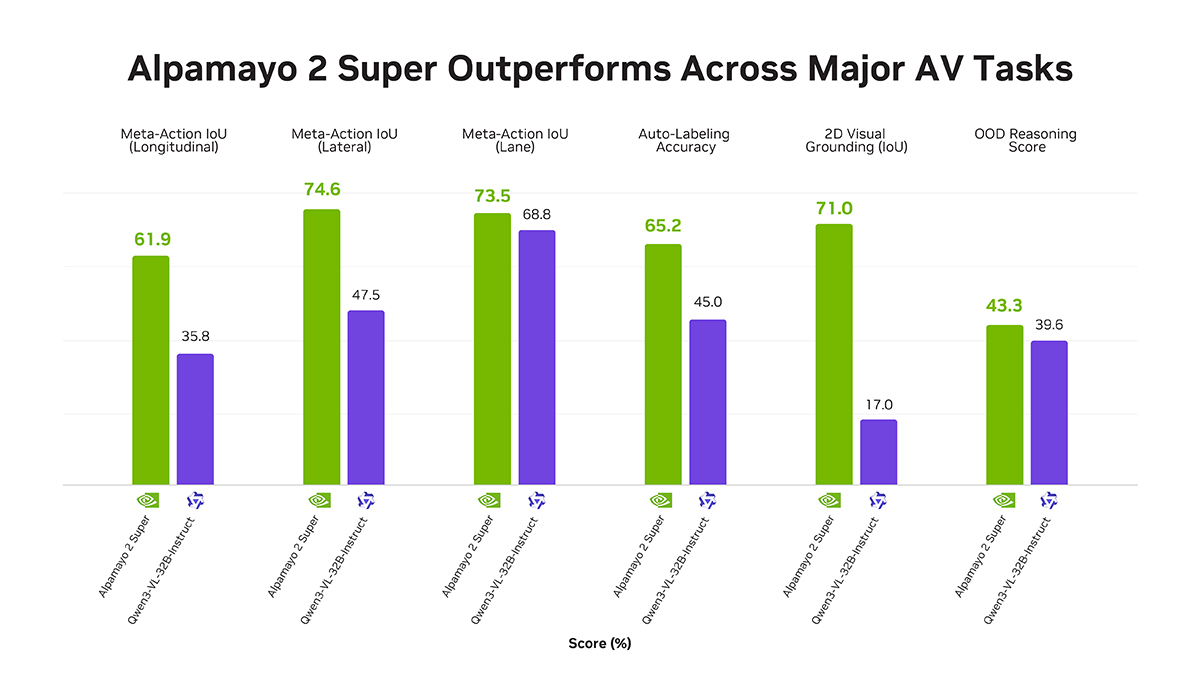
Goes beyond a bigger self-driving model.
The crazy part is that this is pushing toward a general-purpose reasoning model for autonomous driving development, not just a perception module.
$TSLA is fucked
Today, we’re launching Alpamayo 2 Super, our frontier open reasoning model for autonomous vehicles.
Beyond seeing, Alpamayo understands and reasons through the complex world - thinks before it acts.
It’s a powerful backbone for robotaxis, trucks, shuttles, delivery vans, tractors and the long tail of mobile robots—billions of autonomous machines someday.
We’re releasing it for commercial use under OpenMDW-1.1 so teams can inspect it, fine-tune it and deploy it—open models advance safety and security.
The next wave of AI is robotics—and it starts with autonomous vehicles.
Great work, Alpamayo team!
https://t.co/2PYCCXWjZh
Apple sued OpenAI, io Products, and two former Apple employees, alleging they took trade secrets to support OpenAI's consumer hardware ambitions following its $6.4 billion acquisition of Jony Ive's hardware venture in 2024.
The dispute centers on former Apple engineers Chang Liu and Tang Yew Tan, who joined OpenAI's hardware team. Apple claims confidential information was misappropriated, while OpenAI denies the allegations and says it does not have or want Apple's trade secrets.
After filing the lawsuit in July, Apple sought a preliminary injunction and forensic access to OpenAI systems. OpenAI agreed to preserve evidence and stop any alleged access but rejected broader inspections.
On August 3, OpenAI published a detailed response, calling Apple's lawsuit "careless, aggressive and oddly personal."
A hearing on the injunction is scheduled for October 1.
@bridgemindai Grok 4.5 and all cursor models are cheap compared to their incredible performance.
Imagine, Grok 4.5 leads community opinions, ahead of 15 other models
This would be a much better way to present it.
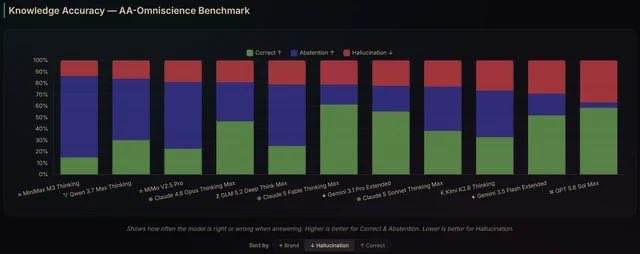
GPT models have higher hallucination rates, but this benchmark doesn’t allow web search and since GPT models excel at using web search, their hallucination rate is much lower.
That’s why GPT can feel less hallucinatory than Gemini
Every OpenAI model has the worst hallucination rate in AI.
GPT 5.6 Sol hallucinates at nearly double the rate of Opus 5 and Fable 5.
This is exactly why GPT 5.6 Sol wrote the code that deleted every Stripe subscription my business had.
It never hesitated. It never said it was unsure.
OpenAI keeps shipping frontier scores and shrugging at hallucination.
Smart does not matter if it lies.
Nope.
Reasoning ≠ Thinking.
One is specific, bound by rules and logic and takes structured steps to produce answers.
The other is a broad mental process that produces truly creative, intuitive and innovative ideas.
All reasoning is thinking but not all thinking is reasoning.
@kimmonismus Considering GPT-5 was the world best model last year. Yea, a lot of people won't notice we've been in the singularity for a while now.
https://t.co/rDoH1vtrTy
GPT-5 was the world's best model less than a year ago.
Today, a free and open-source model fraction of its size (Qwen3.6 27B) is already better than it.
The pace of AI progress is brutal.
Cerebras, Groq, and SambaNova entire pitch is that frontier speed requires custom chip.
Celeris-1 and Inception’s Mercury 2 took a diff bet. A diffusion architecture, which generates multiple tokens in parallel instead of in sequence, and delivers better speed on standard GPUs.
Crazy: Artificial Analysis currently ranks Celeris-1 #1 for output speed at roughly 2,086 tokens per second @ 75.9% on MMLU-Pro!
Celeris says it achieves this on off-the-shelf GPUs, without custom inference silicon.
In Celeris’ own same-harness evaluation, the model scored 75.9% on MMLU-Pro, compared with 78.5% for GPT-5 mini and 81.9% for GPT-5, while responding 13-16× faster.
@kimmonismus Celeris says it hits 2,000-plus tokens per second on off-the-shelf GPUs, with no custom inference silicon.
Let’s wait and see the response from Cerebras, Groq, and SambaNova.
China is winning the AI race with open-weight models and could catch up to US frontier labs as soon as this year.
The reason is in the structure: Chinese labs run an open collaboration and sharing ecosystem, while US model makers are building in silos and risk falling behind.
I hate Claude Opus 5.
1. It is overly pedantic and yaps a lot. Also overly cautious and annoying to work with.
2. Overthinks simple tasks.
3. Makes more mistakes despite spending more tokens reasoning I think it is "RL-fried."
Anyone experiencing the same things?