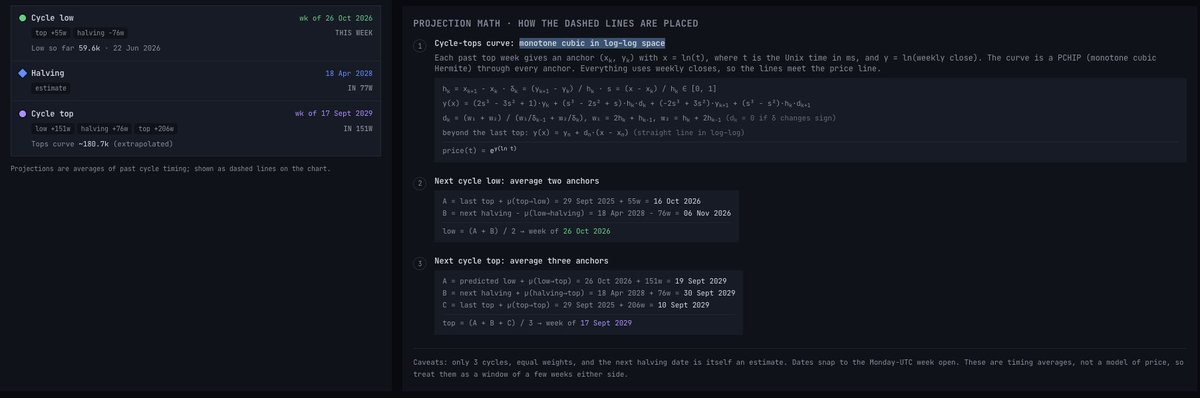
claude, treat weekly btc as a time series p(t). Find its local maxima: the cycle tops, one per ~4-year cycle. derive a function f(t) in log space that fits those maxima: f(t_k) = ln p(t_k) for every top k. It should pass through the maxima exactly, not approximately. It should be smooth and monotone between them, so no overshoot above the peaks. Past the last maximum, extrapolate it so it gives a ceiling estimate for the next top. Plot exp(f(t)) as a line on the cycle chart.
claude, treat weekly btc as a time series p(t). Find its local maxima: the cycle tops, one per ~4-year cycle. derive a function f(t) in log space that fits those maxima: f(t_k) = ln p(t_k) for every top k. It should pass through the maxima exactly, not approximately. It should be smooth and monotone between them, so no overshoot above the peaks. Past the last maximum, extrapolate it so it gives a ceiling estimate for the next top. Plot exp(f(t)) as a line on the cycle chart.
Everyone on CT is crying about why there wasn't a $1b runner in the past months.
Remember ICOs? They were a way to raise money for your project by selling tokens you just minted yourself. Similar to how you sell private equity to raise funds for your company.
Nowadays, we launch coins on @Pumpfun / @ponsdotfamily and reward launchpads with 0.3-1% on volume (!!) on every single coin. The project (dev) is not selling you tokens, but the vaults (curves) of these launchpads do. Creators get rewarded too while there is some volume on their coin, but usually this volume fades, and liquidity rotates into the newest and shinest coins. Nobody holds a coin anymore because it may not be safe, or bundled, or snipped heavily. There is zero trust and so conviction.
You don't need to trust. Why not just verify the blockchain yourself? You can just tell an AI agent to do it for you. Read the blockchain, verify smart contract sources, docs, website and X. Identify a good project/coin and hold.
Both engineers shouldn't have had access to the prod system, given how they are being described in the postmortem.
Not even small startups give you access to prod because there is simply no reason why you'd need it.
Experienced devs 1) know very well how git works 2) would not fall for an interview scam that has been around for about 4 years and is pretty well known in the industry
@tayvano_@pashov But why would the dev‘s (who’s obviously not experienced) VPN/intranet user has permissions to break the entire system?
Also if they were about to install brew it indicates that it may be their first day at work?
The story is a joke.
@binance So the employee who downloaded some software from a website was connected to the company's VPN and had permissions to the wallet engine?
Hard to believe.
Imagine how much money scammers on the darknet are investing in computing to train their own hacker AI, after making billions over the decades through phishing scams and social engineering.