Deep in DeFi, RWA, NFTs and AI. I explore new protocols, break down interesting ideas, find hidden gems, and share what catches my attention along the way.
A few Web3 ambassador programs are currently open 👇
Some are looking for creators and community builders, while others are specifically looking for people with strong ecosystem connections.
Here are 4 worth checking out:
1. RabbitHole 🐇
The RabbitHole Ecosystem Ambassador Program is now live with up to $150K in cumulative bounties.
They’re looking for people who can open doors to protocols, foundations, wallets and infrastructure teams.
Real access, verified outcomes and bounties tied to what you bring to the ecosystem.
Apply:
https://t.co/XbS86rZeaw
2. SpringX × Monad
SpringX has opened its Ambassador Program for Monad creators.
The program is focused on spreading awareness across X and Discord, with creators able to participate and earn through their contributions.
Read the thread, fill out the form and join the program:
https://t.co/246PcxDQPn
3. ClawChat 🦀
ClawChat’s Ambassador Program is open.
They’re bringing in creators to help shape the next generation of social experiences on Bitcoin.
Ambassadors can create content, participate in campaigns and events, contribute feedback, compete on the leaderboard and earn rewards based on their final position.
They’re specifically emphasizing quality, authenticity and genuine audience connection rather than simply posting for the sake of posting.
Applications close September 30th.
Apply:
https://t.co/efZPcMG1no
4. HeLa Ambassador Program 3.0
HeLa’s Ambassador Program 3.0 is still active for builders, creators, community leaders and AI enthusiasts.
The program includes opportunities such as:
→ Geo-specific swag drops
→ Speaker, mentor & judge opportunities
→ Founding Ambassador title
→ Free AI API credits
→ Tourist NFT
→ Monthly group AMAs
→ Contribution-based certification
→ Revenue share on eligible referrals
→ Co-author rights
→ Conference & summit access
There’s quite a bit packed into the program, especially for people already building around AI, Web3 or community.
Join:
https://t.co/7QVBt8AzHA
I’ll be keeping track of more ambassador programs that are actually open, so there’s less digging through X to find them.
Save this post for later.
Like + repost so more creators can see these opportunities.
And if you know someone hunting for an ambassador program, tag them below.
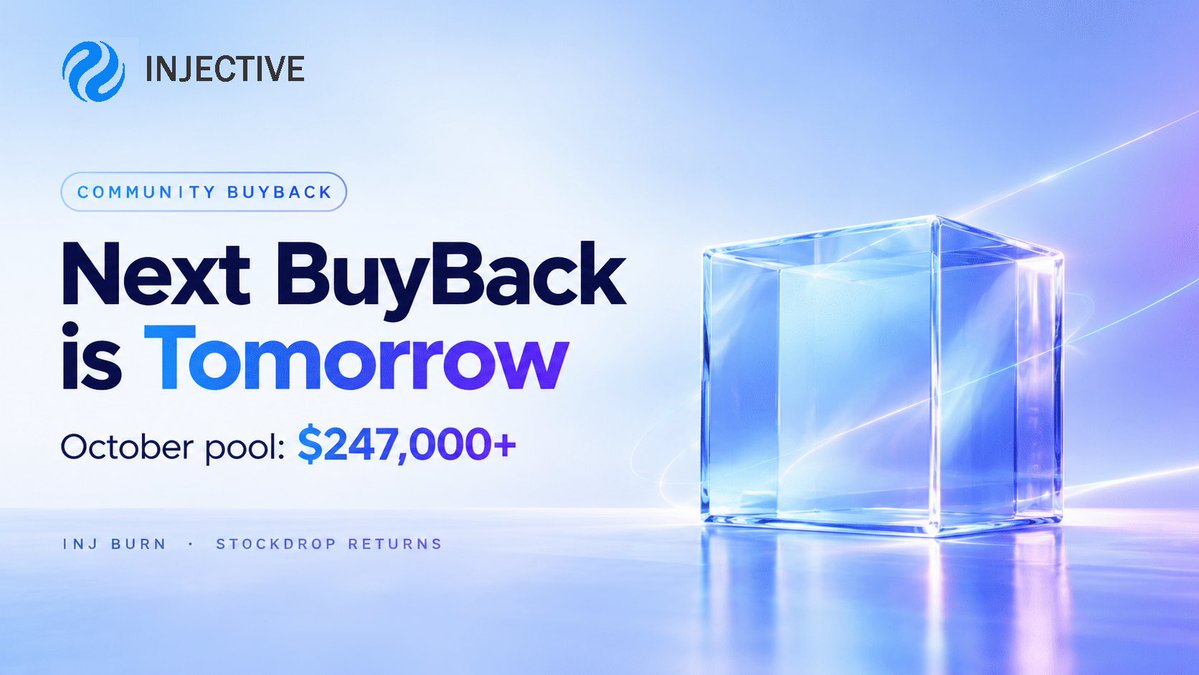
Tomorrow, the @injective Community BuyBack returns with an October pool worth over $247,000. 🥷
Here’s why this event is worth paying attention to.
The Community BuyBack lets participants commit $INJ in exchange for a proportional share of revenue generated across the Injective ecosystem.
Once the event concludes, the committed INJ is permanently burned, while the revenue pool is distributed among participants based on their contributions.
That means the event connects two things: ecosystem activity and INJ’s token supply.
And there’s more this time.
Stockdrop is returning too. The program gives participating wallets a chance to receive tokenized stock rewards alongside their usual BuyBack rewards.
The specific Stockdrop rewards for October haven’t been announced yet, so keep an eye out for the details.
Another round, another INJ burn, and another look at how Injective connects ecosystem revenue with its tokenomics.
Follow @injective for the latest updates before tomorrow’s event.
Gas estimation is one of those things users rarely think about until it causes a failed transaction.
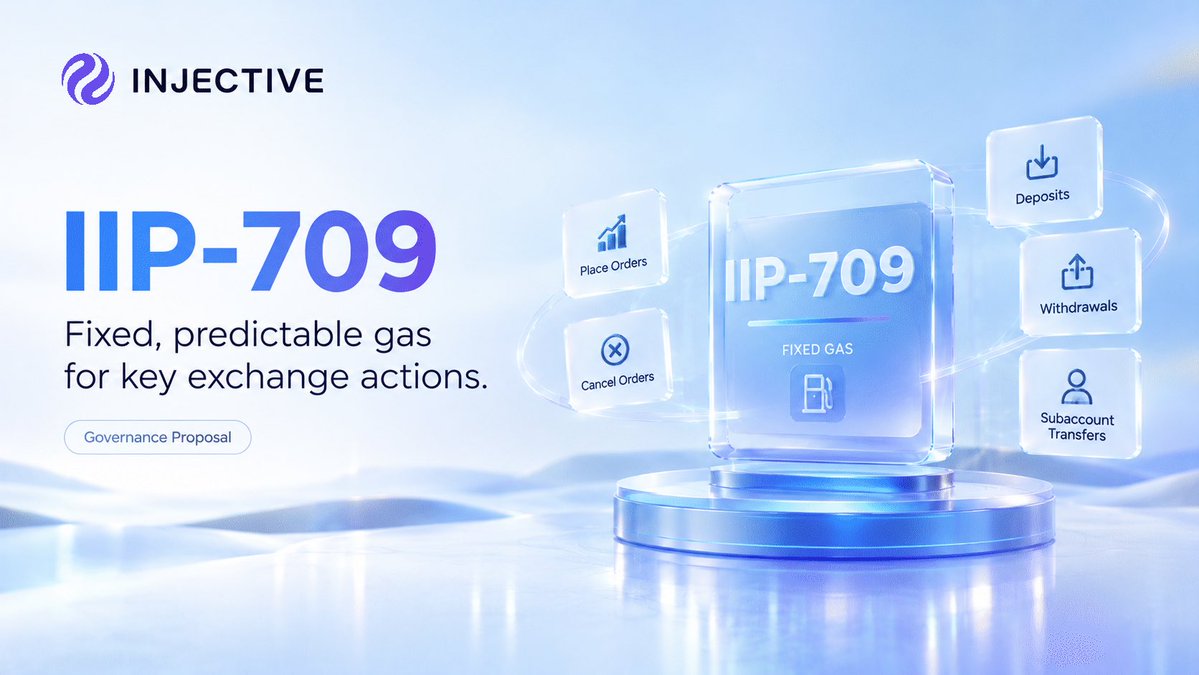
@injective has now activated fixed gas for supported exchange transactions through IIP-709.
Here’s why that matters 🧵
1/ Before this change, applications often had to estimate how much gas a transaction would need before submitting it.
If that estimate was too low, the transaction could fail. For trading apps handling frequent orders, that extra step also adds friction.
2/ IIP-709 enables fixed gas requirements for supported exchange messages.
That includes actions such as placing and cancelling orders, deposits, withdrawals, and subaccount transfers.
Instead of simulating every supported action to estimate its gas usage, developers can work with published gas values.
3/ This matters for more than convenience.
Trading applications and market makers need transactions to execute reliably. More predictable gas requirements can simplify transaction preparation, reduce estimation overhead, and help prevent failures caused by insufficient gas.
4/ There’s an important distinction here.
Fixed gas does not mean every transaction costs the same amount, and it does not mean transactions are free.
Different supported actions have different gas requirements. The actual fee still depends on the gas limit and gas price used for the transaction.
Trading fees are separate and were not changed by IIP-709.
5/ The change also makes integration easier for developers building on Injective.
When gas requirements are known in advance, applications can handle supported exchange transactions with less uncertainty. That is useful for trading interfaces, automated strategies, and infrastructure that processes orders at scale.
6/ IIP-709 is a relatively focused change, but it addresses a practical part of onchain trading: execution reliability.
Low fees are useful. Knowing how much gas an action requires before submitting it makes the experience more predictable.
Injective has now enabled fixed gas for supported exchange messages on mainnet.
That’s another piece of the trading infrastructure behind @injective.
Injective’s RWA perpetual markets have crossed $1.1 billion in trading volume year-to-date.
And the activity isn’t limited to one market.
Over the past month alone, these markets generated more than $230 million in volume across equities, foreign exchange, commodities, indices, and pre-IPO assets.
Think about what that means.
Traders can gain exposure to markets traditionally associated with stock exchanges, forex desks, and commodity markets through onchain perpetuals. Instead of limiting onchain trading to crypto assets, Injective is expanding the range of markets traders can access within its ecosystem.
The volume also gives us a concrete way to measure interest. It’s one thing to talk about bringing real-world assets onchain; it’s another to see billions in cumulative trading activity across different asset classes.
Of course, volume alone doesn’t tell the whole story. Liquidity, execution, market access, and sustained demand will matter just as much as the headline numbers.
But $1.1B YTD and $230M+ in a single month are meaningful milestones for onchain RWA trading.
Real-world markets are finding their place onchain, and @injective is building a serious footprint in that shift.
@injective $INJ
.@injective already has low gas costs. IIP-709 is about making them more predictable.
The proposal targets fixed gas requirements for key exchange actions, including placing orders, cancelling orders, deposits, withdrawals and subaccount transfers.
Why does this matter?
Today, applications may need to estimate how much gas a transaction will consume before submitting it. Fixed gas requirements give developers known values to work with, helping simplify transaction preparation and reduce failures caused by inaccurate estimates.
This is especially useful for trading applications and market makers that need to execute transactions efficiently.
It doesn’t eliminate gas fees or change trading fees. It makes gas requirements more predictable.
IIP-709 is a governance proposal, and $INJ stakers can help decide whether fixed gas should be enabled on mainnet.
The voting process is still live you havnt casted your votes
Read the proposal and cast your vote:
https://t.co/2St8rtYF5P
The chain upgrade to bring the lowest predictable gas fees on Injective is now live.
Injective already has some of the lowest gas fees. Now RWAs, perp trades and soon private transactions will all run on the lowest fixed gas fees.
Built for every user, trader and institution.
Injective is starting to look less like a blockchain built only for crypto trading and more like infrastructure for traditional finance moving onchain.
Look at the range of activity around the network.
POSCO International and LG CNS are exploring tokenization of trade receivables. Laser Digital has brought its fund infrastructure onchain. Musicow is working on music intellectual property, while Gulf Labs is exploring tokenization and stablecoin use cases in Thailand.
These aren’t all the same use case. They involve different assets, institutions, and regulatory requirements.
That’s what makes the development worth watching.
@injective is building around several parts of the financial lifecycle: issuing assets, creating markets for them, moving value, and supporting the infrastructure institutions need to operate.
Its 135 live RWA markets provide another indication of how far that market layer has developed.
But the real test isn’t the number of partnerships or assets announced. It’s whether these markets attract sustained liquidity, real users, and meaningful financial activity.
If Injective can turn institutional interest into products people actually use, its role in onchain finance could become much more significant.
The infrastructure is developing. Now comes the harder part: proving it at scale.
🚨 3 Web3 creator & ambassador opportunities to check out
1. StableCash — Paid Creator Program
StableCash is recruiting for several paid roles:
Brand Ambassadors
Creator Partners
UGC Creators
Affiliate Partners
The goal is to help bring stablecoins into everyday spending.
📩 To apply, DM your portfolio and preferred role.
2. Elyon Chain Ambassador Program
Elyon Chain is looking for people who can help grow its Web3 community, spread awareness, and contribute to the ecosystem.
💰 Rewards: USDT + $ELN for contributions
🔗 Apply: https://t.co/MpvvNtjPN7…
3. Qoder Ambassador Program
For builders who use Qoder, share what they create, and inspire others to build.
🎁 Benefits include:
One year of free Qoder credits
Early access
Event support and more
🔗 Apply: https://t.co/VGXuVklZx4
Different opportunities for creators, community builders, and developers.
Save this post and share it with someone who might be interested.
Nearly half of the markets on @injective are tied to real-world assets. That’s a serious part of the network’s financial activity.
There are already 135 RWA markets covering equities, foreign exchange, commodities, indices and pre-IPO assets.
Think about what that means for someone using Injective. They aren’t limited to crypto-native assets. They can access markets linked to traditional financial instruments through onchain infrastructure.
And this is the important part: RWA access isn’t being treated as a separate feature bolted onto Injective. It’s becoming part of the network’s core financial stack, alongside trading infrastructure and other onchain financial applications.
The real measure of progress won’t just be how many markets are listed. It will be how much liquidity they attract, how actively people use them, and whether that activity can be sustained over time.
135 markets is a strong starting point. Now the question is how much real usage comes next.