You built an AI Agent on AMA Hub?
An Agent people like using?
Reply with your published agent link
Show us your most popular agent +
Share your building experience
We'll Follow our favourite ones
But they need actual usage, chain-verifiable
Compose on AMA
I'm joining the https://t.co/CZA4QAMWuP Early User Campaign 🦉
Join early & earn $YNX rewards! https://t.co/a7aMJWBrKg #YneraXOne#YNX#YneraX#Giveaway#YNXToken
🦉YneraX One . Gleam Campaign is LIVE!
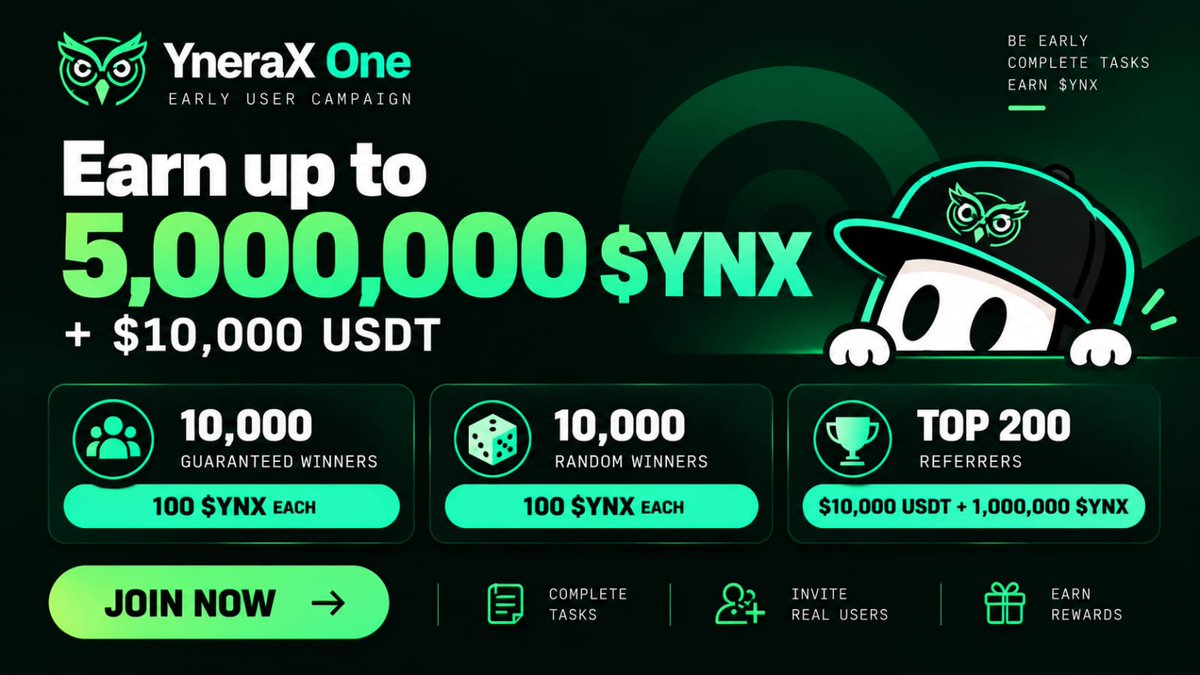
YneraX One is offering a total reward pool of 5,000,000 $YNX + $10,000 USDT.
🎁 10,000 First-Come, First-Served Winners
Each gets 100 $YNX
🎲 10,000 Random Winners
Each gets 100 $YNX
🏆 Top 200 Referrers
Each gets additional $YNX and a share of the $10,000 USDT rewards.
How to Participate?
🔗 Event Link:
https://t.co/lJJXb1aT6m
Complete tasks, invite users, earn more entries, and move up the leaderboard. The more you participate, the more entries you can earn.
On 1 October, the Ethereum Foundation blog introduced zkAPI, built by the Open Anonymity Project with the EF: a way to pay for a metered API, AI inference first, without the payment being tied to who you are.
You deposit credits into a vault contract on Ethereum once. After that, your device produces a zero-knowledge proof that says, in effect, "a funded note covers this spend and nobody has spent it before." The server checks it, issues a short-lived API key capped in dollars, and never learns which deposit paid.
The design choice worth noticing is where those proofs get checked.
Day to day, spending goes through the server, which verifies spend proofs off-chain. Getting money out is handled differently: "The vault contract verifies the same kind of proof at deposit, close, and escape, so your exit never depends on the server's honesty." A balance can be closed and withdrawn on-chain "even if every zkAPI server disappears."
So the operator is relied on for one thing and not the other. Everyday spending runs through the server. The step that returns your funds is checked by the contract itself.
Not every check in a system has to run on-chain. In this design, the one that guards the exit does.
https://t.co/KPblUUWPJi
#DeepSafe #Web3Security
FAMILY, CHECK YOUR PORTFOLIOS 👀
Your welcome bonus is waiting. Check your balance and see when it unlocks.
A little something from us to get you started.
https://t.co/wCWZV0Ia9x
Trail of Bits published notes on 18 September on reviewing the Miden zkVM. The part worth reading is what happened before the review started.
Security firms — the same firm included — have published a number of posts describing how they pointed an agent harness at a codebase. This post is about a stage earlier than that: "before code review even starts, agents now allow us to build custom tooling and formal models that improve the quality and depth of our reviews."
Miden has its own assembly language, MASM, and very little tooling around it. The firm had six months of lead time, because the implementation was not yet feature complete. It spent them having its agents build an LSP server, a decompiler, a static analysis engine, and a Lean model of the VM executor. None of that was the review.
Applied during the review that followed, those tools produced concrete results. The static analysis identified over 400 unique locations where type validation could be improved, all of them reachable from the library's public API, as well as one high-severity finding: a remainder supplied by the prover was never validated before being passed to a 32-bit subtraction — "a malicious prover could exploit this to forge Falcon signatures and drain any Miden account controlled by a Falcon key pair." The Lean modeling effort produced 95 machine-checked correctness proofs covering all the binary arithmetic in the core library, and surfaced two more bugs the existing unit tests had not caught.
The detail worth sitting with is smaller than any of those. The decompiler was the single largest piece of the work, over 100 agent-generated commits across months. The firm's own account of where the benefit landed: "The main benefit of this work turned out to be the decompiler's internal analysis frameworks and intermediate representation, which we could reuse for static analysis, rather than the full decompilation pipeline."
The post is direct about why work like this did not happen before. It is "highly exploratory in nature, and the end results and potential payoff may be difficult to predict," which makes it "hard to sell clients on them in advance."
What has changed, on the post's own account, is the cost of a miss: "Today, a failed side project only costs tokens." The payoff is no easier to predict than it was. What a wrong guess costs is smaller.
One thing about this particular case is worth noting on its own. The main benefit ended up somewhere the single largest piece of the work had not been aimed at. That is a payoff shape easier to recognize once the work is finished than to argue for before it starts.
https://t.co/972ijKSY19
#DeepSafe #Web3Security