@zanderkyork@atTimMaggs@treg_ai@typesafeai But I think it’s worth it for some people who just want to run a hiring agency for example and know nothing about programming and make slop version 99% of the time and bit prod ready systems. User gets good UX and the platform receives discount for distribution from the labs.
@hello_code_ Replaced by real systems. However great tool to prototype early ideas to understand a workflow and reduce the complexity by visualizing it.
George Washington's Farewell Address [foreign policy excerpt]:
Observe good faith and justice toward all nations. Cultivate peace and harmony with all. Religion and morality enjoin this conduct. And can it be that good policy does not equally enjoin it? It will be worthy of a free, enlightened, and at no distant period a great nation to give to mankind the magnanimous and too novel example of a people always guided by an exalted justice and benevolence. Who can doubt that in the course of time and things the fruits of such a plan would richly repay any temporary advantages which might be lost by a steady adherence to it? Can it be that Providence has not connected the permanent felicity of a nation with its virtue? The experiment, at least, is recommended by every sentiment which ennobles human nature. Alas! is it rendered impossible by its vices?
In the execution of such a plan nothing is more essential than that permanent, inveterate antipathies against particular nations and passionate attachments for others should be excluded, and that in place of them just and amicable feelings toward all should be cultivated. The nation which indulges toward another an habitual hatred or an habitual fondness is in some degree a slave. It is a slave to its animosity or to its affection, either of which is sufficient to lead it astray from its duty and its interest. Antipathy in one nation against another disposes each more readily to offer insult and injury, to lay hold of slight causes of umbrage, and to be haughty and intractable when accidental or trifling occasions of dispute occur.
Hence frequent collisions, obstinate, envenomed, and bloody contests. The nation prompted by ill will and resentment sometimes impels to war the government contrary to the best calculations of policy. The government sometimes participates in the national propensity, and adopts through passion what reason would reject. At other times it makes the animosity of the nation subservient to projects of hostility, instigated by pride, ambition, and other sinister and pernicious motives. The peace often, sometimes perhaps the liberty, of nations has been the victim.
So, likewise, a passionate attachment of one nation for another produces a variety of evils. Sympathy for the favorite nation, facilitating the illusion of an imaginary common interest in cases where no real common interest exists, and infusing into one the enmities of the other, betrays the former into a participation in the quarrels and wars of the latter without adequate inducement or justification. It leads also to concessions to the favorite nation of privileges denied to others, which is apt doubly to injure the nation making the concessions by unnecessarily parting with what ought to have been retained, and by exciting jealousy, ill will, and a disposition to retaliate in the parties from whom equal privileges are withheld; and it gives to ambitious, corrupted, or deluded citizens (who devote themselves to the favorite nation) facility to betray or sacrifice the interests of their own country without odium, sometimes even with popularity, gilding with the appearances of a virtuous sense of obligation, a commendable deference for public opinion, or a laudable zeal for public good the base or foolish compliances of ambition, corruption, or infatuation.
As avenues to foreign influence in innumerable ways, such attachments are particularly alarming to the truly enlightened and independent patriot. How many opportunities do they afford to tamper with domestic factions, to practice the arts of seduction, to mislead public opinion, to influence or awe the public councils! Such an attachment of a small or weak toward a great and powerful nation dooms the former to be the satellite of the latter. Against the insidious wiles of foreign influence (I conjure you to believe me, fellow-citizens) the jealousy of a free people ought to be constantly awake, since history and experience prove that foreign influence is one of the most baneful foes of republican government. But that jealousy, to be useful, must be impartial, else it becomes the instrument of the very influence to be avoided, instead of a defense against it. Excessive partiality for one foreign nation and excessive dislike of another cause those whom they actuate to see danger only on one side, and serve to veil and even second the arts of influence on the other. Real patriots who may resist the intrigues of the favorite are liable to become suspected and odious, while its tools and dupes usurp the applause and confidence of the people to surrender their interests.
The great rule of conduct for us in regard to foreign nations is, in extending our commercial relations to have with them as little political connection as possible. So far as we have already formed engagements let them be fulfilled with perfect good faith. Here let us stop.
Europe has a set of primary interests which to us have none or a very remote relation. Hence she must be engaged in frequent controversies, the causes of which are essentially foreign to our concerns. Hence, therefore, it must be unwise in us to implicate ourselves by artificial ties in the ordinary vicissitudes of her politics or the ordinary combinations and collisions of her friendships or enmities.
Our detached and distant situation invites and enables us to pursue a different course. If we remain one people, under an efficient government, the period is not far off when we may defy material injury from external annoyance; when we may take such an attitude as will cause the neutrality we may at any time resolve upon to be scrupulously respected; when belligerent nations, under the impossibility of making acquisitions upon us, will not lightly hazard the giving us provocation; when we may choose peace or war, as our interest, guided by justice, shall counsel.
Why forego the advantages of so peculiar a situation? Why quit our own to stand upon foreign ground? Why, by interweaving our destiny with that of any part of Europe, entangle our peace and prosperity in the toils of European ambition, rivalship, interest, humor, or caprice?
It is our true policy to steer clear of permanent alliances with any portion of the foreign world, so far, I mean, as we are now at liberty to do it; for let me not be understood as capable of patronizing infidelity to existing engagements. I hold the maxim no less applicable to public than to private affairs that honesty is always the best policy. I repeat, therefore, let those engagements be observed in their genuine sense. But in my opinion it is unnecessary and would be unwise to extend them.
Taking care always to keep ourselves by suitable establishments on a respectable defensive posture, we may safely trust to temporary alliances for extraordinary emergencies.
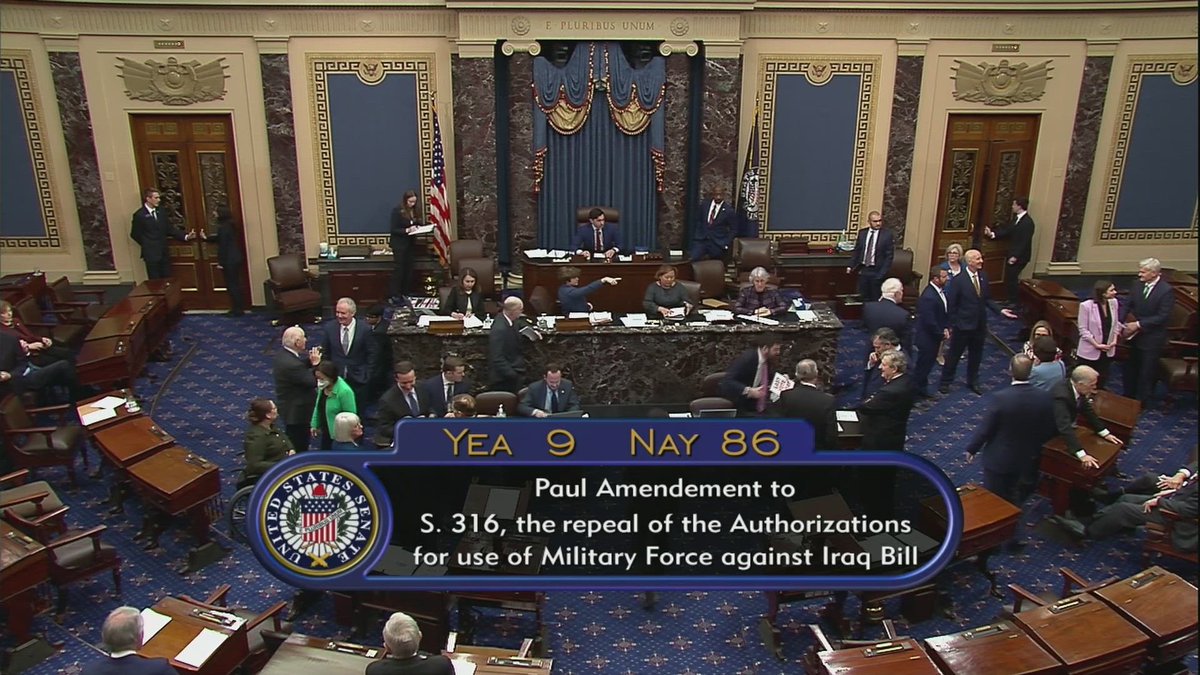
The Senate voted 9-86 yesterday on Senator @RandPaul’s amendment to repeal the 2001 Authorization for Use of Military Force.
Earlier this month, the House voted 103-321 on @mattgaetz’s Resolution to withdraw troops from Syria.
In December, Senator Sanders caved to White House pressure and backed out of forcing a vote on the Yemen War Powers Resolution to end US support in that conflict.
These three examples perfectly demonstrate why DC is a lost cause. States like Montana and Arizona must pass the Defend the Guard Act to prohibit the president from sending a state’s National Guard troops to war without a congressional declaration of war.
In a nearly unanimous vote last session, Montana’s legislature passed HJ Res 9, which called on Congress to repeal the 2001 AUMFs, end endless wars, and for Congress to take back its war powers.
Clearly, Congress will not do its job. Instead, Montana, Arizona, and all other states must pass the Defend the Guard Act to force Congress’s hand and to make Congress go on record before our blood and treasure are spent in another conflict.
If a conflict is important enough to risk the lives of Montanans, it should be important enough for Congress to do its job.
#mtpol #mtnews #mtleg