The line between AI trading bots and human traders is blurring faster than expected.
Within the next year, market sentiment will be driven more by algorithmic response time than traditional analysis.
Adapt early or get left behind. What is your strategy for this shift?
This is genuinely what building for the long term looks like.
Huge credit to this team for building something that can actually make this kind of alignment possible.
Two days ago 37 people supported $GOOD with 11 ETH. It took 37 minutes.
They've already been paid over $2,000 in trading fees, and they'll keep getting paid for as long as the token trades.
That's what we spent 12 months building https://t.co/eQkfFqyy0k for. Teams whose whole focus is their community, who are honest about it, and who want to still be here in a year.
@GoodCoinRH is the case study
Buying memes at these levels is a blessing
It's hard to see it during a bear market
But top memecoins are going so much higher
Retail investors buying back in
Major news outlets talking about crypto
Billion dollar memes across multiple chains
It's going to be an exciting next 12-36 months
I hope you've positioned yourselves accordingly
Memecoins are the fun part of crypto. Without them, the industry would be way too serious, predictable, and honestly, boring.
Love or hate them, memecoins aren’t going anywhere. They’ll keep evolving until they become something even more annoyingly indispensable. 🤷♂️
@Rahim_mahtab Agree there will be multiple winning launchpads on RH.
We spent 12+ months building https://t.co/VXDEFyt0dX which suits a very different project/token launch than a pons style pad.
Might have to make it down to one of your events to tell you about it. Will send you a dm.
Clarity got delayed
- BTC pumped
Saylor sold Bitcoin
- BTC pumped
US attacked Iran
- BTC pumped
We are pumping on even bad news now
You know what that means
INSIGHT: "We don't want to see China take over crypto, I don't want to see China win with AI. Crypto is a big deal.
People are paying with Bitcoin, that takes pressure off our dollar, that's a good thing for our country" says President Trump.
Crypto has a dilution issue that could be fixed with more of a focus on quality over quantity.
If any teams are looking to put effort into a launch reach out, we will help.
https://t.co/eQkfFqyy0k is for teams who can look their community in the eye and say:
-At launch, every single person paid the same price.
-You all saw every allocation before you committed a cent.
-You all earn from this for as long as it trades.
Every mechanism is designed to keep those three things true, permanently.
Every agent that pays for work is paying someone. On XE, that someone can be you.
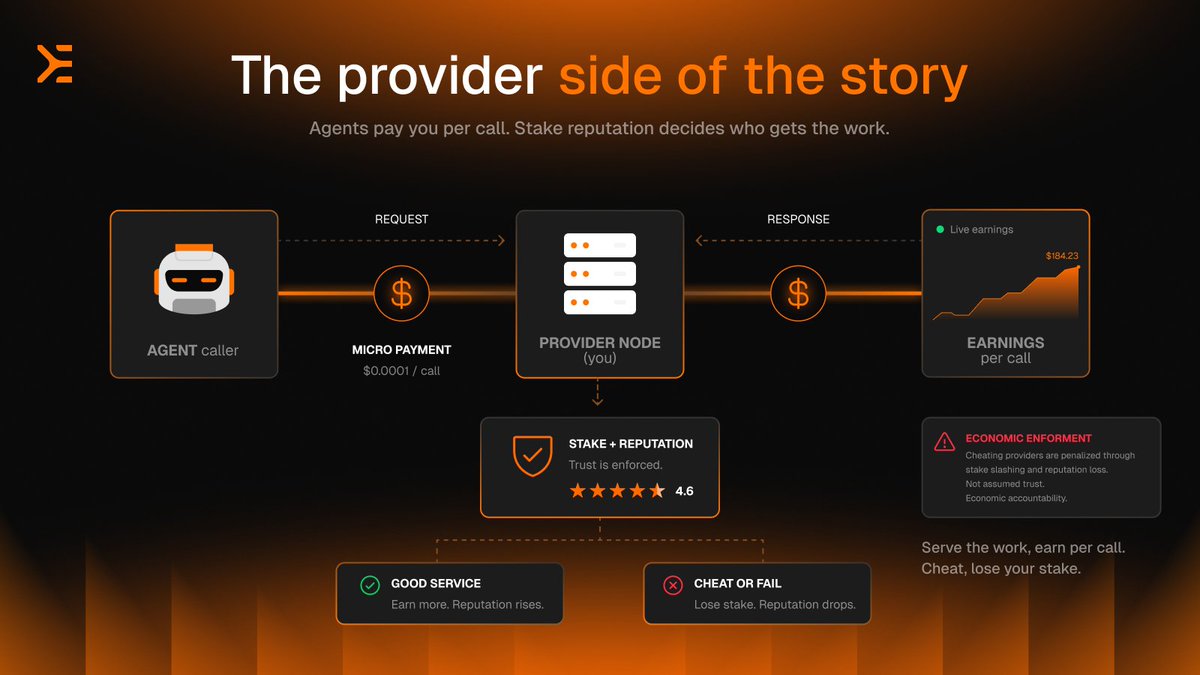
Run a provider node, and agents send you work to run, an inference, a computation, a task, and pay you for each one the moment it's done.
This is the supply side of XE ⤵️
◼───◼───◼
Every post we've written about agent payments has been from the caller's side, the agent that needs a job done and pays for it. Flip it around. Someone has to be on the other end actually running that job, and getting paid for it. That someone is a provider, and it's a role anyone with hardware can take.
Here's what it is, concretely. You run a node, a machine with compute to spare, GPU, CPU, storage, whatever the network needs. An agent has a job it can't or won't run itself, an inference to execute, a model to run, a task to process, so it sends that job to your node. Your machine runs it, returns the result, and the moment you deliver that result, the agent's payment settles to you. That's what you're paid for: running the work the agent sent you, one job at a time.
And it happens per call, automatically. No invoice to send, no account for anyone to set up, no month-end billing to chase. An agent sends a job, your node runs it, you get paid, and it repeats, thousands of times an hour, each one settling on its own the instant the work is delivered.
That changes what running hardware can be. Today, if you want to sell compute, you're a line item on someone else's cloud, or you're not in the game at all. Here, you run jobs directly for the machines that need them, at whatever scale your hardware can handle, and you're paid for exactly what you run, the instant you run it. The earnings tick up job by job, and they're yours, not a platform's cut passed down to you.
Every GPU, every stick of RAM, every machine you own is now worth more than it was, and sitting idle it earns nothing. A network that lets your hardware serve real work and get paid for it, per call, turns it into something that finally pays for itself.
The obvious question on the other side is trust. If an agent is sending jobs to a stranger's node and paying per call, what stops a provider from taking the money and cutting corners, or not running the job at all? The answer isn't a promise. It's economics and game theory.
To take on work, a provider puts up a stake, collateral that sits behind every job you run. Do the work properly and it works for you: your reputation climbs, more agents route jobs to you, and you earn more. Cheat or fail to deliver and it works against you, your stake gets slashed, and your reputation drops, so less work comes your way. Cheating doesn't just get caught, it costs more than the job was ever worth.
That distinction is worth being precise about. XE doesn't claim to cryptographically prove that every result you return is correct. What it does is make cheating economically irrational. A provider with a stake to lose and a reputation to protect has every reason to run the job properly and none to game it, because gaming it never comes out ahead. Trust here is enforced by incentives, not assumed and hoped for.
Put the two halves together and you get a market that runs itself. Agents bring the demand, sending out jobs and paying for them. Providers bring the supply, running those jobs and earning per call. Stake and reputation sort the reliable nodes from the rest without anyone refereeing, so work flows to the providers who've proven they deliver. No platform in the middle taking a cut, no gatekeeper deciding who's allowed to sell. Just jobs, payment, and a reputation you build one call at a time.
◼───◼───◼
This is the half of the machine economy that has to exist for the other half to work.
Every agent that needs a job run needs someone to run it, and that someone is whoever chooses to bring the hardware.
Run a node, run the work, and the network pays you for it, directly, per call, at machine speed.
$ xe providers → $ xe lease
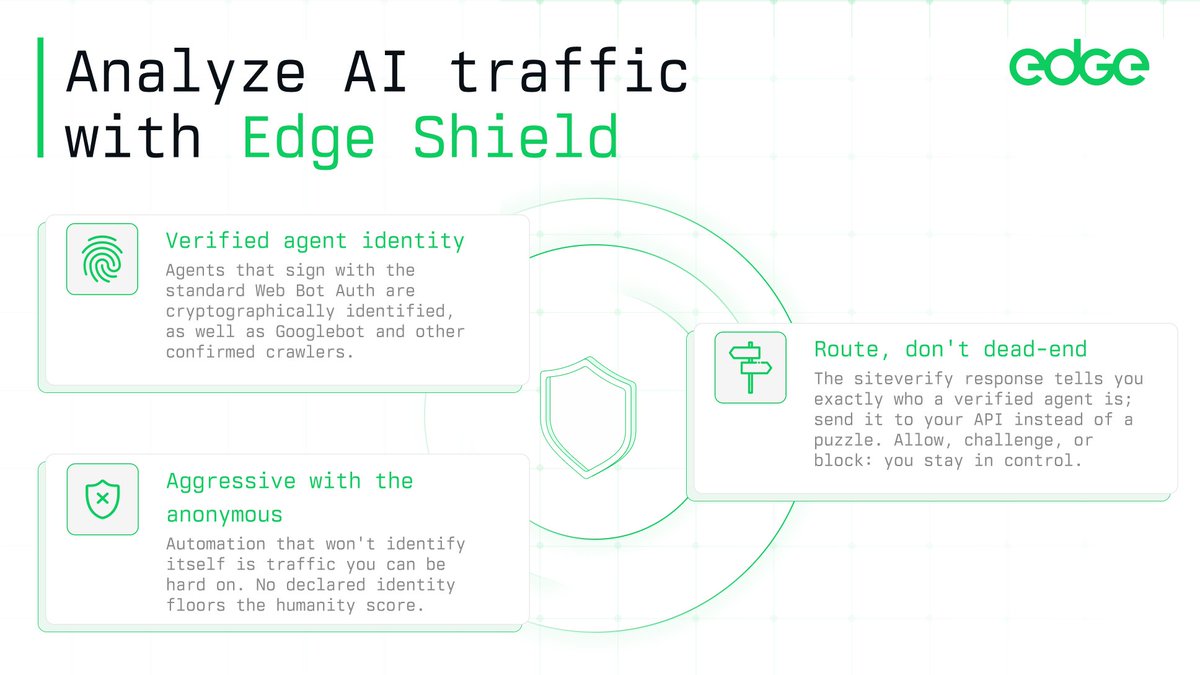
A growing share of legitimate traffic isn't human: it comes from shopping assistants, booking agents, research tools acting for real people.
But most bot defence asks one question: human or not?
Edge Shield asks a better one: who is this agent, and what should happen next?