AI Coins by Q1 2026 Revenue: Who's Actually Generating Real Money?
This time, only the numbers I could independently verify made the cut.
$TAO: $43.2M
$LINK: $15.9M
#VIRTUAL: $3.03M
$AKT: $0.25M
TAO isn't just leading, it's not close. Nearly 3x LINK, and more than 14x everyone else on this list combined.
One honest caveat: LINK's figure is Chainlink's total protocol revenue across oracles, CCIP, and staking, not AI-specific revenue. It's included because it was independently verified and was part of the original comparison, but it's the one bar here that isn't really measuring "AI usage" the way TAO's and VIRTUAL's numbers are.
Price follows revenue. Always has. Always will.
Are you holding the right ones?
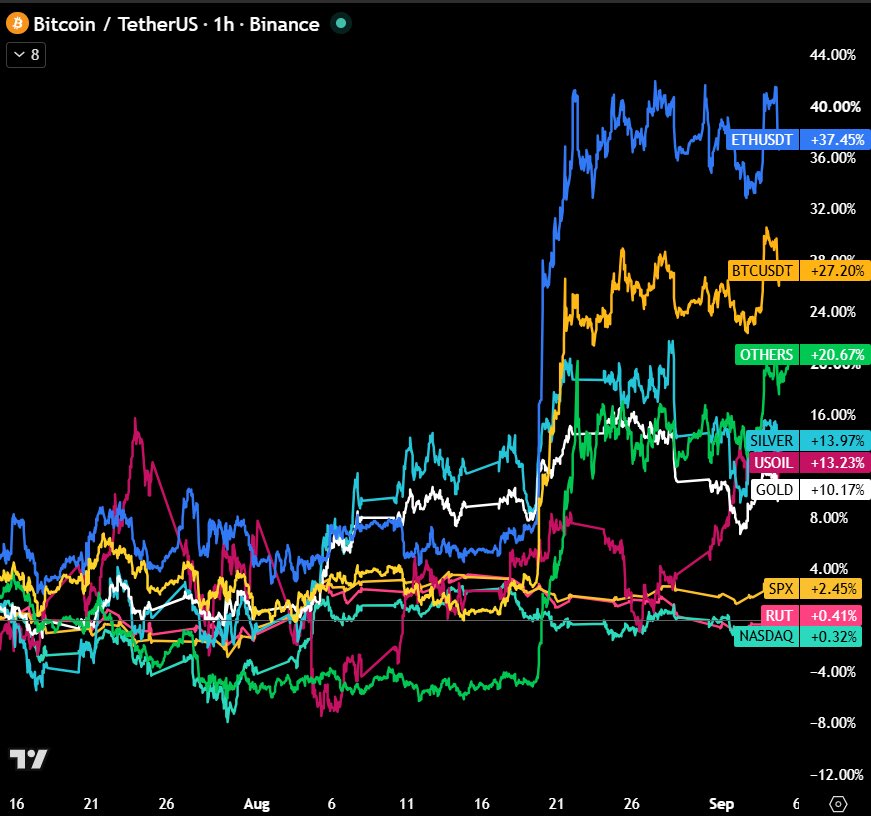
If you had invested $10,000 three months ago, you would have:
Ethereum: $13,745
Bitcoin: $12,720
Altcoins: $12,067
Silver: $11,397
Oil: $11,323
Gold: $11,017
S&P 500: $10,245
Russell 2000: $10,041
Nasdaq: $10,032
Crypto has started to outperform everything.
Many years of hard work went into the Poseidon family of hashes, and they have provided great real-world value on Ethereum and elsewhere and will continue to do so for several years. They are the reason why it's fast to generate a client-side SNARK for a modern privacy-protocol.
The fact that we have ultra-fast general-purpose STARKs (mid-three-digit overhead for basically any batched computation) and may well soon drop to double-digit or even lower is more amazing than anything that we had been hoping for in the early 2020s.
Big congratulations to all involved in Poseidon, and all involved in STARKs.
https://t.co/cdERDYkj6n
flight delayed 3 hours. guess the universe wants me to actually read whitepapers instead of skimming them
half the projects on my watchlist look like garbage tbh but the other half… might change my life. we'll see
$731M into BTC ETFs in a single day and net assets over $103B? Part of me says this is peak euphoria... but the other part sees TradFi money that isn't going anywhere. Hard to bet against that flow. Are we early or late? #Bitcoin
BTC dancing around that $80K line has me glued to the charts 👀 Feels like the market can't decide if it wants to send it or dump it. Weekend pumps are getting shakier lately. Who else is watching this closely? #Bitcoin
$13B in scams traced mostly offshore... yeah, no surprise there. But honestly this is why clearer US rules would help legit projects thrive instead of getting lumped in with shady overseas operators. Bullish long term. #crypto
Who else sees it this way?
yo peep this - XRPL traders down like 40% but volume actually jumped 79% 👀 fewer people moving way bigger bags, and TVL just cracked $4B. feels like whales quietly taking over lol
whales-only era? #XRP
Another wild day in crypto and I'm sitting here wondering... does anyone else feel like we blink and miss three major stories? The pace is unreal lately. Are we still early or just addicted to the chaos? #crypto
One positive consequence of all the recent detailed thinking about transaction formats - not just 8141, also "future of state" discussions eg. UTXOs, PBT, keyed nonces, and also recursive STARK mempool - is that we have a much more explicit understanding of how transactions have "actions" and "dependencies", and we can engineer around optimizing the two separately.
An action is an effect that a transaction has.
A dependency is a fact about the transaction and/or the state that must be true for the transaction to be valid.
eg. a signature is a dependency, a Merkle proof of a UTXO is a dependency, a ZK-SNARK (or STARK) is a dependency, a call that sends ETH is an action
Dependencies can be processed in parallel. Dependencies that involve state can be reasoned about by a mempool, especially if the specific state accessed is statically declared. Dependencies that are pure (no state calling allowed) can be processed once at the mempool layer and never need to be processed again - and potentially even replaced with a STARK verifying them, allowing not just execution but also data to be elided.
In principle, dependencies and actions can all be expressed as calls (if needed, calls to precompiles). This would make the transaction format itself very bare-bones and minimalist (a list of calls, flags for the type of each call eg. dependencies would be static or pure calls, and origin, nonce, etc) and allows maximum cross-compatibility even if different EVM chains have different features.
In 2015-era Ethereum, thinking explicitly about these differences was not very important: execution was execution, there were few enough transactions that we could process them all serially, and single-key ECDSA accounts were good enough for everyone.
Ethereum's current scaling strategy, however, requires moving beyond that paradigm. Ethereum is beloved by many developers because the execution and state model is so dynamic and flexible. But dynamic and flexible is not friendly to scaling. Fortunately, >90% of Ethereum's activity by volume does not require anything dynamic and flexible. So, we require contracts, accounts and transactions to more explicitly specify what is dynamic and flexible and what is more statically-analyzable but more restrictive, and more statically-analyzable things get the lowest gas cost and thus scale the most. Effectively, learning from the best of both the 2015-era Ethereum model and a more Bitcoin-like model (reminder: Bitcoin has had what I call account abstraction since the beginning), and making a mixture of both (really, the full spectrum between both) available, with gas costs appropriate for the level of scale involved.
New state types, the recursive STARK mempool, keyed nonces, etc all go in this direction.
This all relates to transaction types, because a general-purpose transaction type is a very natural interface layer on top of which all of this can be implemented, and the current thinking around the EIP-8141 transaction type is going in this exact direction that is friendly to these kinds of future generalizations.
So in that sense, 8141 done well is not just a culmination of 10 years of account abstraction work, it's also preparation for the next few years of responsible decentralization-friendly hyper-scaling.
My price targets for 2027-2029:
$BTC: $160,000 - $200,000
$ETH: $8,000 - $10,000
zcash:native: $2,500 - $4,000
$HOOD: $300 - $600
ethereum:0x514910771af9ca656af840dff83e8264ecf986ca: $50 - $100
$BNB: $1,500 - $3,000
hyperliquid:native: $400 - $800
If you’re in any other industry right now, pivot to crypto.
ngl i still have a soft spot for nfts even after everything. yeah most were junk but some of the art i collected in 2021 still hits different when i scroll through my wallet
Oil at $90, yields climbing, gold bleeding... and BTC just shrugs? The dollar strength is the only real headwind I see right now. Is Bitcoin quietly proving its resilience thesis here? #BTC
Wait, the Sheriff's association went from opposing the Clarity Act to neutral? That's a bigger shift than people realize. Regulatory winds are quietly changing... who else thinks this bill actually has legs now? #CLARITYAct