Excited to announce that EnclaviumFNF is officially collaborating with @PoweredByVolt
Volt is a world built by builders, for builders.
Work together. Enhance opportunity. Get funded, rewarded and educated.
We’ll be there to support the journey and help make the VOLT mint launch a successful one.
Raffle will live in Discord
I tracked the last 7 days of all 100 traders announced by Pumpfun aggressive KOL campaign
You can now check how much of their PnL comes from:
> Holding for 1m
> Holding for 1h
> Holding for multiple days
All the info is in the table 👇
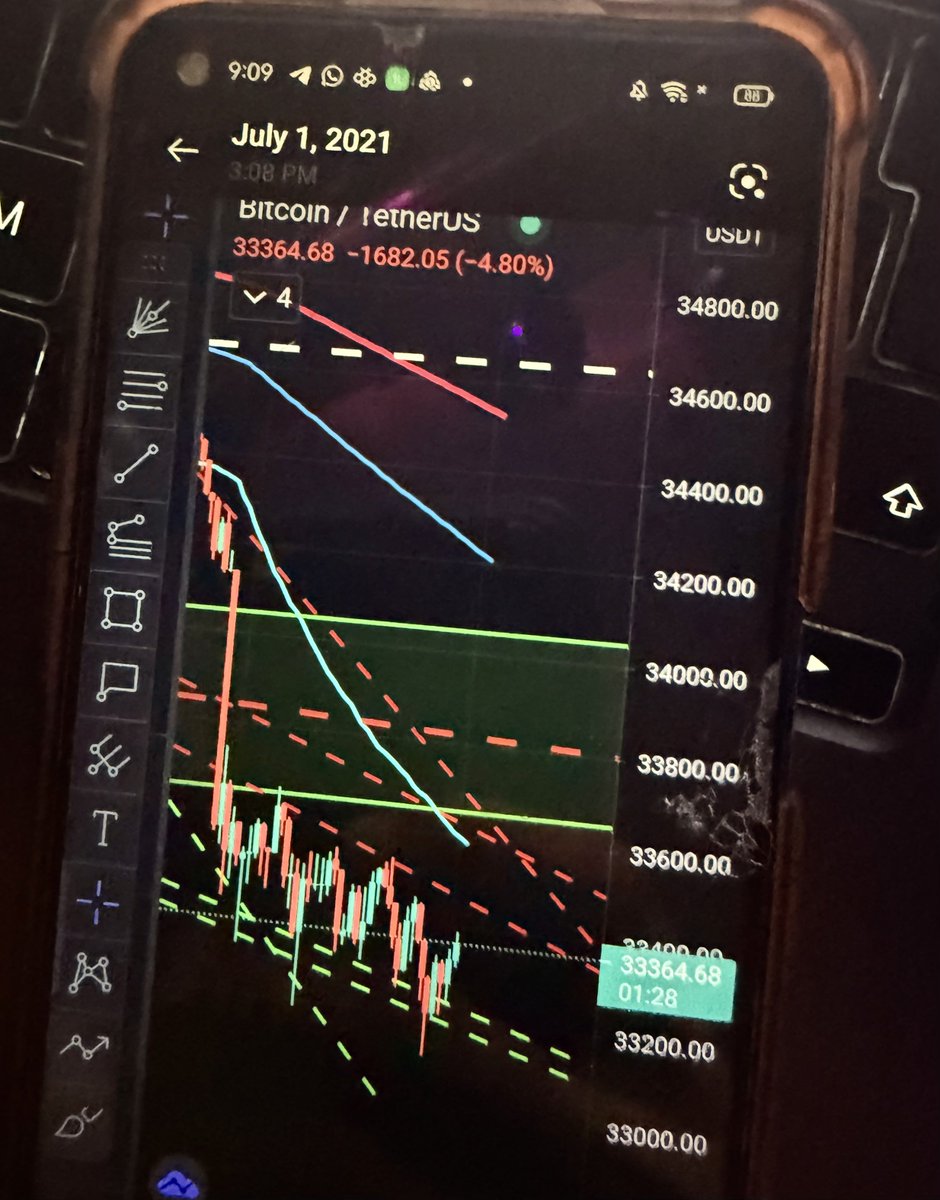
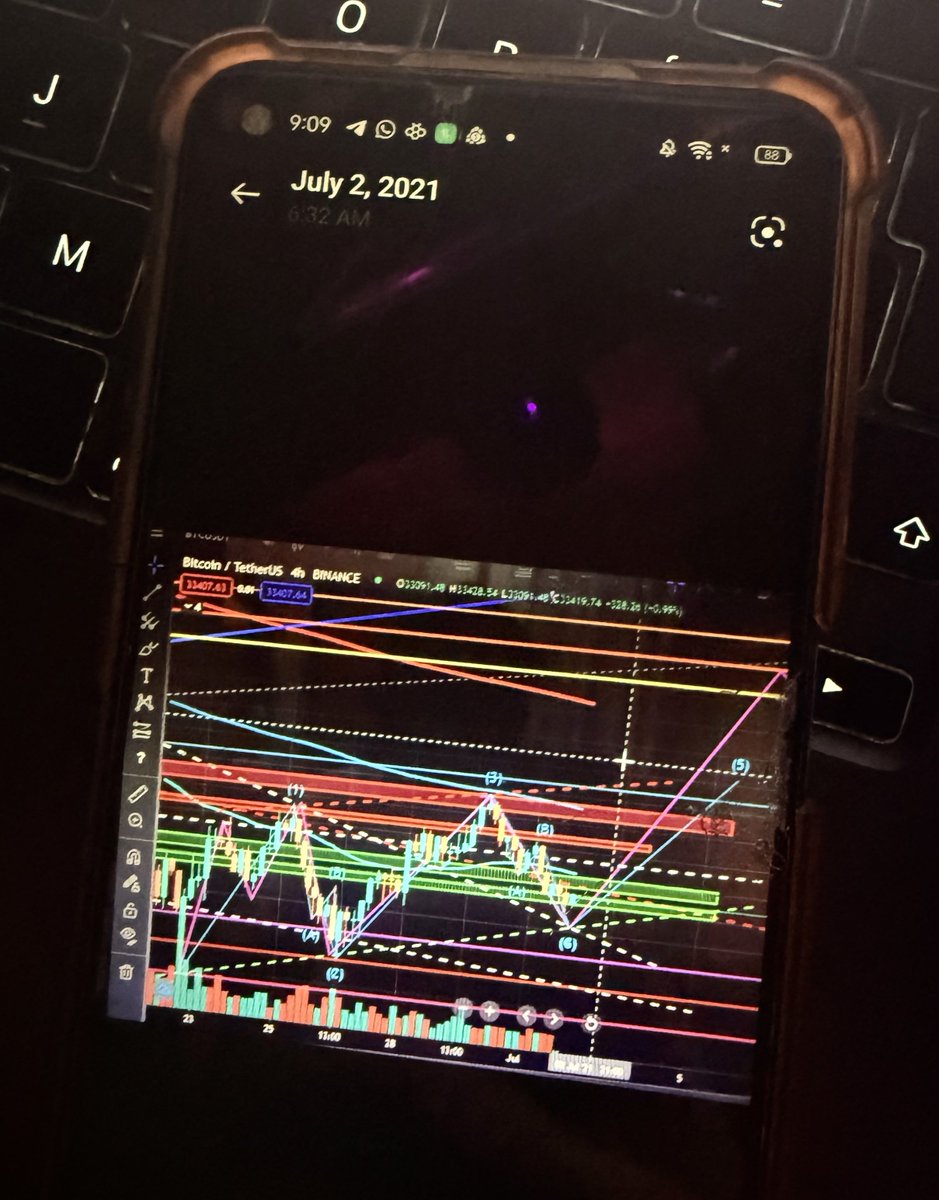
what my charts from 2021 looked like
this is bacc when i didnt know much and had joined a paid group that used to teach triangle patterns and got everyone liquidated
been quite the journey now that i look bacc, from being a depressed child with no family backup all on his own to being financially free and having the strength to have been around the world
from nothing to something, if a child like me could do it so can you, i was 16 bacc then and i rmmbr drawing these charts from my school with my old android phone with a broken screen :)
Banger.
Trading is the monetization of risk. The practice of systematically acquiring exposure to risk that the market compensates, while identifying and shedding the risk it does not. Profit lives entirely in how honestly and rigorously you draw that line.
Every $BTC OrderFlow "Expert" Right Now:
"Spot is not participating, this is perp driven, extremely weak move, prepare for a big dump!"
Correct? NO!
(not necessarily)
Here is the part that most miss - Context 👇
OrderFlow does not work in isolation: The exact same data signature can represent bearish distribution (beraish divergence) in one context and bullish accumulation (bulllish absorption) in another. A falling spot CVD while price rises can be a major warning, but it can also be evidence of strength! Context decides which one it is. So let's try to understand the context:
You have to answer two questions:
Where is trading activity happening right now in the context of the broader market?
And who is initiating trade?
Anyone can look at a declining spot CVD and call weakness. The real skill is comparing venues, separating aggressive from passive flow and looking at how price responds.
1. You may be misreading spot CVD
A declining spot CVD simply means that aggressive spot sellers are hitting the bid.
It does not automatically mean there is no spot demand or that spot buyers are not participating.
The important question is:
Why is price refusing to move lower despite all that spot market selling?
There are two very different possibilities.
- Bearish divergence: Perp buyers are driving price higher opening new longs (perp CVD rising) while spot remains a net seller into this flow (spot CVD falling). The rally is being supported by leveraged demand rather than genuine spot accumulation. There is no real support and once aggressive buying dries up, without a strong fundament a liquidation cascade can quickly drive price back down to the lows - major weakness.
- Bullish absorption on spot side:
Aggressive spot sellers are hitting passive spot bids, but those buyers continue absorbing the supply without allowing price to break down. The difference here, passive buyers are actively absorbing the selling pressure and accumulating. Their bids below current price build a strong foundation and real support - strength!
At first glance, both scenarios can look almost identical. In the current case, the spot market selling is not producing meaningful downside acceptance. Aggressive spot sellers keep hitting the market, yet price continues to hold. OrderFlow is showing that someone is willing to absorb the supply on the spot side. We can also see large passive spot bids stepping higher chasing price, rather than remaining static below the market.
2. Large buyers do not need to chase with market buys at first:
Large participants generally cannot enter their full position with aggressive market orders. They would be paying the spread and creating significant slippage giving them a worse fill price.
So instead, they often work passive limit orders and allow aggressive sellers to fill them first.
That appears to be the dynamic here for now!
Large passive buyers are stepping their bids higher while impatient or bearish sellers continue crossing the spread into them. Price refuses to break down.
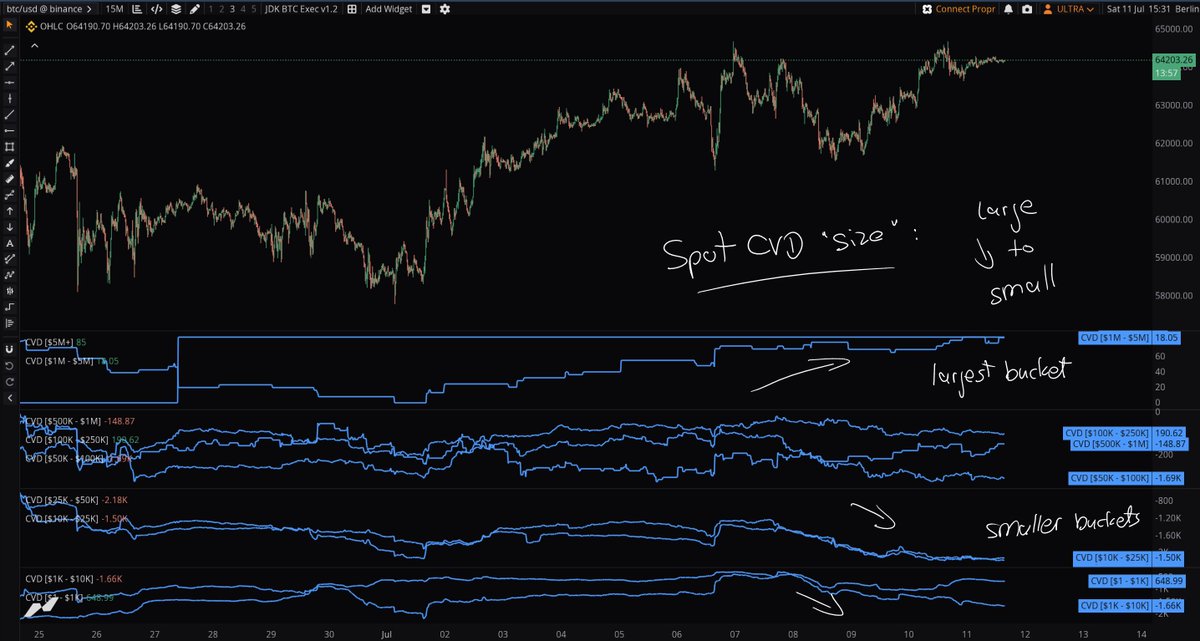
The trade-size data adds another layer: larger-size flow is holding up better, while much of the persistent selling is coming from smaller order buckets. That does not prove the identity of the buyer, but it does show that the flow is more nuanced than “spot is selling, therefore the rally is fake.”
3. The perpetual short trap:
Bears see declining spot CVD like everyone on X right now, conclude that the move has no real demand behind it, and begin opening fresh shorts over and over. But those shorts are also failing to create downside acceptance.
Each attempt lower is absorbed, price recovers, and newly opened shorts become trapped and get liquidated.
That creates fuel for repeated short-covering moves and explains why downside attempts keep failing on the lower timeframes with price creeping higher.
The key signal is not merely that traders are shorting.
It is that their selling is having very little impact on price even though spot is adding supply and we are already sitting at value extremes!
4. Acceptance matters more than the headline:
This is not a single low-volume wick above resistance that immediately rotates back into the prior range.
Price is spending time at higher levels, building value, and holding near the upper edge of the structure.
That matters.
A market that is truly weak usually struggles to maintain acceptance at the highs and around value extremes. Here, price is grinding, consolidating, and repeatedly rejecting lower prices despite ongoing sell pressure. The market is not simply spiking higher. It is attempting to establish value higher!
💡 The bottom line:
A declining spot CVD while price rises is not automatically bearish divergence.
It becomes bearish when price is being carried higher primarily by leveraged perp demand while spot sellers remain in control and with no real absorption from passive bids on the spot side - no real support!
It becomes bullish absorption when aggressive spot sellers are continuously absorbed by passive spot buyers and price refuses to accept lower.
Those two conditions can look almost identical at first. The difference is revealed by:
- price response,
- venue comparison,
- passive versus aggressive execution (check the orderbooks),
- structural location,
- and whether the market accepts or rejects lower prices.
Right now, spot sellers and fresh shorts are failing to gain acceptance lower, even with price trading at the edge of value.
As long as passive buyers continue absorbing that flow, the structure remains supported.
And if aggressive selling begins to fade near the highs, the market may no longer need to fight through constant supply. That is when the move could begin to accelerate to the upside. Then we actually need to see spot buyers participate (Spot CVD rising), with new longs joining and price rewarding as price is breaking bearish structure - thats real strength.
Same CVD signature. Completely different market reality. Context decides which one you are actually looking at. And right now it's not looking too bearish anymore.
The market had any reason to break lower, but continues to accept higher. What looked like weakness first is turning into strength.
On top of that we have a strong structural low, with clear bullish absorption at the lows (trapped shorts) and the initial bounce was mostly spot driven! Don't forget this...
This is basically everything I hate about trading on socials. As a beginner you get pushed in completely the wrong direction, because the first thing you’re shown is a wall of order books, tick-by-tick prints, and now an AI agent supposedly doing it all for you.
None of that has anything to do with why people actually make or lose money. The problem is that this stuff looks highly technical, and beginners confuse “technical” with “competent.” A flashing depth chart and a feed of prices updating every second signals mastery to someone who doesn’t know better, so they chase the aesthetic of sophistication instead of the boring fundamentals that actually work.
You end up thinking the person with the most complicated screen is the one who knows the most and now it’s worse, because you’re not even being asked to understand the shit you don’t need; you’ve got an AI agent handling the shit you didn’t need in the first place.
Altseason is a mind virus for newbies.
The basic assumption is: Bitcoin runs, then consolidates; the liquidity that accumulated in BTC rotates downward. If you want to be specific, you could even say first into majors, then through mid-caps, and eventually into the long tail of small-caps and absolute shitters. It's a sequential, almost mechanical picture of capital flowing through the market. Holding your favorite shitters through this period is, in effect, holding a lottery ticket on a hypothesized regime change.
Strip the narrative away, and what people actually *want* but never really articulate is: exposure to trending altcoins. Trend is the actual unit of return. If you want exposure to trending altcoins, the right object of analysis is trend itself. Concretely: identify what is likely to trend in the near future based on observable signals rather than on a thesis about a project's fundamental future.
TL;DR: Fuck altseason. Be in trend when it's present and out of it when it isn't, and size accordingly.
🧵 Maybe this post can help some of you.
There are a few reasons why I prefer shorter duration trades, and my style gears toward that rather than longer holding periods.
This is not to say that I do not hold trades for long periods of time, there are many instances where I do, but they simply do not represent the majority.
As a caveat, I should start by saying I was trained this way early on and the people trading around me had a very similar approach.
1st - Personality, and this is important, because a lot of you will end up choosing a style based on what you think is cool. The first thing you should do is find what "fits." I like to be close to both the action and the feedback loop, and I get bored easily. Believe it or not, misalignment here is one of the reasons traders struggle initially, and this actually comes in handy for my last point (5) at the end.
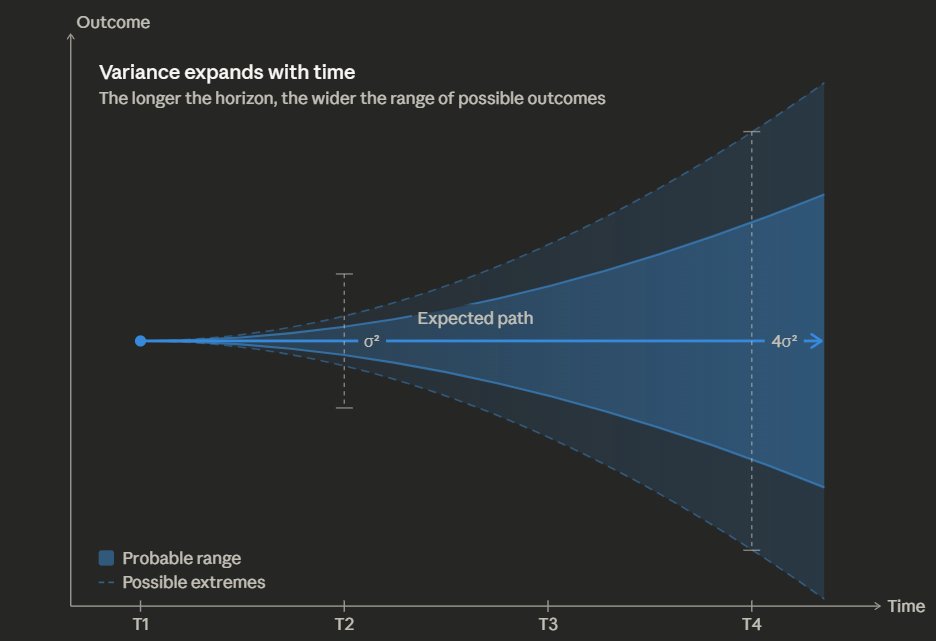
2nd - My belief is that mid-frequency trading is probably the most difficult. Over very long periods the market is honest, and over very short periods it can be wildly distorted and create a significant amount of opportunity. The middle ground is where the danger exists. It is also probably the most competitive timeframe, and the hardest one to build a durable edge in.
earth full gameplay guide and review:
- takes 3 years to unlock voice chat
- tutorial takes 18 years
- banned at level 60-80
- can’t respawn
- pay to win
- good graphics, no lag
- can’t choose your own spawn server or username
- signing up takes 9 months