Real Markets Are Coordination Problems, Not State Machines
From a research perspective, the most interesting thing about @reya_xyz is what it refuses to abstract away.
Timing matters. Ordering matters. Risk does not stay local.
Markets are coordination systems first and state machines second.
Designs that forget this tend to look elegant on paper and behave strangely in production.
Reya implicitly invites a different mindset:
design for stress as the normal condition, not an exception.
Design for interaction effects, not isolated success paths.
If Web3 infrastructure is ever going to earn long-term trust, it won’t be through prettier dashboards or faster demos it will be through architectures that remain legible when conditions are least forgiving.
@wallchain
And that’s the layer where serious research actually belongs.
Individual exchange features can be copied.
The harder part is integrating the entire stack.
Sequencing.
Matching.
Execution.
Dedicated capacity.
Reya's direction is simple: build the chain and the exchange as one system, then make it reliable under real trading conditions.
Protecting keys matters. Limiting what a compromised key can do matters too.
“Security has to cover the whole system: the code, the people operating it, and the access they have. That means looking beyond contract vulnerabilities to how the system is operated and who has authority to act.
So our starting assumption is that any single component or credential could be compromised. We design for that. Authority is limited, responsibilities are separated, and critical actions sit behind independent layers of protection.
We don't treat any single safeguard as a guarantee, and we keep reviewing those assumptions as the system changes.
Protecting keys matters. Limiting what a compromised key can do matters too.” - @arturbegyan Reya Labs CTO
One chapter of Reya is closing.
V1’s AMM handled $135B+ in volume with 10K traders.
V2 starts differently: an orderbook designed for high throughput, low latency and zk verification.
Private Beta is now live.
Reya's V2 launch has a deliberate sequence:
Orderbook → Liquidity → Traction → Token.
No fixed TGE date. No artificial countdown.
The team is committing to the sequence and the criteria, then announcing each milestone as it gets cleared.
Reya v2. It's coming.
With it comes Season 2, a short season designed to pack incentives into the orderbook launch.
The earliest in reap the richest benefits.
Read the article to understand:
- How this works for you
- What happens to what you earned in Season 1
- Where this goes next
Not a queue. A position. Opening 28th September.
The full picture 👇
Unchanged: application trading, balances, staking.
Changed: endpoints, signatures, payloads, sockets.
The launch date is September 28. The work for desks is the window before that.
Reya v2 goes live September 28.
The onchain order book is almost here, and the new API is already testable on devnet.
If you integrate with Reya programmatically, spot or perps (including current AMM and API clients, market makers and bots), you'll need to migrate to the new order book API before launch. Base URLs stay the same; endpoint paths, signing, requests, responses and WebSocket all change.
Trading in the app? Nothing for you to do. Deposits, withdrawals and staking stay open throughout.
Start building and testing on devnet today:
https://t.co/bvdOFsesn0
Exact cutover time to follow. Bring integration questions to Discord.
Reya V2 is starting to look less like a roadmap and more like a live migration.
Another 12 markets are now reduce-only as the AMM gives way to the orderbook.
The real test comes next: how liquidity and execution perform on the new market structure.
Market changes as we approach the Reya V2 transition from AMM to orderbook
Heads up: the following 12 markets move to reduce-only today at 13:00 UTC.
ADA, APT, PENDLE, GRASS, WLD, ME, LINEA, OP, POL, FTM, DOT, LAYER
From 13:00 UTC you'll be able to close or trim existing positions, but not open or add. Please manage any open positions ahead of time.
Deposits, balances and all other markets are unaffected.
RNIP-6 is interesting because Reya isn't asking RLP to become a market maker.
Instead, RLP capital can be delegated to professional market makers while remaining inside the ecosystem.
The market maker takes the trading PnL risk.
That's a very different LP structure.
There’s a common theme across Reya’s recent updates:
capital is becoming increasingly productive
Collateral can earn
RLP can support liquidity.
Taker fees can incentivize makers.
And deeper liquidity can improve execution.
The pieces are connected.
Now the data has to prove it.
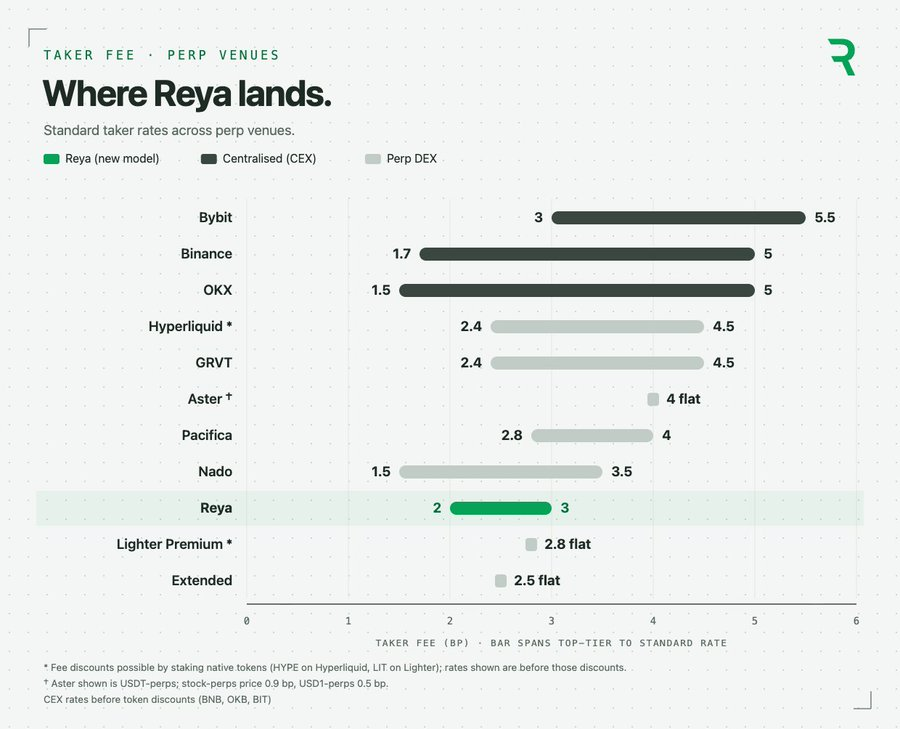
Fee-sensitive? Look at the whole cost, not just the headline.
Reya's taker fees are now as low as 2 bps. And they'll fund the maker rebates coming with the orderbook, tightening spreads and lowering your all-in cost.
Full model in the QTd article.
Token vestings for Flares Season 2 is now LIVE.
Vesting has been running since Aug 10th. Today covers the first 10 days & moves the remaining to a daily schedule.
Check your allocation in the app: https://t.co/GeMaXqTqMJ
AMM → orderbook is already happening.
Now Reya is adding more builders to the team behind it.
Senior Rust Engineer
Senior Fullstack Engineer
If you like low-latency systems and onchain trading infrastructure, this is probably your kind of problem.