Post-quantum security and privacy on Ethereum are currently prohibitively expensive: a single PQ STARK proof would cost ~6.4M gas.
@VitalikButerin about EIP-8288 at ETHTaipei: in-mempool recursive STARK aggregation that solves scalability, privacy, and PQ security at once. 🧵👇
Hash-based signatures need to support millions or billions of transactions without becoming impractical.
Our latest research explores how to support up to 2³⁰ signatures per key, while reducing signature sizes and computational cost
https://t.co/FCKRzaS98k
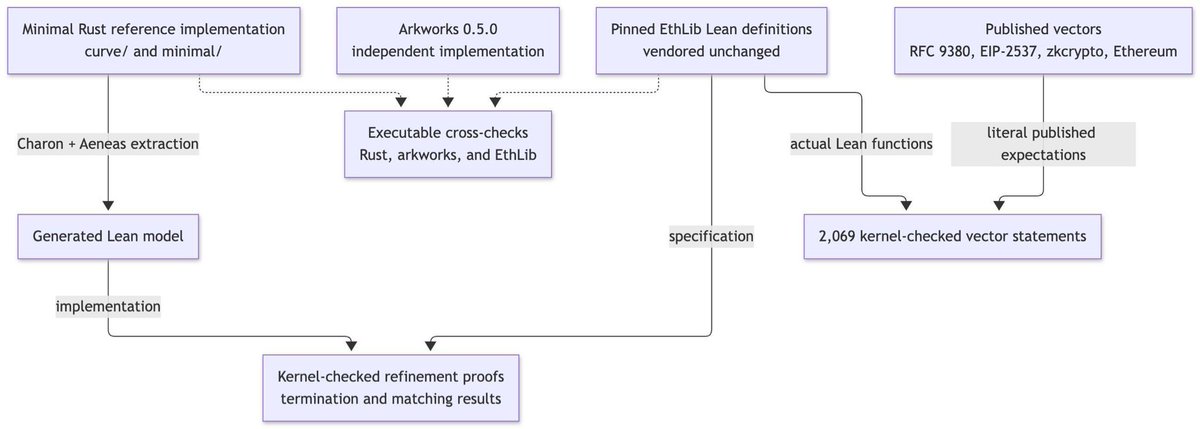
Experimenting with conjuring proofs for cryptographic code
arkworks (@arkworks_rs) is a comprehensive optimized toolkit for a wide range of snark-related cryptography
EthLib is a Lean spec for Ethereum related algorithms, including cryptography, that was published recently
1/7
Real-time Ethereum proving, still on a single machine with 4 GPUs, and now with:
✅ 128-bit provable security
✅ final proofs under 300 KB
✅ a fully open-source stack, CPU and GPU
Pico 3.1 is live. 🧵
If Echidna has ever helped you find a bug, now is your chance to help Echidna: https://t.co/b0ttrnVPHa
Only $12k is needed for it to qualify for the DAO vote
Most think vibecoding at scale is slop. Here’s a counterexample.
Today we release a 16M-line formalization of the entire Stacks Project, critical infra underlying modern math, with optimized code quality and its highly interconnected structure preserved.
A mathematical city 🌆
I am happy to share FlashProve: our performant open-source prototype for provable inference. We believe that this has significant implications for security, pacing AI development, integrity guarantees, and more.
FlashProve allows a provider to commit to model weights, and then prove that replies originate from the committed model. The proof leaks no information about the weights, and the verifier can efficiently verify it on consumer hardware.
Our library is performant, proving a 400B parameter MoE model at 100 tok/s. We have open-sourced the associated code and Lean formalization. We hope that it catalyzes further progress in verification of inference, and look forward to seeing it.
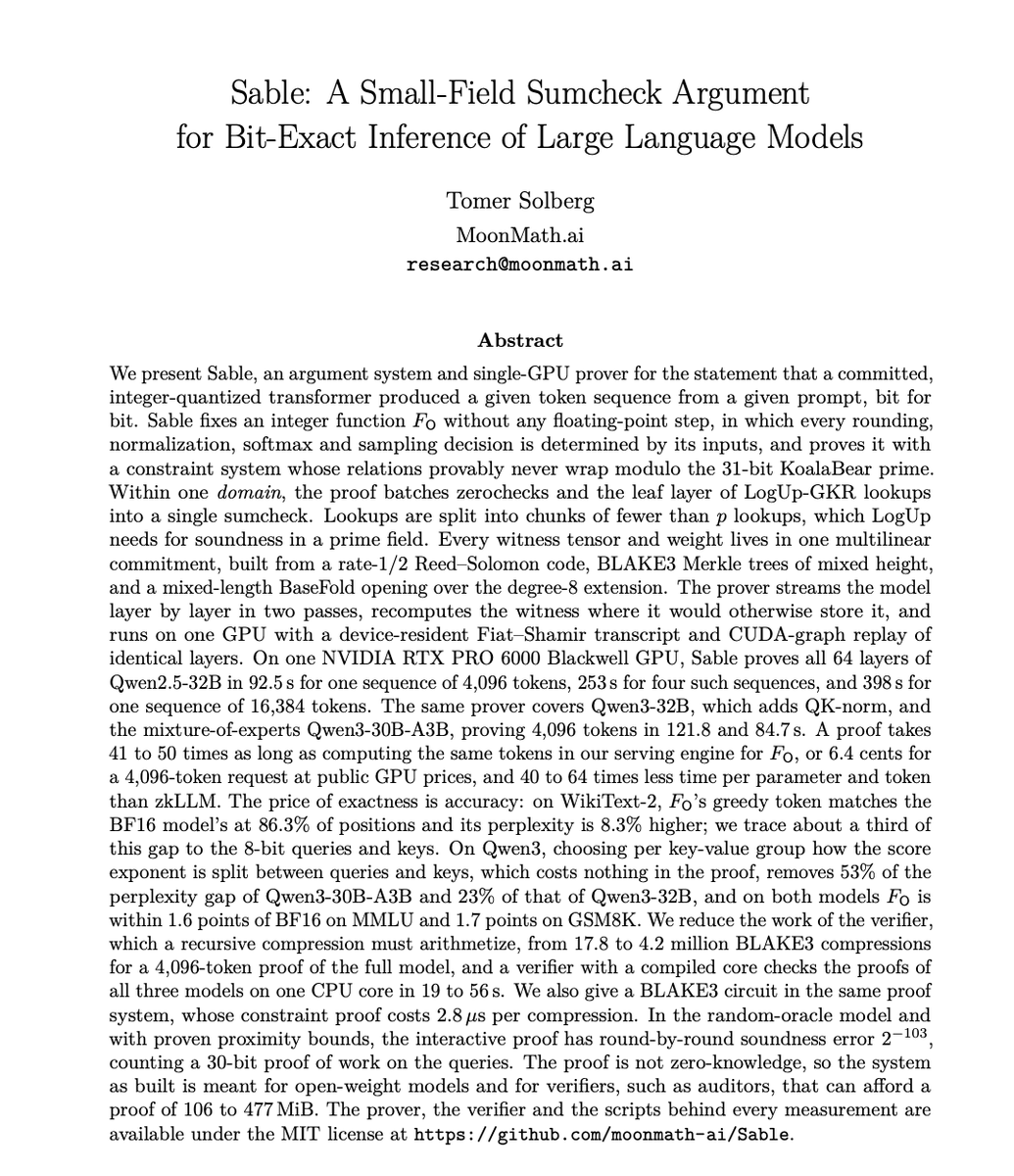
Introducing Sable, our verifiable inference system.
Soon to be deployed for our Dolly models - cryptographic proofs of committed weights, quantization, sampled randomness and more!
Code and paper: https://t.co/2zTdUDp2a0
evm.asm, our collaboration with EF on an e2e verified EVM implementation for zkVMs, now has its own autoresearch competition: https://t.co/EI48SzxG1C
Prove the lowest runtime to validate an Ethereum block!
Anthropic @AnthropicAI ❤️ zkSTARKs:
In collaboration with @StarkWareLtd co-founder Prof. Alessandro Chiesa and other brilliant researchers, Anthropic just open sourced a zk STARK system for proving the integrity of LLM inferencing, bringing us closer to verifiable AI.
As we said long ago (since 2018), zkSTARKs are the end-game: highest scale, best security (post-quantum). Now, also AI agile and supporting AI integrity.
https://t.co/kgAMnOVhtw
SOLAR: 100x FASTER SOLIDITY
Solar is the future of Solidity and the EVM.
It's >100x faster than Solc.
It has faster bytecode than Solady with no assembly.
Its bytecode is faster to interpret by the EVM.
Solar fixes Stack Too Deep!
foundryup
forge --use solar
Blog below.
EVM fast | Ethereum Foundation, zkSecurity & Yukon
Goal: Build a Ethereum validator with a lean proof that it takes less than X steps in RISC-V. For the smallest X.
We are approaching the full automation of cryptography research.
https://t.co/ofslyZUChT
Open Frontier Science
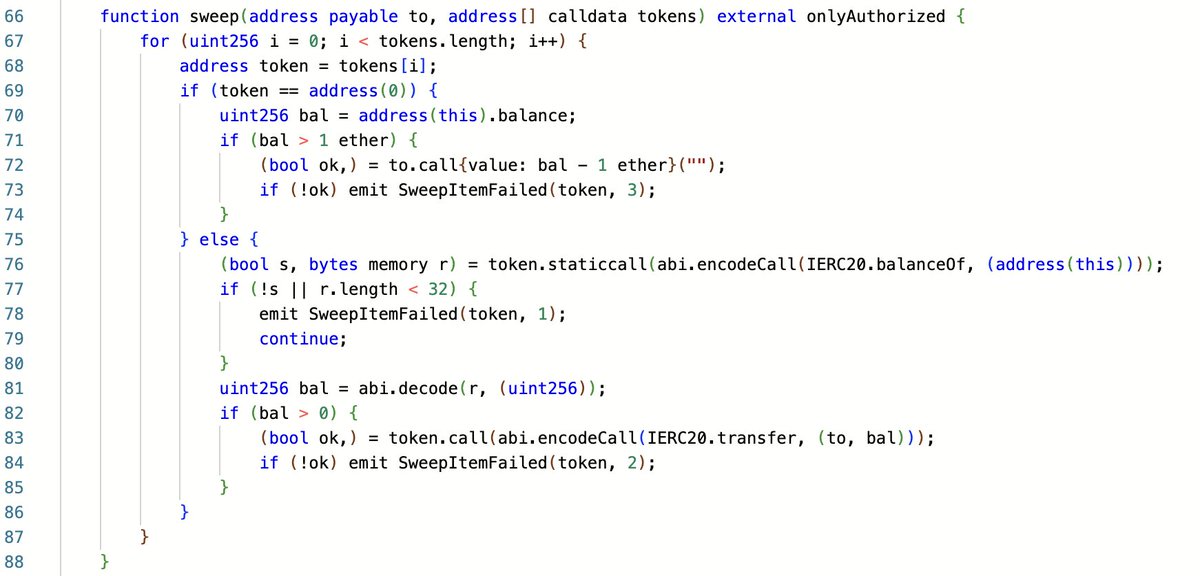
Reading the reconstructed bytecode of the Binance EIP-7702 sweeper (`0x63e8...6fae`) is wild.
This wasn't a generic drainer. It was custom-engineered for Binance 14's architecture:
- Leaves exactly 1 ether behind (`bal - 1 ether`) when sweeping ETH so Binance's automated hot wallet queue wouldn't error on gas and trip alarms.
- Uses raw `staticcall` + `continue` loops with custom error codes (`SweepItemFailed`) so one bricked or blacklisted ERC-20 wouldn't revert the $6B batch.
- Includes a custom `callExecute` function to impersonate Binance 14 as controller of an external vault holding $823M in USDC.
They leave a comment: "robberies could be prevented if getaway cars were slower."
You can't fully blame EIP-7702, but it sped up the attack. Without 7702, draining 64 tokens plus an external $823M vault from a live exchange hot wallet meant fighting moving nonces across 70+ transactions. Defense systems would've killed it after tx #3.
With 7702, Lazarus sprayed 50 consecutive nonces in one type-4 payload, turned an EOA into a custom proxy, and atomically swept billions in a single block.
Ethereum core devs built the ultimate getaway car. Surgical state-sponsored engineering.
This could be etched onchain:
`if (bal > 1 ether) { https://t.co/ou2j9VqGvv{value: bal - 1 ether}(""); }`
The Binance hacker might have just pulled off one of the smartest moves I’ve seen in crypto.
First, Tether froze $1.5 billion in USDT.
Then Circle froze another $800 million in USDC.
At that point, it looked like the hacker’s money was trapped.
But apparently, he had already planned for that.
Instead of holding the stolen USDT in a wallet, he allegedly deposited it into Aave and used it as collateral to borrow ETH.
Then he walked away.
That’s where the story gets crazy.
Tether can freeze the USDT sitting in the wallet.
But it can’t freeze the ETH he already borrowed.
So now Aave is left holding frozen collateral, while the hacker is sitting on liquid ETH.
And unless the protocol can recover it somehow, he may not even need to pay the loan back.
Two companies froze billions of dollars in seconds.
But someone who understood how to use DeFi may have found a way around both of them.
Pretty insane when you think about it.
New post on Eth Research!
Post-quantum signatureless authorization with recursive verification
By:
- ignotusnemo
🔗 https://t.co/iDdcHgTsxQ
Highlights:
- Signatureless authorization replaces digital signatures with reusable zero-knowledge proofs of knowledge of a secret bound to a specific intent (request), aiming to remain secure in a post-quantum setting.
- The key security challenge is safe reuse under adaptive, chosen-request attacks; the paper gives a quantum security reduction in an explicit “address-compatible random-completion” model and quantifies forgery probability in terms of preimage, simulation, extraction, and binding failures.
- The construction is specialized to binary fields (using F_{2^128} inside F_{2^256}) and uses a Poseidon2b-based authority relation plus masking, linear-claim reductions, and a Reed–Solomon-style code argument with fixed-before-challenge transcript structure to ensure binding and extractability.
- It is designed for recursive verification: the verifier checks the capsule using compatible binary-field arithmetic, enabling composition with proofs of execution while keeping authorization independent of public execution state for a fixed intent and authority.
- An implementation is provided with measurements: median proving around ~0.8–0.9s and verification ~25.6ms on the stated CPU setup, with capsule sizes roughly ~89–90KB and a maximum canonical size of 92,696 bytes; the verifier tile adds 16,536 incremental rows in the recursive system.
ELI5:
Normally, you prove you’re allowed to do something by signing with a private key. Quantum computers could break many of today’s signatures. This work replaces signatures with a different idea: you publish a public “commitment” (like an address) to a secret, and every time you want to authorize an action you send a fresh zero-knowledge proof that you know that secret and that it matches the requested action. The proof reveals nothing about the secret, can be safely reused many times with new randomness, and can be checked inside larger recursive proofs so systems can prove “this action was authorized and executed correctly” in one combined proof.
🚨 @binance - Loss ~$201.2M (2026-10-29)
Network: Ethereum
Type: Delegation Abuse (EIP-7702) / Private Key Compromise
Follow-up sweep in the Binance hot-wallet drain. The wallet 0x28c6…1d60 carries an EIP-7702 delegation (code 0xef0100 + 63e842b0…), pointing at the same operator-gated wallet-drainer kit. In this tx the attacker operator EOA 0x7c8601d4 (NOT the account owner) called sweep(address recipient, address[] tokens) = 0x8a179be4, and the delegate code transferred the wallet's inventory — 200.40M USDT, 369.8 ETH, plus LINK, UNI, ENA, COMP, AAVE, QNT, PEPE, SHIB, ONDO, PENDLE, IMX, MORPHO, NIL and more — to attacker collection 0x5227f603c1ee34ce3c06efe6477003bdfccb2f8c. Net ~$201.2M in this transaction. Setting a 7702 delegation requires a signature from the account's own key, so this is a signing/private-key compromise of an exchange hot wallet, extracted via an operator-gated universal sweep (one of several sweeps totaling ~$2.5B).
TX: https://t.co/ozZ790yDYf
Attacker: https://t.co/TvHX35ZL8H
Victim: https://t.co/NqcJJlIUQP
⏱️ Real-time alerts: https://t.co/X9cKWDVOJz