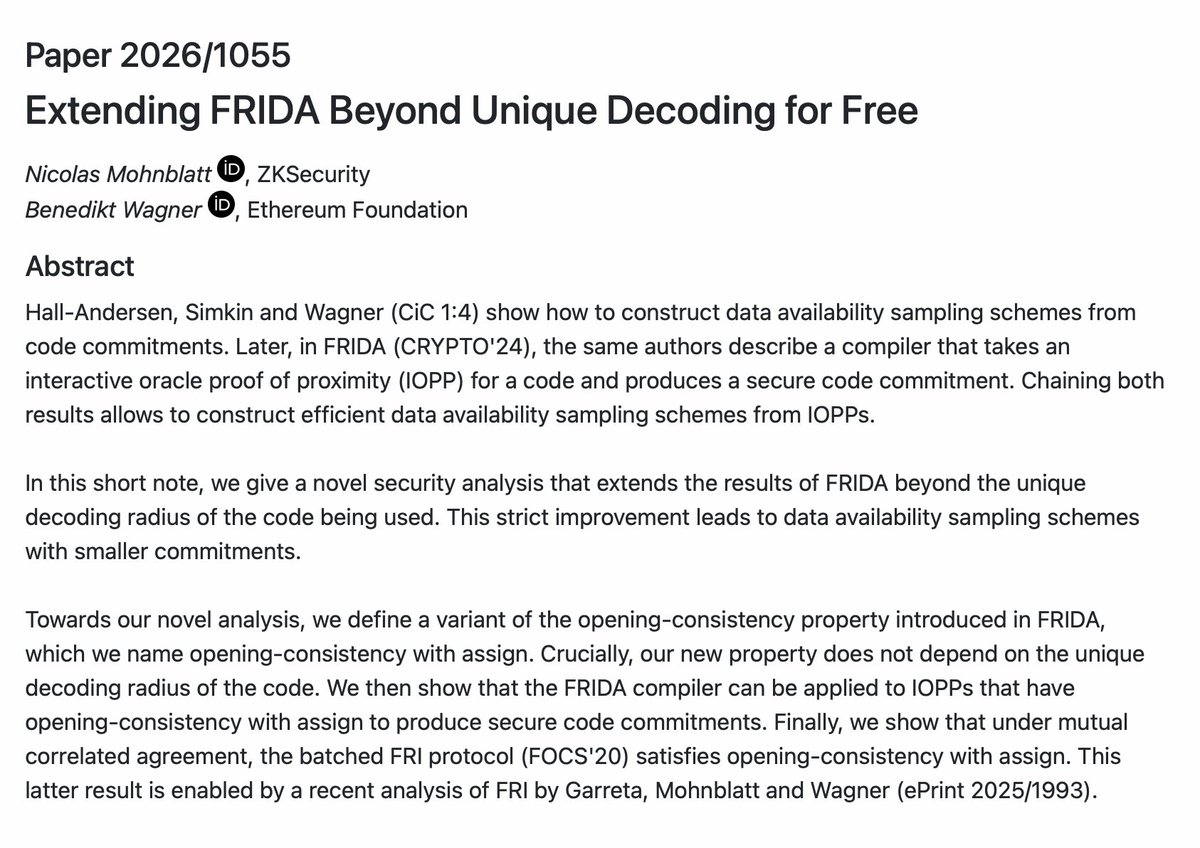
1/ Very happy to share a new paper with Benedikt Wagner on data availability sampling (DAS). In this one we extend FRIDA with our recent findings on FRI
FRIDA was a 2024 paper in which they showed that we can construct DAS from proofs of proximity that satisfy 3 conditions
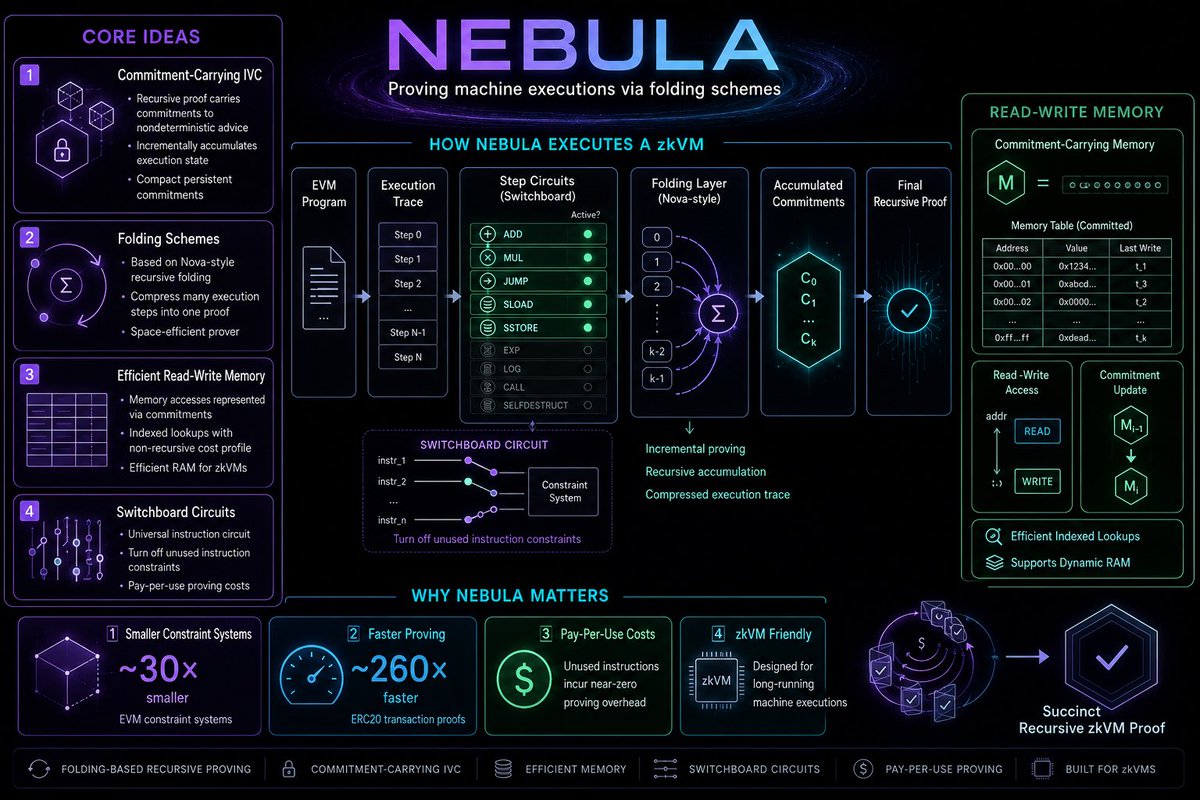
Our work “Nebula: Proving machine executions via folding schemes” won the Distinguished Paper Award at @IEEESSP!
Key innovations are: (1) devising efficient read-write memory checking in the folding setting, and (2) pay-per-use switchboard circuits. A quick overview of the work
Hash-based SNARKs are fast, PQ secure, and transparent.
But they have a major flaw: they historically lack ZK properties without massive overhead.
Enter ZO0k: a true minimal overhead ZK IOP framework presented by the local Italian star @GiacomoFenzi at ZK Summit. 🧵👇
Arkworks 0.6.0 is out 🎉
The headline isn't BabyBear, KoalaBear, Mersenne31, Goldilocks.
It's `SmallFp` — a macro for any prime up to 64 bits that picks the optimal layout + arithmetic at compile time.
Drop-in. Non-breaking. Up to 30% speedup.
READ: https://t.co/Ic98YEO5b8
Can AI write EVM bytecode + a Lean proof of solvency under arbitrary reentrancy, bypassing the compiler entirely?
Yes! In this experiment we create 86 bytes of WETH bytecode plus a sorry-free Lean solvency theorem 👇
(thread + link below)
Algebraic tensor reductions provide a unifying language for many recursive protocols. In this series, we’ll help you build a solid understanding of tensor reductions, using the well-known sum-check protocol as our guiding example https://t.co/l5UNyxIJsR
I factored the number RSA1024-1 using my home-built QPU stack; alarming sign that RSA1024 will soon be broken.
I'm choosing Full Disclosure, in the interest of transparency and Science advancement: https://t.co/UyImHud2n2
Non-ZK proof that the correct RSA1024 was used: https://t.co/eLdU0xpTMU
@yuvadm your move
Our newest sum-check optimizations are out! https://t.co/A50h9UbhGd
We propose a *better* domain for sum-check: the infinity hypercube.
Evaluations over this domain give *precisely* the monomial coefficients, and lead to a ~10% prover speedup over 128+ bits prime fields
🧵/ n
Standard RISC-V has 32 registers.
In hardware, spilling to cache is cheap.
In zkVMs, every memory operation is an expensive constraint to prove.
What happens if we hack LLVM to give RISC-V 1024 registers?
A breakdown of @leonardoalt's latest experiment. 🧵👇
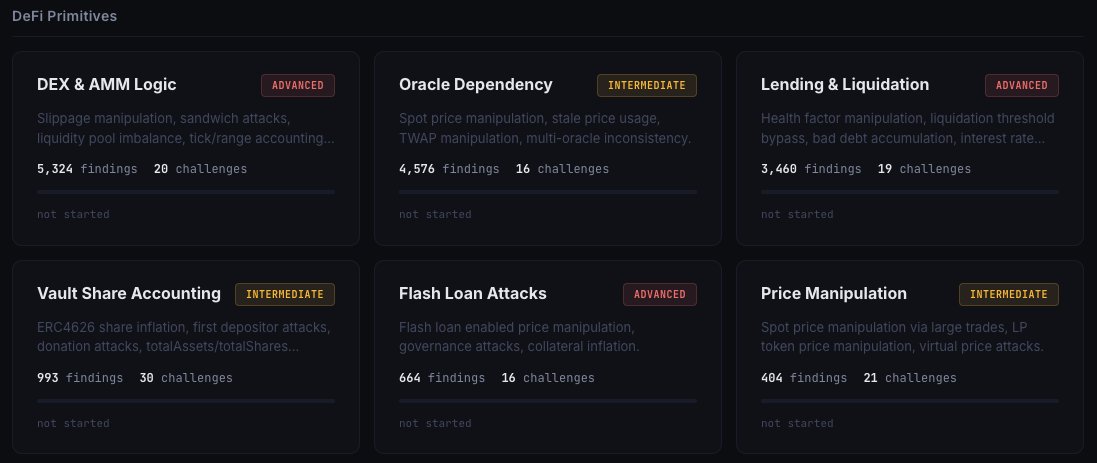
🚨Junior/Advanced secruity researchers - this is for you!!!
A new Training Hub that teaches you web3 vulnerability patterns and thinking as an attacker. Thanks to @ValvesSec, great job👏
URL: https://t.co/0eXoTFWEfv
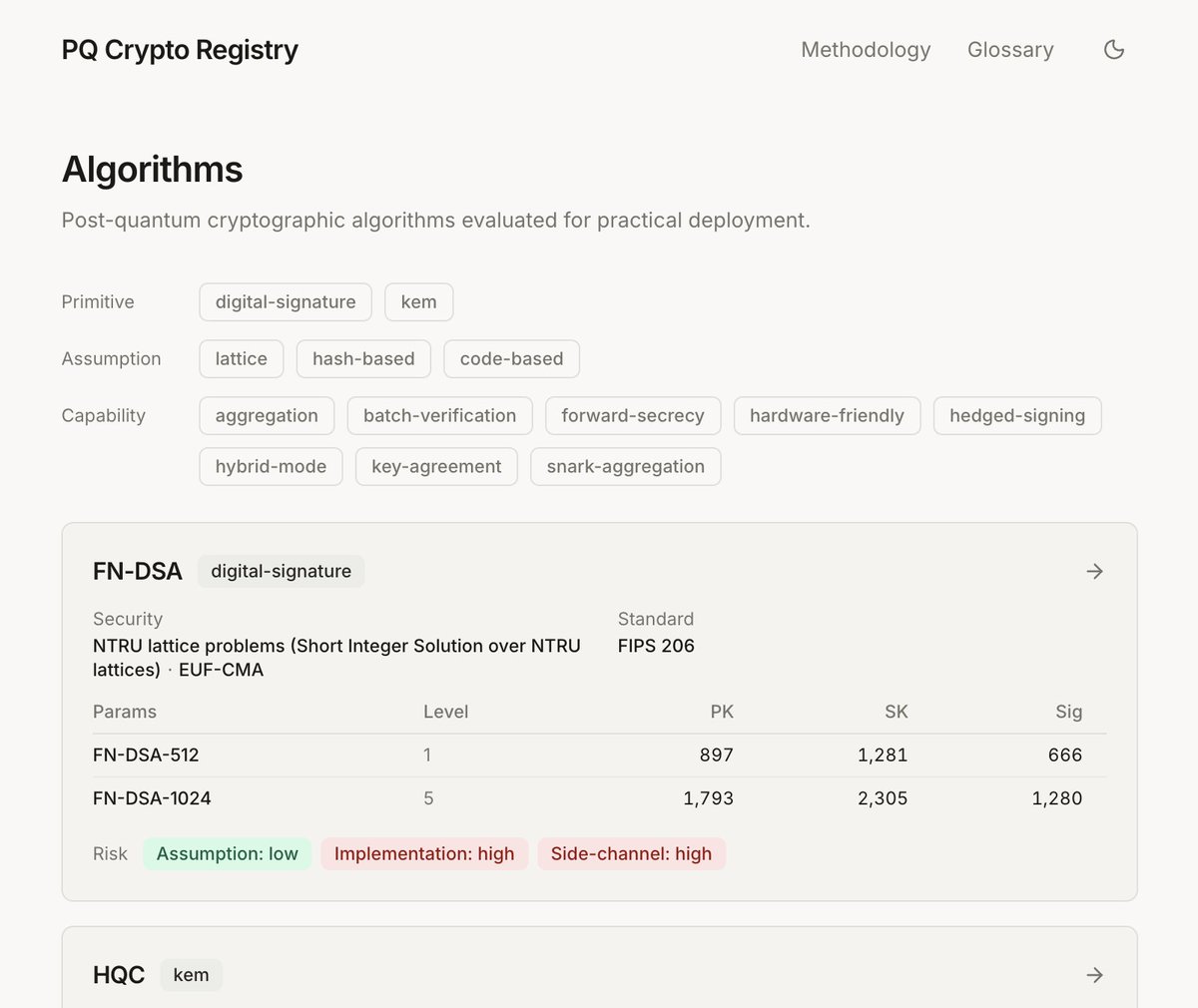
I've been working on a post-quantum cryptography registry/wiki and it's now live. If you're an engineer trying to evaluate PQC algorithms side by side, you have to piece together information from FIPS documents, ePrint papers, mailing list threads, and scattered READMEs.
There are some existing resources out there for parameter sets but I wanted something that goes much further and includes everything; algorithm descriptions, use case and feature filtering, benchmarks, implementation references, and wiki-style prose all in one place with a consistent schema. So that's what this is.
It covers nine algorithms today; the NIST standards (ML-KEM, ML-DSA, SLH-DSA), the NIST pipeline (FN-DSA, HQC), blockchain-specific schemes (SHRINCS, SHRIMPS, leanSig), and XMSS. There are a lot more I want to add and the registry is open source so contributions are welcome.
Our cryptographic researcher @alexand_belling revealed yesterday at @eth_proofs that Linea is moving to RISC-V.
After 3 years of directly arithmetizing the EVM, producing a 1000+ page spec and one of the most rigorous proving system in production, we’re changing course.
Here’s why 🧵
One other thing worth noting: this doesn't affect just EC signatures, many ZKP systems are affected just as much.
Broadly speaking, modern ZKP systems use one of three types of cryptography under the hood:
1. Elliptic curves (whether paring-based or not) - these are used by most SNARKs.
2. Collision-resistant hashes - these are used in STARKs and Ligero, among others.
3. Lattices - these are relatively novel but up-and-coming systems.
Quantum computers, like the ones mentioned in Google's paper, will straight up break anything that uses elliptic curves (e.g., it will be possible to create proofs for computations that never happened).
Hash-based and Lattice based systems are not vulnerable - but out of these, only hash-based systems are probably secure (given the underlying hash function is secure).
Another aspect of this is that data encrypted with EC-based cryptography and stored on-chain may be vulnerable even now. This is because of "harvest now, decrypt later" attacks. This is especially relevant for blockchains where data (even if encrypted) once stored on-chain is accessible forever.
This is one of the reasons we chose STARKs for Miden from the start. Our proof system is hash-based (and thus resistant to Quantum computers), and we use state commitments rather than encrypted state. That sidesteps the harvest-now-decrypt-later problem entirely.
Announcing powdr-wasm!
powdr-wasm is an optimized zkVM for WASM, built on top of @openvm_org and the novel 𝑐𝑟𝑢𝑠ℎ ISA.
Early benchmarks already show 1.5x fewer trace cells & faster proof times compared to RISC-V (OpenVM).
It also supports Go guests via WASI!
👇
Quick announcement: After long and heavy suffering :) the S-two white paper is finally out:
https://t.co/8WyVwoPE6h
Although nothing new in regard to the basic principles (a circle STARK, etc.) the white paper yet contains several details of broader interest:
- A formal description of the flat AIR circuit model (used by several contemporary zkVMs)
- A thorough soundness analysis of multi-table proofs: If one does not use "lifted" FRI, taming the soundness error turns out to be more sophisticated as expected. We introduce the notion of "cross-domain correlated agreement", and show that multi-table FRI satisfies this property.
- A discussion of adjusted conjectures, which takes into account the recent boost of proximity gaps counter examples. We believe that it is plausible to hope for acceptable list- and line-decodability properties up to the information-theoretic barrier, the Elias bound.
Thanks for all the help from the StarkWare team, and in particular to Dmitry Krachun for the many helpful discussions around his counter example.
🚀 New Plonky3 release just dropped.
This is probably our most impactful and ambitious release so far:
- MUCH faster lookups
- High-arity folding
- N-ary Merkle trees + Merkle caps
- Major Poseidon2 optimizations
- Poseidon1 support
- And many more…
Let’s break it down 👇
1/11 Lean Ethereum is preparing for a PQ future.
But how secure are the hash-based SNARKs powering it?
A recent $1M prize by the EF sparked a flurry of papers.
Here is the breakdown of the discussion between @nico_mnbl, @asanso and @GiacomoFenzi for @zeroknowledgefm !🧵👇
New work with @GalArnon42, Ale and Eylon! We show a few tricks to verify m evaluations of a univariate polynomials of degree d in time O(m + d) instead of the naive O(m*d) or O((m+d) * log^2(m + d)). This has applications to speeding the STIR verifier and PCS batching (and more?)