For sure, but I remember there was real demand for using BTC for payments in in 2014 - 2017 timeframe (Stripe first integrated BTC payments into its APIs in 2015 and then dropped the support in 2018 because of tech issues). Had the tech actually worked for this use case then, we might be living in a very different world now.
So, I think the issue is technical - but, of course, things have changed a lot since then, and I agree - it is much more of an uphill battle now.
A token can have long-term value for one of two reasons:
- It is backed by a business with revenue.
- It becomes money.
In the second case, SoV is one approach, but it'd surely be more beneficial if the token also had practical utility (e.g., it would have been great if Bitcoin was both SoV and a functional payment network).
In the US, yes - but internationally? If I'm transacting in Europe, LATAM, MENA etc. using USD as UoA is not that much easier than using BTC, ETH, ZEC etc. And if we are converting between different stablecoins, I'm not sure it is much better than sending BTC around (assuming it works as well as sending stablecoins).
Overall, my point is that these are mutually reinforcing use cases. If you have SoV covered and tech that allows the token to be used for payments (and maybe other things), over time, it is very likely that it'll grow into MoE. This will increase the market cap, which will reduce volatility, that will eventually make UoA use case also feasible. And eventually, the token becomes money. The timescale here is probably over a decade (or maybe more).
If the tech works, a token can still be used for payments even w/o being a unit of account. For example, in Russia in the 90s, computer prices were always quoted in USD because ruble was too volatile - but payments always happened in rubles.
Over the long term though, as something gets bigger and bigger, the volatility should go down. The main question is how big is big enough.
“Client-side proving is the holy grail for privacy because what leaves your device is only the proof." - @schmiddominik1
Dominic says Miden's partner mainnet has around 1,000 users one week in, and he expects to open it up in January.
I asked the @0xMiden co-founder how Miden balances privacy with what institutions need.
> How do you balance strong privacy with the compliance and selective disclosure institutions need? > What advantages does client-side proving give users and institutions, and what are the tradeoffs? > What have you learned from real usage on partner mainnet so far? > How is Miden different from other privacy-focused chains? > What insight made you spin out of Polygon and double down on Miden? > What does successful institutional adoption look like over the next one to two years?
Full Q&A👇
From privacy basics to post-quantum wallets in one day.
INTMAX joins Practical Privacy Day at @EFDevcon.
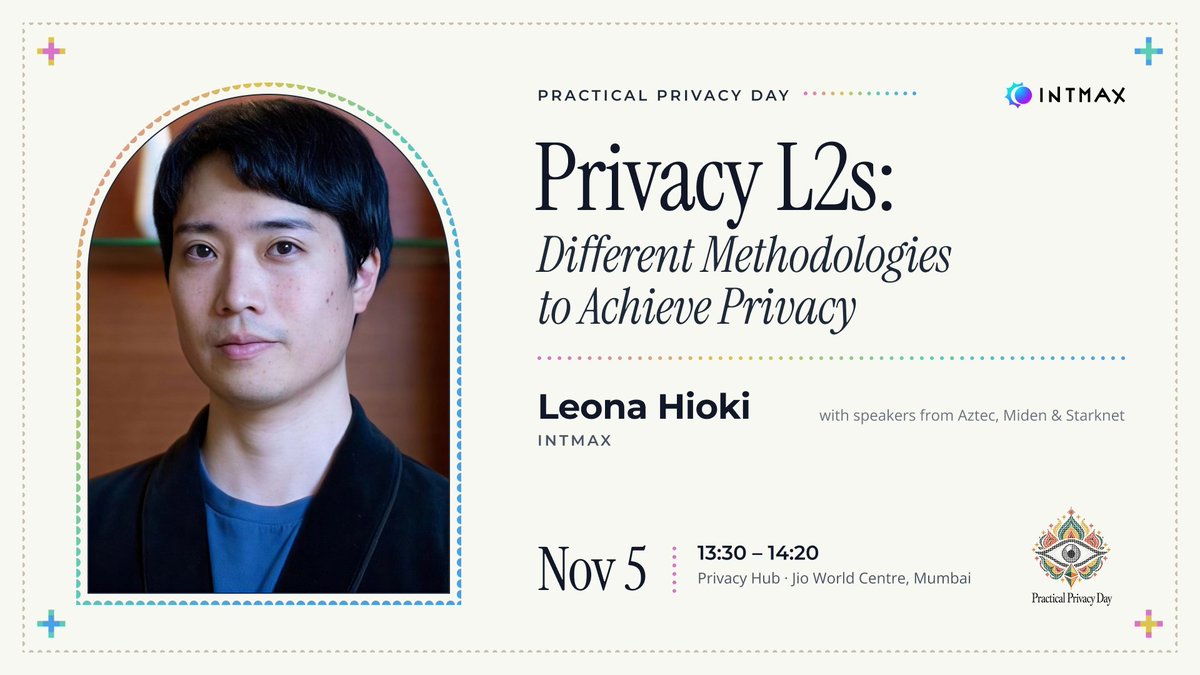
Panel, Nov 5, 13:30: our founder @HiokiLeona with @Zac_Aztec, @schmiddominik1, and @gyanlakshmi talking about Privacy on L2s.
Luma link below↓
We are running scheduled maintenance on Miden mainnet, so you may see some interruptions over the next 2 hours.
We will post an update once everything is fully back up.
The simplest thing to do is to allow the account owner to cancel the transfer during the delay. So, for example, if a private key is compromised, the attacker's transaction can be canceled by the original owner.
There are more sophisticated ways to deal with this too, but all can be done w/o giving up the core principles of crypto.
Re Binance hack: the specifics are not clear yet - so, just a general statement about crypto:
there is no good use case when moving billions needs to happen in a few seconds. We need delays and rate limits everywhere - this is the only way to make the system safe.
A lot of the treaties came after US and USSR had already built up sizable nuclear stockpiles.
One interesting titbit is that 1963 test ban treaty band testing in atmosphere and underwater but not underground because without FFTs these couldn't have been distinguished from earthquakes. There is a cool Veritasium video on the subject: https://t.co/vOnmGx4BTn
But the main point is that without verifiability, there is no way to have a treaty between US and China. So, the main question is how can such a slowdown be verified.