Certainty is a symptom of running a single model; calibration comes from an ensemble.
Tetlock's forecasting tournaments found that hedgehogs (experts with one big theory who filter all evidence through it) predict worse than "foxes" who hold many small, partial models and aggregate them, despite (in fact because of) the hedgehog's greater confidence.
That is precisely why ensemble methods beat single models in statistics. A random forest outperforms one deep decision tree, model-averaging beats any single estimator because averaging many independent, individually-mediocre views cancels their uncorrelated errors.
The fox is an ensemble; the hedgehog is a single over-committed model; the felt experience of certainty is the sensation of having stopped averaging. You know your forecast is degrading at the exact moment it starts to feel clean.
A borrowing rate is a forecast too. Each lending venue is a single model - one utilization curve, one governance regime, pricing its own local noise as if it were the cost of capital. Accept a fixed rate from any single venue and you've trusted a hedgehog: it feels clean, one number from one source, which is the tell.
IRIS prices across venues at once. A solver's fixed rate isn't Aave's estimate or Morpho's but it's what remains once each venue's idiosyncratic noise cancels against the others: the systematic cost of capital, no longer padded for any single venue's local shocks. The ensemble, not the hedgehog.
The rate that survived aggregation.
https://t.co/yAEhtjuNwH
Over the past few weeks we've talked a lot about our thinking, but we haven't talked much about 'fixed rates' itself, or the problem with variable rates..
Yes, it does solve institutional adoption and provides predictability in funding costs.
But to us, fixed rates are simply the medium through which a borrower’s most specific intent can be expressed, fully and precisely.
Intent is what matters. Market structure is secondary.
https://t.co/Km826FqLCL
"We've already solved liquidity. The next frontier is making credit more efficient, predictable + competitive."
Try it yourself today : https://t.co/np0MkUJpLA
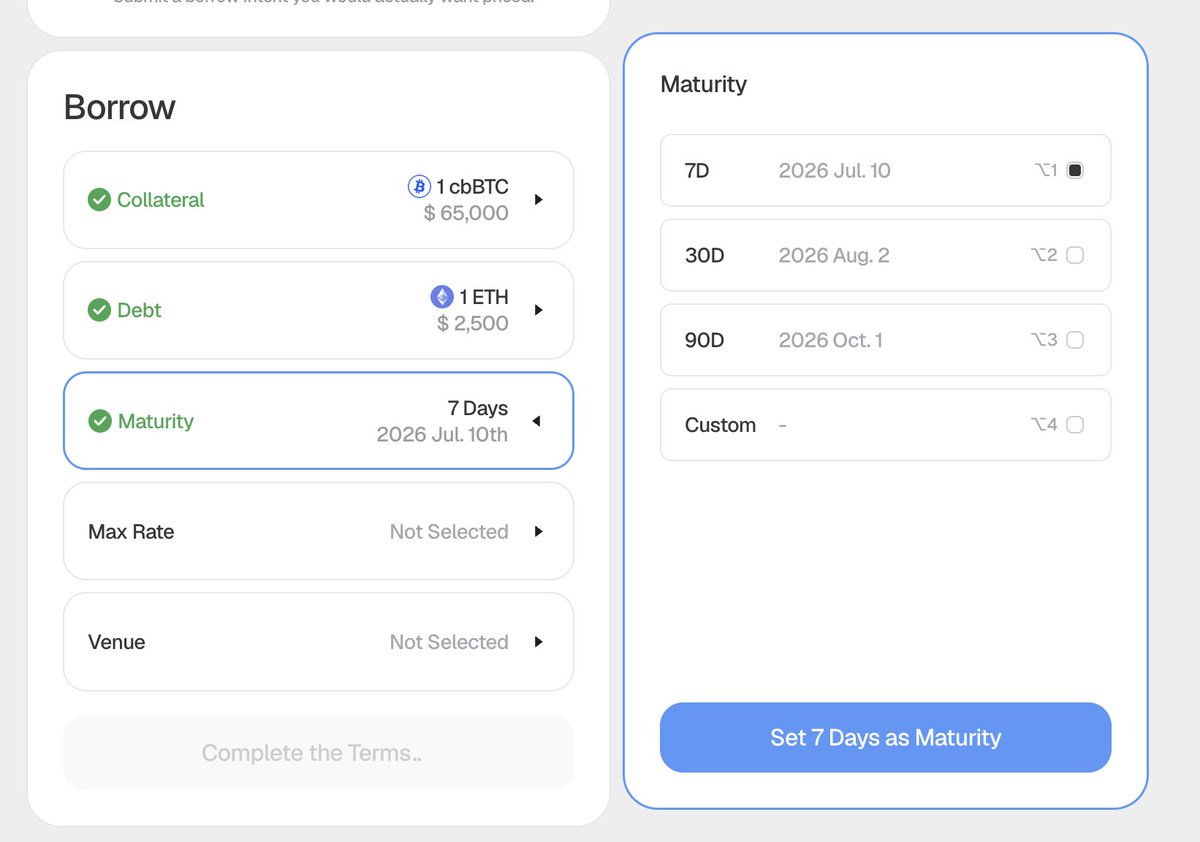
.@iris_credit just gave a sneak peek into its fixed-rate borrowing UX powered via an intent-based model.
The experience is pretty straightforward:
Simply specify your preferred loan terms and professional solvers compete to fulfil them.
This is a natural evolution of where DeFi credit has been heading.
For years, lending markets have largely revolved around isolated variable-rate pools. They've proven product-market fit, bootstrapped deep liquidity & established robust money markets across protocols like Aave and Morpho.
But variable rates were never the endgame.
As credit markets mature, borrowers increasingly care about certainty, not just liquidity. Businesses, treasuries and long-term capital planning simply work better when funding costs are predictable.
As the DeFi credit landscape continues to mature, primitives like this feel like a natural next step.
We've already solved liquidity. The next frontier is making credit more efficient, predictable + competitive.
Definitely worth giving out a try!
Disclosure: Investor
Before IRIS opens Exclusive Mainnet, we’re opening a small glimpse of the intent-driven borrowing experience.
After submitting an intent, you’ll also see a portal to request access to Exclusive Mainnet.
https://t.co/LX8Pqx8MPr
Over the past few months, we’ve been thinking not only about how a borrower-centric credit protocol should work, but also how it should feel to use.
With this demo portal, you can submit the kind of borrow intent you would want IRIS solvers to price later - collateral, debt asset, size, duration, and preferred conditions.
Try it out today, and tell us how it feels.
This Thursday we’ll reveal a glimpse of that experience and open a portal to request access to Exclusive Mainnet.
Comment some of the collateral / debt pairs you want in the first flow to be the first to try it out 👇
No single lending market can offer the best rate for lenders and borrowers at all times.
As Defi lending becomes more granular and fragmented, supply and demand conditions become increasingly local. One market may have the best borrow rate at one moment and another market may become better later.
There is no reason to assume one venue should consistently outperform every other venue for borrower execution.
This is even more obvious because lending markets are two-sided. A “good rate” means different things depending on which side of the market you are on. A high rate is attractive for suppliers and expensive for borrowers.
A venue cannot be permanently optimized for the borrower’s best rate because lenders are also part of the market it has to serve.
But as an origination layer, IRIS can start from the borrower’s financing need and route execution through whichever underlying market can support it most efficiently at that moment.
In a fragmented credit market, best execution will not live in one place forever and the borrower-side layer should be built for that inefficiency.
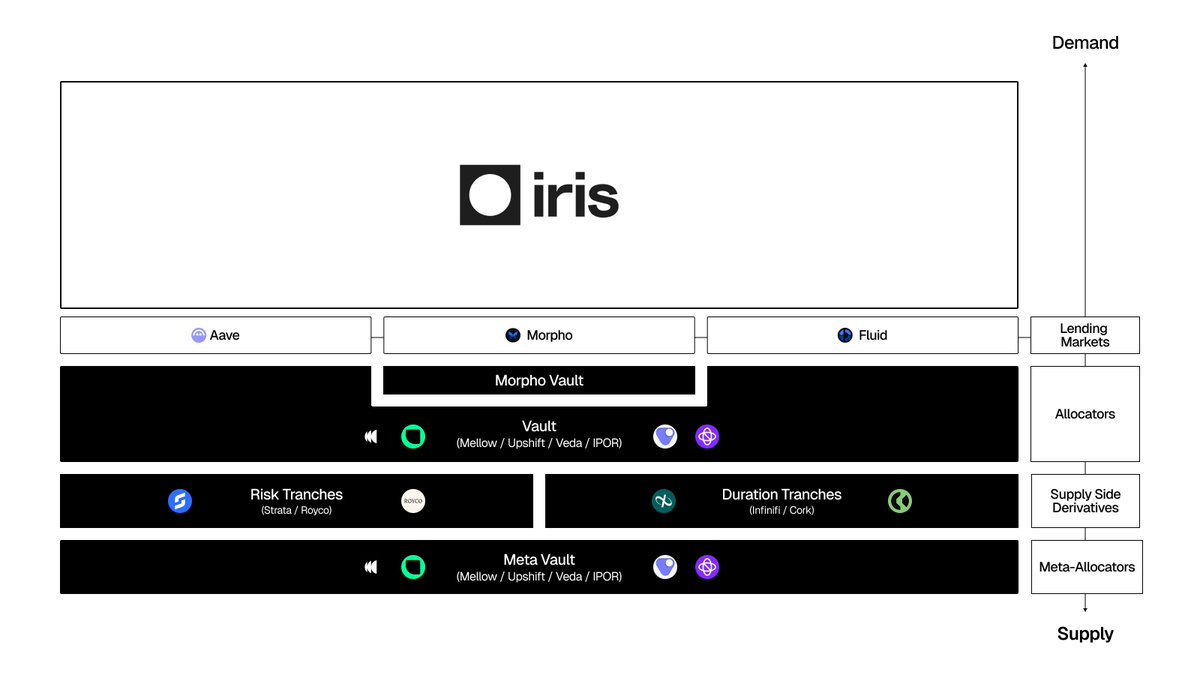
DeFi lending has spent the last few years building out its supply stack and as a result, we now have a fairly rich supply-side architecture layered by teams like @mellowprotocol@veda_labs@ipor_io@upshift_fi on top of base lending markets like @aave@morpho@0xfluid .
Suppliers can choose where to allocate based on their exact risk appetite and there are now multiple intermediary layers helping them do exactly that. ( @Strata_market@infiniFi@Corkprotocol@roycoprotocol )
Capital may have many ways to express itself, while borrowing demand still has 0.
What’s needed is not a “vault for borrowers” because a vault pools capital but borrowers need more granularity.
It is also not just a “curator for borrowers" because borrowers don't really need someone to point them toward an existing market.
That is an origination layer, the empty box in the diagram.
Borrowers should have the same level of specialization on their side of the market as the suppliers with all kinds of vehicles available.
They should be able to express the financing outcome they actually want with their execution preferences and have specialized actors compete to deliver it for them.
IRIS is building the origination layer borrowers didn't know they deserved.
246 Club did not work.
Neither did the two lending-market iterations we explored between 246 Club and IRIS.
We kept coming back to the same thesis. A better lending market should be built around borrowers and what financing outcome they are actually trying to create.
The irony was that every lending market we built still forced us to solve supply first.
Before we could test whether the market was better for borrowers, we had to attract lenders and bootstrap liquidity to make the pool usable at all. The borrower problem kept getting pushed behind the supply problem.
IRIS was the result of refusing that tradeoff.
The biggest design decision we made was to remove new lender liquidity from the critical path.
IRIS starts with existing credit liquidity which lets us focus entirely on the part of the market that actually determines whether credit is useful: borrower demand.
IRIS is NOT another lending market searching for borrowers after supply arrives.
IRIS IS an origination layer built from the thesis that demand itself is the market.
https://t.co/zsSTrYAZll
Defi lending has long traded expressiveness for standardization.
When markets were smaller, the first problem was access. Liquidity had to be pooled, positions had to be made fungible, and borrowers had to fit into simple market structures so price discovery could work at all.
But as more serious financing needs move onchain, expressiveness starts to matter more. They often know the liability they want to create, and they have a reason to care about its exact shape.
A loan is not a transaction that ends at origination. It is a future payment obligation. The more of that obligation a borrower can define upfront, the more expressive the credit market becomes.
With variable rates, the cost of the position remains open to future market state.
And fixed rate makes cost over time expressive, which is one of the core dimensions of any liability.
That is why we do not view fixed rates as just a preference for stability but as a more expressive form of credit.
And this is the lens we are building IRIS around.
The more we worked on lending markets throughout the years, the more obvious it became that the important unit is not the lending pool.
It is what the borrowers want, or the intent.
For borrower who knows the position they want to hold, the asset they want to borrow, the collateral they are willing to use, and the period of time they care about - the missing piece is a clean way to express that demand and let the market compete around it.
That is the experience we want you to try first.
Most DeFi lending products still begin from the market: choose a venue, choose a pool, and borrow at whatever condition is available there.
IRIS is built around a different starting point. A borrower should be able to describe the outcome they want before thinking about where it gets sourced from and how the underlying market works.
We are opening a small public surface around this flow soon.
A single point enters the system. For a brief moment nothing appears organized; there is only movement, displacement, and reaction spreading outward through a field that was never truly still to begin with.
Good infrastructure does not eliminate movement, because movement is already there. Its role is to give that motion a useful shape, so that one clear request can enter a fragmented environment and come back as a defined outcome through coordinated response.
That is how we believe borrowing should work: allowing complexity to remain below the surface while what returns above it is simple and certain instead of forcing the borrower to navigate every path underneath.
We’ve reached a point where the DeFi credit layer is mature enough to support more advanced credit primitives.
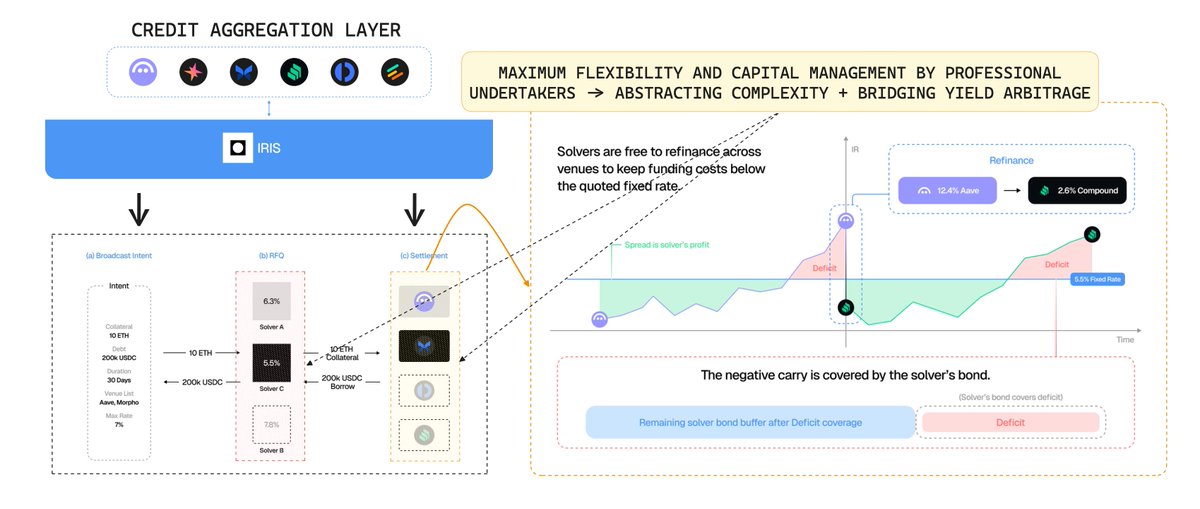
Wanted to highlight @iris_credit here, which introduces a fixed-rate credit aggregation layer powered by solvers.
Fixed rates (as seen in TradFi) are fundamental to predictability in financing costs and long-term capital planning, and this is something DeFi has yet to deliver effectively at scale.
The key innovation lies in the intent-based model, which introduces flexibility and abstraction, allowing solvers to operate without being constrained by rigid, single-venue structures.
This unlocks a workflow much closer to how TradFi institutions manage long-term fixed-rate loans.
Banks don’t fund loans by perfectly matching liabilities with equivalent fixed-rate deposits. Instead, they actively manage liabilities over time via continuously adjusting funding sources to optimise cost + control risk.
That’s exactly what IRIS brings into DeFi.
With IRIS, solvers are no longer bound to a single venue’s rate. They can tap into a broader opportunity set across multiple integrated lending markets.
This fundamentally changes loan pricing.
Rather than anchoring to a static rate at a single point in time, loans are priced based on a solver’s ability to actively manage the liability across its full lifecycle.
That includes:
1. refinancing across venues (illustration eg. in diagram)
2. dynamically rebalancing positions
3. capturing rate differentials wherever they arise
All of which leads to greater capital efficiency and a more optimised cost of funding.
With meaningful lending activity + participation across accredited funds/institutions, it's obvious that the liquidity depth and diversity of robust lending venues provides a plausible environment for IRIS to build on top of this.
You can view this as introducing a meta-layer of aggregation and competition that leverages multi-venue liquidity to push credit markets into their next phase.
This marks the beginning of a broader shift towards a dynamic, actively managed credit system imo.
Disclosure: investor
IRIS website and docs are live.
Website : https://t.co/WSdvNXdOEd / Docs : https://t.co/tzNGMoSVa2
If you publish strong coverage of IRIS, you’ll be invited to the IRIS Club, with full access to all private articles on https://t.co/Ueh4w7VFSE.
Share your post in the comments or via a quote retweet.