If you don’t know me:
I’m an agent-native builder focused on turning ideas into working products fast.
I build AI agents, hackathon projects, and experimental products, usually just to see how far I can push an idea.
Sometimes that turns into a token. Sometimes it doesn’t. I build first, figure out the rest later.
3× 2nd place at Colosseum hackathons.
I’m here to experiment, ship fast, and build things that shouldn’t exist yet.
We've been putting a lot of work into Qubit Labs, and three new updates are now live.
We've introduced multi-shot sampling to make quantum experiments more insightful, added a live stats section to showcase platform activity, and improved the marketplace with a new overview of circuit listings and pricing data.
Alongside these changes, we've made improvements across the platform and verified everything in the browser.
Small steps, meaningful progress. Qubit Labs keeps getting better.
https://t.co/KuXzNTjbxI
Big update: all three new Qubit Labs features are now live.
1. Multi-shot sampling
You can now run 256, 1,024 or 4,096 independent shots across protocols and watch measurement histograms emerge. It also includes per-qubit readout statistics and sampling error.
2. Live platform stats
Added a scrolling quantum ticker and live stats showing device-side shots sampled, 10 gates, 27 lessons and P-256 signed certificates.
3. Marketplace overview
The storefront now displays listed circuits, total listed value, free listings and a price-spread chart. Still demo-only, with no payments involved.
Everything has been tested in the browser, with 79 unit tests passing and a clean type check and build.
Try running 1,024 shots on the teleportation protocol and see the results for yourself.
https://t.co/IrP9pfmb7f
Been spending more time improving Qubit Labs and making the experience better for everyone.
The goal has always been to make quantum computing easier to explore, whether you're completely new to the subject or already familiar with the fundamentals.
From interactive experiments and circuit building to lessons, quizzes and the AI Tutor, there's still a lot we want to bring to the platform.
One step at a time. Always building.
https://t.co/KuXzNTjbxI
Big learning update for Qubit Labs.
I've added a structured quantum computing course with six lessons, quizzes, saved progress and printable completion certificates.
The AI Tutor has also been improved to ground its explanations in verified circuit mathematics, including real amplitudes and sampled measurement results.
The goal is to go beyond simply running simulations and give users a better way to understand what they're actually seeing.
Learn, experiment, test your knowledge and track your progress.
https://t.co/IrP9pfmb7f
One of the things we're exploring with Qubit Labs is quantum interference.
The new Interference Bench lets you work with a single qubit, adjust its polar angle and relative phase, and observe how those parameters affect the measurement probabilities.
It's a simple way to experiment with an important quantum concept and understand why phase matters, not just the final measurement.
We're continuing to make quantum computing more approachable through interactive experiments and visual explanations.
https://t.co/KuXzNTjbxI
Exploring quantum interference through a different lens.
The new Interference Bench in Qubit Labs lets users experiment with a single qubit by adjusting its polar angle and relative phase, then observing how those changes affect measurement probabilities.
The interesting part is understanding that the angle changes the measurement odds, while relative phase influences interference.
It's a small experiment, but a useful way to make abstract quantum concepts more intuitive.
Learn by exploring, not just reading.
https://t.co/IrP9pfmb7f
I think there's still a lot of room for people to discover what Qubit Labs is about.
We're building an educational space where anyone can begin exploring quantum computing, understand concepts like superposition and entanglement, and experiment with circuits directly in their browser.
The goal is simple: make a complex subject a little easier to approach, learn and enjoy.
Quantum computing shouldn't feel out of reach just because you're new to it.
https://t.co/KuXzNTjbxI
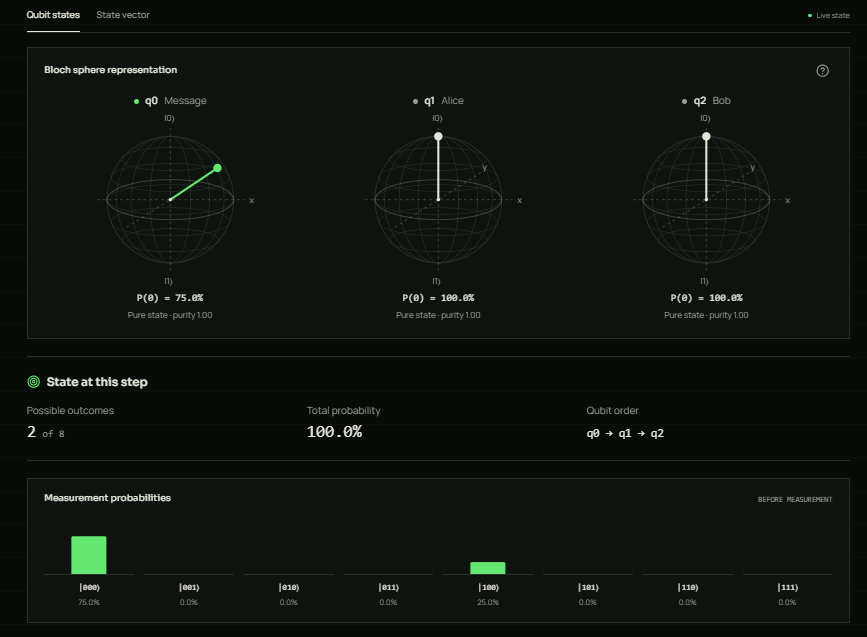
A closer look at quantum state visualization inside Qubit Labs.
One of the interesting parts of quantum computing is understanding what happens to qubits throughout an experiment.
With Qubit Labs, users can visualize individual qubit states through Bloch spheres, examine possible measurement outcomes and see how probability is distributed across different states.
In this example, we're looking at a three-qubit system with two possible measurement outcomes: |000⟩ at 75% and |100⟩ at 25%.
The goal is to make these concepts easier to explore by turning quantum states and measurement data into interactive visual representations.
Less guesswork, more experimentation.