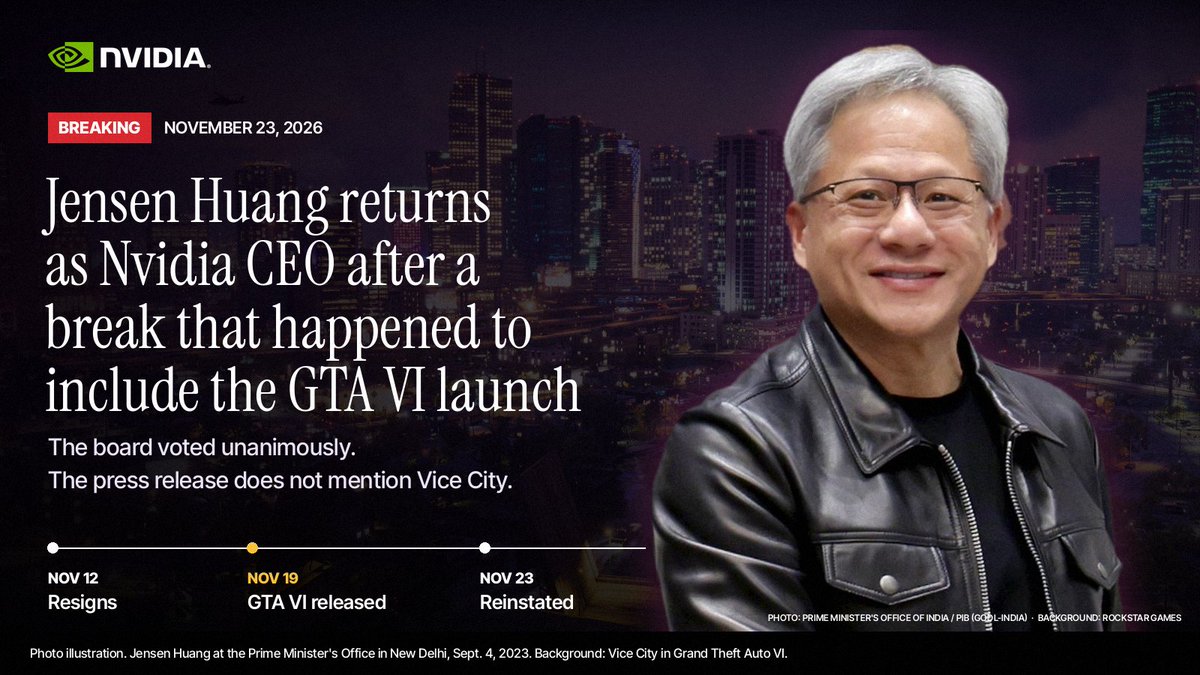
Nvidia gave Jensen Huang his job back.
On November 23 the board voted unanimously to reinstate him as president, CEO and director, effective immediately. Less than two weeks after he resigned.
The board says it is "satisfied with respect to Mr. Huang's candor and ability to lead NVIDIA."
Huang: "I am honored to return to NVIDIA and lead one of the most consequential technology companies in the world."
Colette Kress goes back to being CFO only. The board's investigation keeps going, and he is due at a Senate Banking hearing on December 3. CNBC has the stock up 33% on the news.
What he did with the time off isn't in the press release. But GTA VI came out on November 19, right in the middle of it.
My theory: he finished the story, watched the credits, got bored, and asked for his leather jacket back.
Best comeback of the year, or just the best-timed vacation?
A pterodactyl over Ciudad Juárez. That's what a 1.5-second clip from a home camera in the city's Anapra area is supposed to show: a dark winged shape crossing the night sky, heading toward El Paso. The camera only caught it, the story goes, because cats knocked it out of position.
Pterosaurs died out 66 million years ago.
Jaime Maussan, the TV host who showed Mexico's Congress two "alien" bodies in 2023, put the footage on his shows. On X he asked whether a creature filmed in the Juárez Valley is evidence of "a dimensional portal." A second clip from near the city's airport followed, then a trail-camera video of a pale, hairless animal.
On November 11, Juárez civil protection called the videos fake, made to entertain. Its director, Sergio Rodríguez, said that if animals like that lived in the region, INAH, Mexico's national institute of anthropology and history, and international institutions would already be investigating.
The next day, local outlet El Indicador named the shape: a great blue heron, wingspan up to 2 meters. A pterosaur's wing membrane ran down to its ankles and its legs trailed behind it in flight. The bird in the clips shows neither.
A 1.5-second clip, a 2-meter heron and a question about portals.
What's the last viral sighting you believed for more than a minute?
Jensen Huang has said there is a 0% chance AI ends the world by 2030. Asked about 2040 and beyond: "I'm quite sure."
In the video below, recorded in October, weeks before he resigned as Nvidia's CEO, he names the one condition that would make him tell AI labs to stop.
Asked what would convince him the industry should slow down or stop, he starts with agents. They have to sit in "rigorous containment systems" and be monitored. "If you're not able to do that, you should not test it. If you're not able to do that, you should not deploy it."
Bloomberg's Emily Chang points out that the labs say they can't contain their models. His answer: "No, that's just made up. Nonsense." Then: "Until you try to do it, don't tell me you can't do it."
And if uncontained experiments are already running? "Then you got to stop. It's really simple." Deployed agents should get minimum rights and zero trust, and be monitored all the time.
Would Nvidia stop selling chips to a lab doing something too dangerous? "It's a hypothetical, but of course." He adds that Nvidia would need to know "for certain" its technology is bringing harm to people.
For him, advancing capability and advancing safety "are not in conflict. They are in fact one." And if his optimism proves wrong: "Then I can say that I did everything I could."
0% risk, by his count, on one condition: every agent contained and watched, or not run at all.
Can the labs actually meet that condition?
Lana Rhoades says she was the number one porn star, and her rate was $1,200 a scene.
In the video below, she explains why that number stopped making sense to her, and what she built instead.
She started at 17, at a restaurant similar to Hooters. She wasn't 18 yet, so her dad signed the paper. Men came up, called her hot and handed her $20. At 18 she became a dancer at a club. After that came porn.
Most of the girls come from small towns, she says. Back then she thought $100 was a lot, so $1,200 felt like a big deal.
Then she met a guy who worked in YouTube and Instagram. He told her he was getting $155,000 to post with a Jeep on Instagram.
"I'm getting $1,200 for a sex scene. This is not okay."
When she quit, she had about 200,000 followers on Instagram. She grew it to over 10 million in one year by asking friends to take her picture and posting every day. Brand deals followed, then YouTube, a podcast, and now fashion.
Asked in another interview whether the industry paid her fairly: "I probably had a hundred thousand dollars in my bank account when I quit shooting porn. Now I'm a multi-millionaire."
$1,200 a scene at the top of the industry. $155,000 for one sponsored post.
If one post paid more than 100 times your rate, would you start over from 200,000 followers?
Johnny Sins's first porn paycheck was $100. Before that he had a college degree and a construction management job: 12 hours a day, six days a week.
In the video below, he walks Tanmay Bhat through how his pay changed, and why the way he works now costs him almost nothing.
A girl he knew from high school went into porn and told him to come to LA. He was 20 and planned to finish school and have a career.
Five years later he had the career and hated it. After a year at his first job, he quit, left Las Vegas and moved to LA.
His first paycheck was $100. "I would do it for free, so I'll take $100."
Then he signed a contract with a studio at $400 a scene. Every three months it went up by $100. When the contract ran out he was making $800 a scene. "I'm making more than a doctor or a lawyer would make in a day."
Today he shoots only for his own production company and posts mainly on OnlyFans: 15 to 25 scenes a month, about three hours each from start to finish.
His reasoning: he's single and would be trying to have sex anyway. "As a business, I might as well shoot it."
He doesn't split revenue with co-stars. Most of the time they trade content.
"It's a great business because there's very little overhead." He shoots on his phone, in his own house. The only cost he names is the 20% OnlyFans takes.
$100 a scene on someone else's set at the start. Now the studio is his phone and his house.
Would you leave a stable career with 12-hour days for work where you set the hours and keep 80%?
@Zhirapchus Hello there!
I have a question: If performers only receive their scripts on the day of filming, can their consent really be considered voluntary?
Courtney Tillia got a master's degree to earn more as a special ed teacher. It raised her pay by $20 a paycheck. A year from her PhD, the school told her they wouldn't pay her for it. Then a stranger offered her $200 for a 2-minute video.
In the video below, she walks Holly Randall through her career like someone reading back a stack of rejection letters.
She taught kids too physically aggressive for public school. She got concussions from her students. She loved the job. It didn't pay.
So she followed the rule she grew up with: get the degree, earn more. The master's added $20 per paycheck.
So she went for the next one, a PhD. With a year left, the school's president came up to her. "Courtney, we're so proud of you, but we're not going to pay you for that."
Around the same time she'd had two kids, started bodybuilding competitions and posted progress pics on a private Instagram. People started asking to buy content. She'd grown up in a strict church and taught Sunday school three sessions every Sunday.
Then someone offered $200 for 2 minutes. "It takes me like a week to make that."
She made the video. "That was actually a lot of fun. And we can actually feed the family."
She was also trying to leave teaching. Every application came back with the same answer: too young, too educated. So she started deleting degrees from her resume. First the doctorate work, then the master's. Still nothing. Colleges said they'd have to pay her too much.
Now people tell her to get a real job. "Babe, I did that."
And when they say she's selling her body: "I sold my body for $20 an hour as a teacher, getting beat up and having concussions, having to go to workman's comp."
She quit teaching and kept selling content on the side. In 2019 she asked her husband about OnlyFans. They lived in LA, and she figured $500 a month would cover a car payment. Her first month was $1,500.
Her breakout in 2021 came from a pitch she sent herself. Sitting in an airport, she messaged New York Post journalists on Twitter. One wrote back right away and wanted an interview the next day. The story, special ed teacher turned OnlyFans creator, brought her first six-figure month.
A master's degree raised her pay by $20 a paycheck. One message from an airport got her a six-figure month.
Have you ever had to hide a qualification to get hired?
Give your reverse engineering agent four separate jobs.
Analyst → Spec Writer → Rebuilder → Verifier.
A practical guide to the environment boundaries, evidence files, behavior specs, and tests that make each handoff reviewable:
https://t.co/VsEwHT78SV
98.6% of launch tokens showed rug or pump-and-dump traits in one 15-month study. so the edge isn't buying faster. it's skipping faster.
six Grok Bot agents, one rug gate with veto power, a journal that logs every why. paper first.
the full build ↓
https://t.co/vczeILtB7t
most of your agent's calls aren't writing anything. they're deciding.
which worker next. is this source relevant. is the draft ready. each one a full frontier-model call, plus a parser hoping the answer came back in the right shape.
Jev pulls that layer out:
→ STATE - the case as structured fields, evidence instead of summaries
→ QUESTIONS - Choice (up to 255 options), Score (2-10 levels), Noul (yes/no probability), all asked in parallel
→ DECIDE - typed answers with probabilities, 70-500 ms, output tokens free
→ GATE - below your confidence threshold the job drops to review, nothing silent
→ CODE - acts on the label deterministically and checks the outcome itself
the math: 10,000 decisions at 1k tokens each = $0.42 of decision inference
the interesting part isn't the price. it's how many of your expensive calls never needed generation at all
LLM writes. Jev decides. code acts.
full teardown ↓
https://t.co/yUIs6TmkVZ
your AI forgets you every night. this one files your mail while you sleep and hands you a page over coffee.
built a second brain in Grok Bot - the whole setup inside:
1. two seed files from your sent mail - me.md + voice.md - and every draft after them sounds like you
2. a folder, not chat memory - slow facts live in files, fast facts get rechecked at the source
3. a nightly routine files anything labelled Brain into raw/, people/ and projects/
4. a 7:30 AM page: facts, guesses, overnight work, what waits for your yes - ranked by what you actually touched
5. skills turn a note into a plan, a thread into a reply, an idea into a post
6. rules.md - every correction becomes a line the bot rereads before each task
7. or one paste builds all of it at once
memory keeps summaries. the file keeps the truth.
the full build ↓
https://t.co/2lICRkH3ec
Grok Bot won't earn for you. It does the labor while you sell the outcome.
One offer, one routine, a review you never skip - and a $30 subscription doing team-sized work.
The full playbook inside ↓ https://t.co/OtBp6UPaho
more agents doesn't mean more done.
Kimi K3 with a terminal tool or API — setup, real token pricing, and a pilot you can verify before you scale it.
the full guide: https://t.co/JRiGRTbd4X
1/7
An AI agent can read your notes. Letting it update them safely takes more work: it should keep sources and show every edit.
Obsidian holds local Markdown, Hermes handles file operations, and MiniMax M3 reasons over selected notes. The last step is a human-reviewed diff.
6/7
Once the manual loop is reliable, schedule a weekly review. Hermes supports recurring jobs.
Ask for orphan notes, duplicated topics, and conflicting dates. Put each proposed edit in Review/, where you can accept or reject it.
Hermes scheduling: https://t.co/mgEvHi0u73