The 3-minute $SOL prediction game on @FIH_USD1 is lowkey addictive 😅
Pick UP, DOWN or FLAT, earn points either way, and keep stacking your score for future rewards.
Simple concept, but I've found myself checking back every few minutes.
Anyone else farming points yet? 🐠
#FIHiscalling
Been spending some time on the @FIH_USD1 Prediction board lately and I didn't expect it to be this entertaining.
Every 3 minutes, a new round opens where you predict whether $SOL will go UP, DOWN or stay FLAT.
The catch is that your choice gets locked in during the final 10 seconds, which makes each round a bit more exciting.
What makes it worth playing is that you earn points either way:
🏆 Win = 3 points
🎯 Lose = 1 point
So even if your prediction misses, you're still accumulating points that could be useful when rewards arrive in the future.
I've honestly been using it as a simple way to pass time while farming points. Curious how everyone else is doing on the leaderboard.
🔗 https://t.co/VIC996OBQb
#FIHiscalling
Most social platforms reward you with likes.
@motiontip rewards you with $MOTION.
$MOTION is building TipFi on Robinhood Chain, turning your activity on X into a real tipping allocation.
The loop is pretty simple:
→ Post about supported communities
→ Motion tracks your activity and scores it
→ Your score determines your tip allocation
→ The protocol burns $MOTION from its treasury
→ You use your allocation to tip creators and communities
The interesting part is the treasury.
~80% of the total $MOTION supply is locked in the protocol, with the treasury designed specifically for burns and tip allocations.
Burns happen every 30 minutes, and the transactions are recorded on-chain.
So your posts aren't just generating engagement.
They're contributing to a system where social activity drives tips, while supply gets burned along the way.
Live on Robinhood Chain.
You post. Motion pays attention.
Happy to collab with @WizardX_0x on The Late Stage Archetypes NFT 🧬
▫️Supply : 2,500
▪️Mint: Aug 18
▫️Price : 0.01 - 0.012 ETH
I secured 4 GTD + 20 Early Mint spots for you 👀
To entry:
🔹 Follow @WizardX_0x & @0xmunem_bro
🔸 Like + RT
🔹 Drop your EVM address
Ends in 48H
Khứa này đúng đen luôn, mới tập chơi lên xuống mà dính vô ngay coin rác đi ngay 95 củ VNĐ.
Bài học rút ra: mới chơi thì phải biết quản lý vốn chứ nghe theo các khầy bà đi lệnh thì chỉ có cái nịt thôi anh em ạ.
Good morning guys
@injective is live on LI .FI.
Users can bridge, swap, and deposit $INJ and native USDC across Injective’s native and EVM environments, with seamless access to over 60 supported chains.
This integration expands cross-chain routes, deepens liquidity access, and strengthens interoperability. LI .FI’s universal liquidity layer optimizes execution across bridges, DEX aggregators, and solvers for improved price, speed, cost, and reliability.
Support is live across the full LI .FI product stack, including API, SDK, Widget, and Intents. Builders can enable direct deposits immediately, with Injective available across more than 1,000 LI. FI powered applications and wallets. An integration with Jumper is coming soon.
More pathways for liquidity to flow into the Injective network.
A limit order changes fixed-rate lending from “take whatever rate exists” into an actual pricing decision.
That distinction matters in TermMax V2.
With market execution, a lender or borrower accepts available liquidity immediately. A limit order does something different: it lets the user define the rate they are willing to transact at and wait for matching liquidity.
@TermMaxFi extends that order model across TermMax markets while unified routing brings market and limit liquidity into the same execution environment.
The consequence is subtle but important. TermMax is not treating a fixed rate as a static number published by an interface. The rate becomes a price that participants can actively quote.
For lenders, that creates control over the yield at which capital is offered. For borrowers, it creates control over the financing cost they are prepared to accept. Neither side has to collapse every decision into immediate execution.
That makes TermMax V2 look less like a conventional lending pool and more like a maturity-based rate marketplace.
Once users can express both time and price preferences, fixed-rate DeFi starts developing an actual interest-rate order book rather than simply another lending APY screen.
You can now get even HIGHER APYs with PT Looping now.
To quote our dev: "we magic magic a bit and all markets have 1 to 2x higher leverage now"
Enjoy 🫡
This is a very insightful analysis of Velvet Capital.
The integration of AI into their multi-chain trading platform sounds truly innovative.
I'm keen to see how their specialized crypto model develops.
Velvet isn’t interesting because it has AI. It’s interesting because AI, trading and multi chain access are starting to become one product.
I started exploring @Velvet_Capital for the trading side.
But after spending time with the platform, I think the bigger story is actually how many pieces they're trying to bring together.
You have a trading interface that spans ecosystems including BNB Chain, Solana, Base, Hyperliquid and Ethereum.
You have Perps.
You have portfolio tools.
You have AI Copilot sitting directly inside the product.
And now Velvet is going one step further by training its own crypto specific model.
That last part changed how I look at the project.
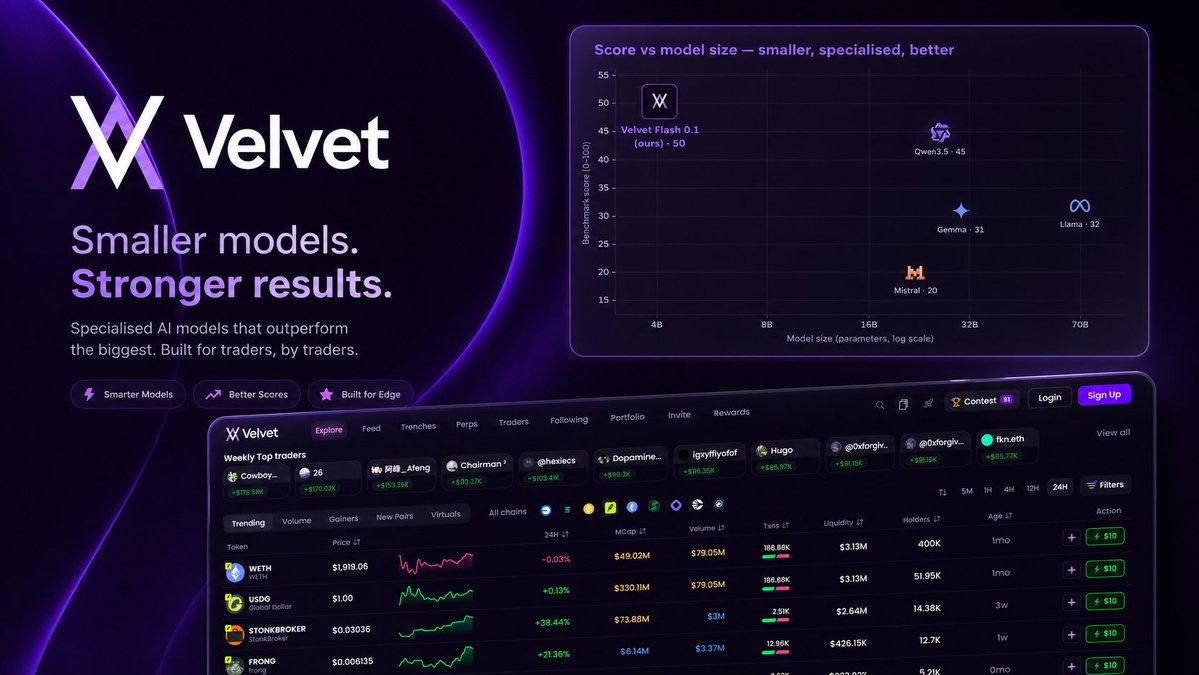
Velvet Flash 0.1 is only a 4B-parameter model, but it isn't trying to be an AI that knows everything.
It's being trained for a much narrower job: crypto operations.
Understanding what a user wants, identifying tokens/chains/addresses correctly, selecting the right command, recognizing risky requests and requiring confirmation before actions involving funds.
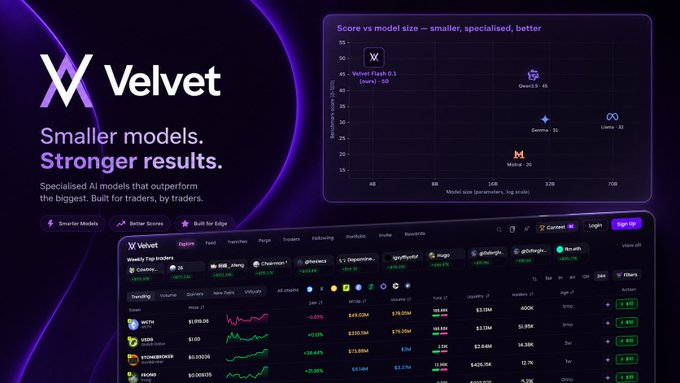
On Velvet's own crypto-skills benchmark, Flash scored 50 versus 23 for its untrained base model.
And the metric I care about even more: safety improved from 28 to 61.
That's important because AI + finance gets interesting only when the AI moves beyond answering questions.
Once you're talking about an assistant interacting with trades and funds, understanding intent correctly and knowing when NOT to act becomes just as important as intelligence.
This is why I think Velvet's different pieces are starting to make more sense together:
🔸Multi-chain access
🔹Trading
🔸Portfolio
🔹AI research
🔸Specialized AI models
🔹Potentially more capable crypto workflows
And then there's the timing.
The Gem leaderboard is approaching its key August 10 moment, when the campaign brief says 2,710,049 velvet:native is set to be distributed, with allocation determined by leaderboard position.
So my final takeaway after exploring Velvet during Amplify S1 isn't “AI will replace traders.”
It's almost the opposite.
The interesting question is whether AI can remove enough friction around research and crypto operations that traders can spend more time on the decisions that actually matter.
Velvet Flash is still 0.1, so there's obviously a long way to go.
But I'm interested in seeing whether Velvet can turn all these individual pieces into one genuinely useful trading workflow.
That's what I'll be watching after the campaign ends.