This post has garnered a lot of attention and I wanted to chime in my 2 cents.
As someone who builds, researches and teaches V4 hooks full time I have seen how malicious hooks can be.
I have also seen how malicious Solidity contracts can be in general. Hooks are no different, they are exploited through poor routing and bad swap settings.
I have worked with the @0xProject team and the @Uniswap team to index a bunch of hooks before. The process is currently quite slow, manual and laborious, but it needs to be.
Upgradable hook? Dangerous.
Dynamic fees? Dangerous.
ReturnDeltas? Dangerous.
But these features are incredibly powerful, and as my best friend Ben used to say: "With great power comes great responsibility, and slow routing".
Hooks have gained massively in popularity and the routing flow has already been improved massively and continues to be a focus for @haydenzadams and the team.
If you need the functionality of hooks, then you have to deal with it and understand it may take a few days and manual effort to index your hook.
If you can't wait and can do what you need without hooks, use V3.
I believe V4 hooks are THE biggest innovation and defi advancement on the blockchain in recent years. @saraareynolds, @saucepoint et al truly crushed.
If anyone has any questions on getting your hooks routed, please reach out to me and I will happily help!
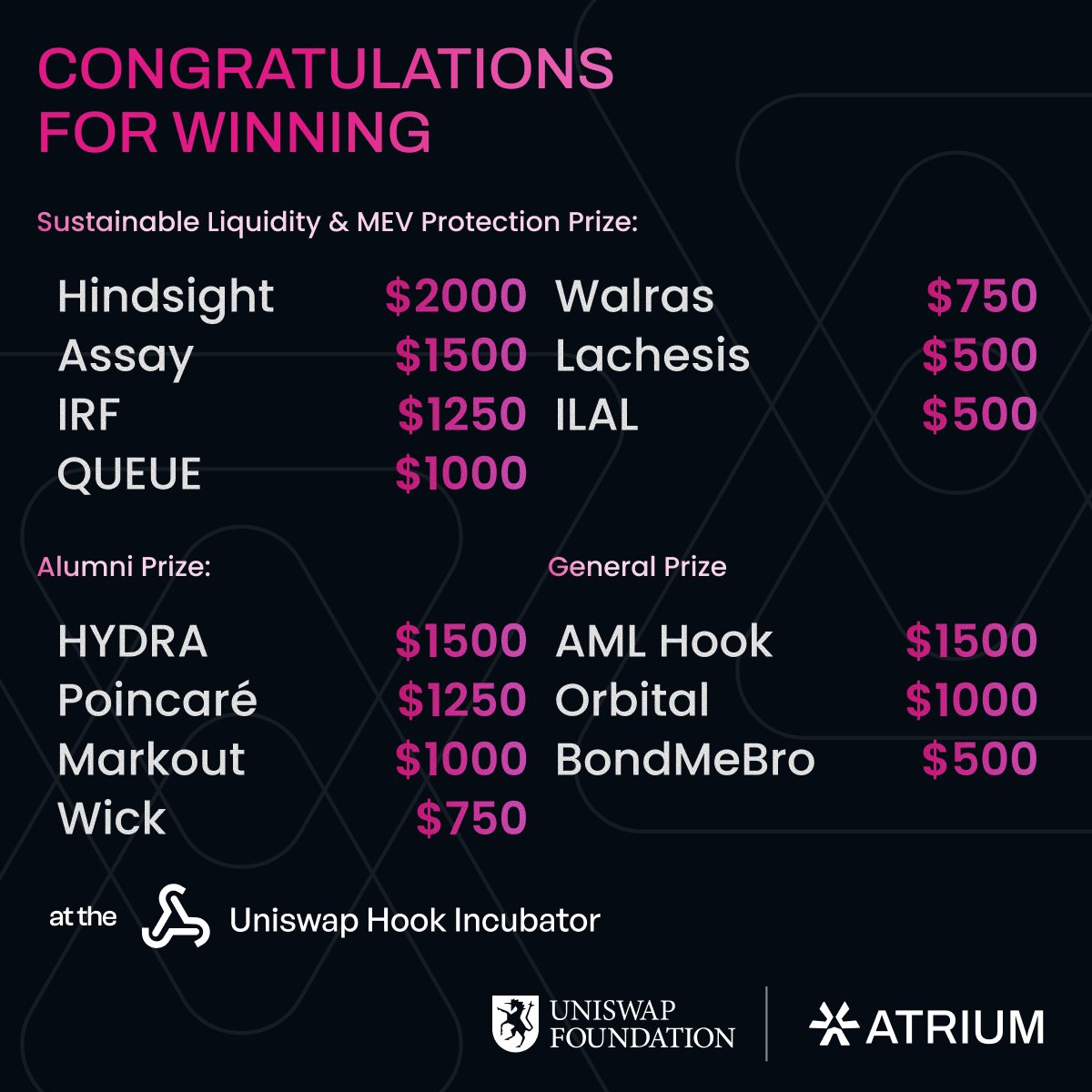
Lachesis is a Uniswap v4 hook for volatile pools that measures each settled swap against an external reference price and charges a configurable share of any stale-price disadvantage to the trade that received it. The proceeds are credited to active LPs, with exact settlement math, a Chainlink adapter, JIT donation protection, router quote support, 92 passing tests, and a live Unichain Sepolia deployment.
• Lachesis: @0xmaues
https://t.co/wIiH4kgByr
Built Ballast for the @arkivnetwork ideathon — a backing attestation registry for synthetic dollar protocols
Morpho & Aave hold billions in $USDe exposure. Risk teams monitor Ethena's centralized dashboard manually.
→ Observer mode: any risk researcher can write attestations day one → Missed attestation epoch = silence = the alert
The data model is the pitch. Three entities, three queries, differentiated expiry as product logic — not compliance checkboxes