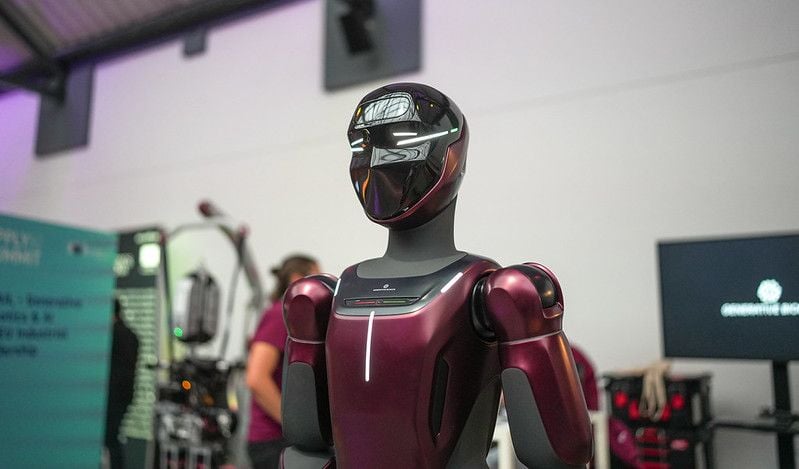
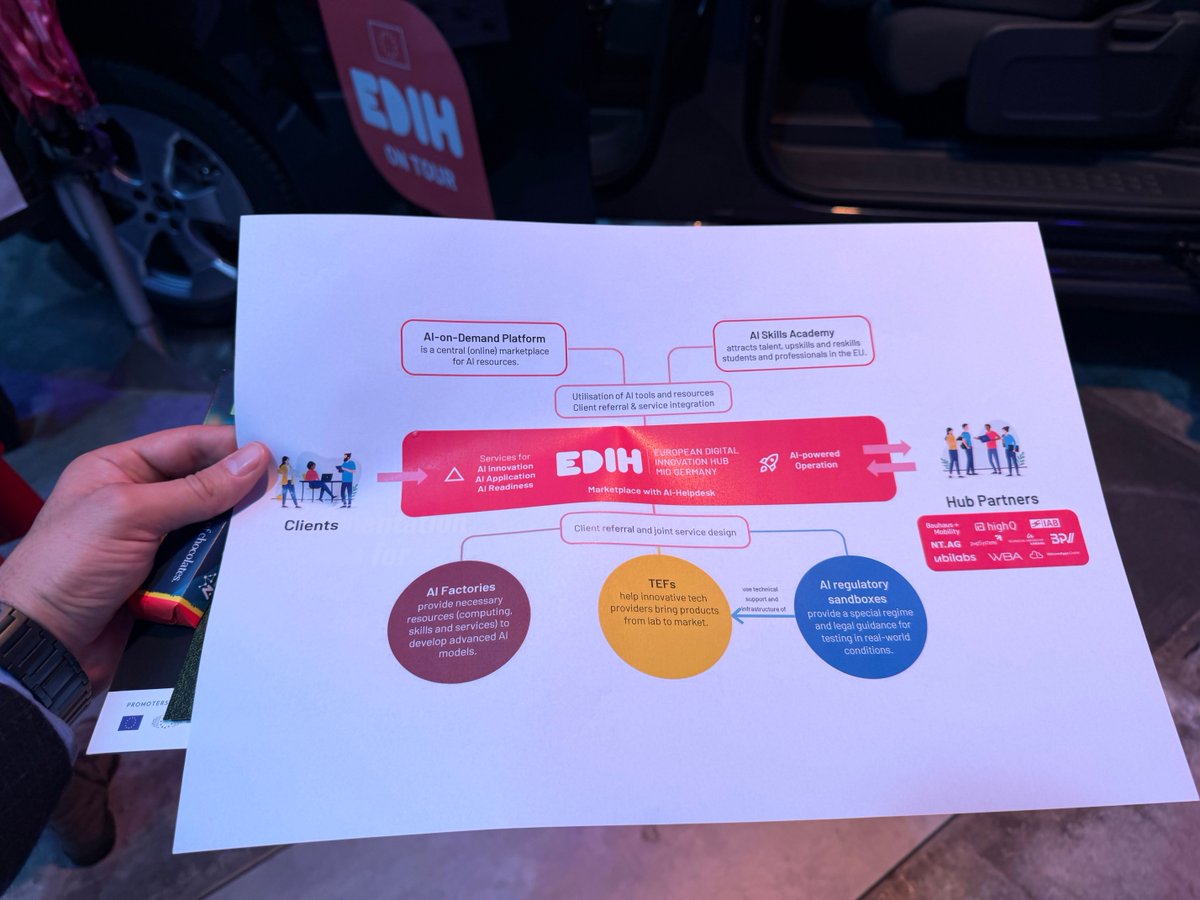
Europe's AI ambition: From developing technology to democratizing it. (Part 2/3)
One of my biggest takeaways from the Apply AI Summit in Brussels was the scale of Europe's efforts to accelerate AI adoption across industries, from robotics and cybersecurity to manufacturing and agriculture.
Some particularly promising initiatives:
• Agrifood EDIC: Shared digital infrastructure and AI services across European countries.
• European Agricultural Data Space: Making agricultural data more accessible, interoperable and reusable.
• Agrifood AI Marketplace: Helping farmers discover and adopt AI solutions.
• AI Factories: Making computing resources more accessible to European innovators.
• Testing and Experimentation Facilities: Supporting real-world technology validation.
When we started developing our AI models at Agcurate, we didn't have access to the agricultural data we needed. So we collected it ourselves.
4-5 years of effort, 150 crop seasons and 10,000 hectares of focused fieldwork, 1M hectares of farmland processed for 5 years consecutively.
Imagine how much faster the next generation of European startups could innovate with access to such resources from day one.
Not every startup should have to build the infrastructure before building the innovation.
In light of these, I genuinely appreciate the direction Europe is taking towards democratizing AI development, commercialization and adoption.
#ApplyAI #Agcurate #AI #EuropeanInnovation #AgriTech
AI in European Agriculture: Are we solving the right problems? (Part 1/2)
Last week, I had the opportunity to represent Agcurate at the Apply AI Summit in Brussels, joining government, European Commission and agricultural industry representatives.
Despite our different perspectives, there was considerable common ground:
• Agricultural data needs to become more accessible, interoperable and reusable.
• Trust must be earned through demonstrable results.
• Technology adoption requires a compelling economic case.
• Public-private collaboration is essential for scaling AI across Europe.
• Bonus: Personally, I always thought a farmer v2 who is not generational but technological, analytical and financially literate will be a subject matter in the not-so-far future. In multiple conversations, including a gentleman's remarks at the end of our panel, I confirmed this repeatedly.
One remark particularly resonated with me: "We need to deliver AI solutions faster than climate change impacts agriculture" You can imagine my enthusiasm when Etienne ACHILLE mentioned it.
During the panel, I emphasised three points that we have learned, sometimes the hard way, at Agcurate:
1. Farmers are not a single customer segment. A cotton producer and a potato grower have fundamentally different operating costs, capital requirements, regulatory pressures and exposure to risk. Technology should adapt to their economics and workflows, not the other way around.
2. Technology adoption is also a financial problem. Insurance, performance guarantees and alternative financing mechanisms deserve greater attention in agricultural innovation.
3. Agriculture needs to become more investable. Greater operational and financial transparency could lower barriers for a new generation of agricultural entrepreneurs.
Reflecting on the discussion afterwards, I believe there were also a few potential blind spots in our collective thinking, including my own:
• Are we paying enough attention to who pays for technology and who ultimately captures its economic value?
• Are we mistaking technological readiness for commercial readiness?
• Can we attract new capital into agricultural production without making access to farmland more expensive?
• Are we expecting AI to solve problems that are fundamentally economic or structural?
These questions deserve as much attention as the technology itself.
At Agcurate, our near-term focus remains very specific: helping food and beverage companies manage their agricultural operations at scale, gain better visibility across their contract farming networks and reduce uncertainty in their agricultural supply chains.
That is where we believe we can make a tangible contribution today while building infrastructure for the future of finance and human capital in the entire industry.
In Part 2, I'll share my personal reflections on a broader challenge: AI adoption, commercialisation and scalability across Europe, beyond agriculture, drawing on my entrepreneurial experience across different technology industries, including cybersecurity and software.
I'd like to take this chance and thank you to organizers among which were (but not limited to) Gabriel Carlin, Doris Marquardt, Franco Accordino,
distinguished participants from the government for communicating the importance of wide adoption of AI and tech in the sector:
- Minister of State for Artificial Intelligence, Digitalization and Trade Promotion of Ireland, Niamh Smyth,
- Minister of Agriculture, Agri-Food and Food Sovereignty of France, Annie Genevard,
fellow panelists for their excellent and visionary remarks:
- Inspector General of Digital Affairs at Ministère de l'Agriculture et de la Souveraineté alimentaire, Etienne ACHILLE,
- Head of Data Governance at European Commission (DG AGRI), Pierluigi Londero,
- Senior Vice President Middle Europe at CLAAS, Dr. Benjamin Schutte,
and a special thanks to the Director for Future Networks at European Commission, Thibaut Kleiner for igniting a genuinely thought-provoking discussion.
#ApplyAI #AgriFood #AgriTech #AI #EuropeanInnovation
A prediction: NVIDIA gets crushed under vicious competition, Jensen gets called back, fires everyone who were afraid of their shadows when firing him, rebuilds NVIDIA.
Next week, on 17th of November, I'll be at ApplyAISummit held by @EU_Commission DGConnect (@DigitalEU) in Brussels.
Representing @agcurate , I've been invited to join as a panel speaker on the session "Scaling and applying AI in the Agri-food sector through systemic actions – Boosting competitiveness, resilience, and innovation".
We will discuss the state of tech adoption in the industry and pan-European marketplace for agritech, shaping ideas around agri-startups and AI.
For an industry as strategic as agriculture, I definitely believe every continent and country should have a sovereign, safe and sector-specific AI, consisting of frontier tech and models, boosting resilience and economic growth across the entire supply chain.
In this sense, the Apply AI Summit marks the first anniversary of the Apply AI Strategy (https://t.co/j0ks4yXz4n) and concludes the European AI Innovation Month. It will bring together high-level policymakers, start-ups and industrial stakeholders to discuss how AI is strengthening Europe’s competitiveness across industries and the public sector. The Summit will focus on sectoral AI applications and success stories made in Europe as well as innovative projects fundamentally contributing to turning Europe into an AI Continent.
Panel Speakers: https://t.co/zW7B7JDpeO
More info: https://t.co/qN4w4KOste.
AI finishes in seconds. Review takes minutes. Measure the full task—including corrections, exceptions and maintenance—before calling it a time saving. Sometimes a narrower automation delivers more value.
https://t.co/zIPAOmjpuu
Your best automation lives in one employee's account. A handover needs more than a workflow export: map ownership, connections, alerts and recovery, then let the new operator prove they can run it.
https://t.co/hRPCMDL7cQ
A second business needs more than a login. Turning an internal tool into SaaS means defining organization boundaries, onboarding, billing and support—and proving two customers can operate independently.
https://t.co/CYfGlgFZ5j
A “small” feature can change permissions, billing and old data. Before debating the estimate, describe the customer outcome and agree on examples that count as finished. Start with the smallest useful version.
https://t.co/TNZ853CcYa
So, now what?
These guys didn’t accept that stupid counter, however:
should we start to think that there is a fund somewhere which actually went ahead and fired for example the minority co-f to get funded?
If so, is there a guarantee that suddenly they won’t decide our team is “too non-EU” and we should hire “EU person with diverse identity” as an executive or co-f?
Day by day I’m inclined to just get popcorn and watch things instead of building smth.
Here's some fuel for all the Europoor haters:
Germany just told us we'd have to fire one of our 3 founders to qualify for funding.
I was in talks with a German state-backed fund of fund managing billions, with one single mandate: invest in German funds to drive innovation and economic growth in the country.
They literally told me they like us a lot and are also impressed by our track record and performance so far, and even though not everyone in their team is a fan of our thesis, they believe in it.
But they passed for a whole different reason:
Because our all-male team of 3 people isn't "diverse enough" lol.
they literally told me: hire two more female partners (impossible on the economics of a fund our size), or let one of the three of us go to make room for a quota hire. do that, and they'd strongly consider investing.
I won't even get into how discriminatory this is toward men in the first place. nobody takes that seriously anyway, and honestly I don't care.
but what actually gets me is something bigger: as a German, I have to face the fact that the whole world continuing to laugh at Germany and overall Europe is completely justified.
a system that quietly kills the smallest, hungriest teams, the exact ones this money was created to support. and then everyone acts surprised that talent and capital keep leaving the country.
You have backups. Could you restore the working app? Rehearse recovery in isolation and check files, sign-in, permissions and background jobs. A successful database import is only one part of the proof.
https://t.co/sPQ4EcUCmu
12 years ago I founded Boom, as a software engineer doing hardware for the first time. I’m probably the least handy founder in hard tech. My 12 y/o son does my soldering and 3D printing for home projects, and I’ve struggled with imposter syndrome the whole way through. What business does a software guy have building supersonic jets and turbines?
More than a decade in, the most insane realization is that software is the key to reaccelerating hardware engineering. But in a way that I don’t think is widely understood or implemented, even in the burgeoning hard tech community.
Most hardware engineering is actually software engineering in disguise. It’s spreadsheet “code,” engineering calculations done as one-offs. Eg wing structural loads in, spar sizing design out. Thermal loads in, air conditioning system sizing out.
Everything is a calculation, and calculation is software. But these calculations are done essentially by hand, as if we are doing arithmetic but have not yet discovered algebra.
Hardware engineers have baby software, built in spreadsheets, the kind of crappy software I wrote as a kid before I understood architecture, unit tests, APIs, version control, and everything else that makes modern software good.
Our airplanes and engines are built with the software sophistication of a script kiddie.
So what we tell our engineers: don’t design the hardware, design the *algorithm* for designing the hardware. And take the algorithm seriously—as an algorithm and as a first-class engineered software system.
Never design a piece of hardware, such that you couldn’t redesign it tomorrow with a different set of assumptions.
This all sounds obvious, yet our experience at Boom is that it changes everything.
Ten years ago we couldn’t afford to build much software. We had a small team—and there were few software engineers with the curiosity, brilliance, and vision required to learn hardware engineering.
But now AI changes the equation. Now everyone can code. The software engineers define the architecture. The hardware people bring the physics and engineering know-how.
We have a turbomachinery design tool that lets one engineer do in realtime what previously took 100 engineers six months. Another tool auto-generates 65% of entire aircraft structure. I’m sure we’ll figure out the other 35% too. Eventually these should not be multiple tools, but one integrated physics model of a complete vehicle, airframe and powertrain.
The results speak for themselves. A boomless supersonic airplane built by 50. A full scale supersonic turbine made by 150. And with this approach, I don’t think we’ll need that many more people to build and certify a supersonic airliner.
You don’t need a big team to build big things—not when everyone on the team is a software engineer.
AI works in the demo but fails for customers? Trace extraction → search → evidence → answer before changing the prompt. Missing source information cannot be fixed by asking the model to “be accurate.”
https://t.co/c7MS3Ozt3m
Measure AI cost per useful result, not just per request. Include failed attempts, retries and human review. A cheaper model call can cost more overall if it creates extra corrections.
https://t.co/MT3Ij5RytF
Two emails, two orders, two charges: different failures. Trace the records before replaying a job. Retries are normal; your app needs to make repeating the same intended action safe.
https://t.co/FQVYA28y3j
A login does not prove customer data is separate. Test permissions with two dummy accounts across records, files, search and exports—including direct server requests. Hidden buttons are not access controls.
https://t.co/7kZhfI2AD3
AI made 10x engineers 100x.
But it also made the false promise of handling everything an engineer does off-the-shelf. Someday we’ll get there or close it but not today.
Today, the product you are building is at most a prototype by the industry standards and once you onboard a couple of users you should seriously start thinking about outsourcing the tech.
Good news is you don’t have to hire anyone or build an in-house team. Bad news is you should still have someone take care of the product and own the tech.
Every fix breaks another feature? Before approving a rewrite, trace the change, map shared dependencies and test the customer journeys around the repair. A working checkout does not prove invoices still work.
https://t.co/mGe3gmIagW
Every fix breaks another feature? Before approving a rewrite, trace the change, map shared dependencies and test the customer journeys around the repair. A working checkout does not prove invoices still work.
https://t.co/mGe3gmIagW
“- Europe is all about building a tech business, with profit forecasts, less invention
- In the Bay, you have to build a startup: something nobody else has
“
US wants to win big, EU wants to lose small. That’s the only difference we need to focus on - everything else is just nuance.