wall street doesn't run on vibes, it runs on math nobody teaches you in school
this is an actual mit lecture on how portfolios get built, mean variance optimization, risk measures, the stuff that decides how much to hold and where
same logic sits under every hedge fund that survived more than a decade, size and diversification beat picking winners every time
the article below covers the other half of the equation, how much to bet once you have an edge
watch this first for how the pros think about risk, then read how they think about sizing ↓
144 AI workers got the same job on one machine and almost all of them died in the same second
most people arguing about graph engineering online have never actually watched a run crash and figured out why
Source → 144 workers → 72 folders, two stages each, first one writes a file, second one can't start until it exists
pacing was the only thing that changed, six at a time instead of all 144 at once, and every single folder came back finished
the crash wasn't a usage limit, it was a burst tripping a temporary rate limit, and anthropic's own docs call this dynamic workflows not graph engineering
a checker that just matches strings handed back a clean report on a file with 82 real problems in it, three readers asking different questions caught 27 of them the string match missed
you're not paying for more work happening at once, you're paying to stop waiting, and the arrow code only gets written once
bookmark this and watch it run, then read the article below
this creator broke loop engineering down into an actual four condition test before you build anything, does the task repeat, is there a clear definition of done, can you afford to be wasteful, does it have the tools it needs
00:00 - Boris Cherny's actual clip explaining why he stopped prompting Claude
02:22 - the four building blocks, trigger, execution skills, goal plus verification, output and memory
04:14 - his one rule, never build a loop without a battle tested skill behind it
05:52 - how he verifies non-technical tasks that can't just be measured with a number
09:16 - loop training mode, the guardrail that pauses every step until you approve it
his line that sums it up, the agent forgets, the repo doesn't
watch the breakdown, then the loop engineering article is right below ↓
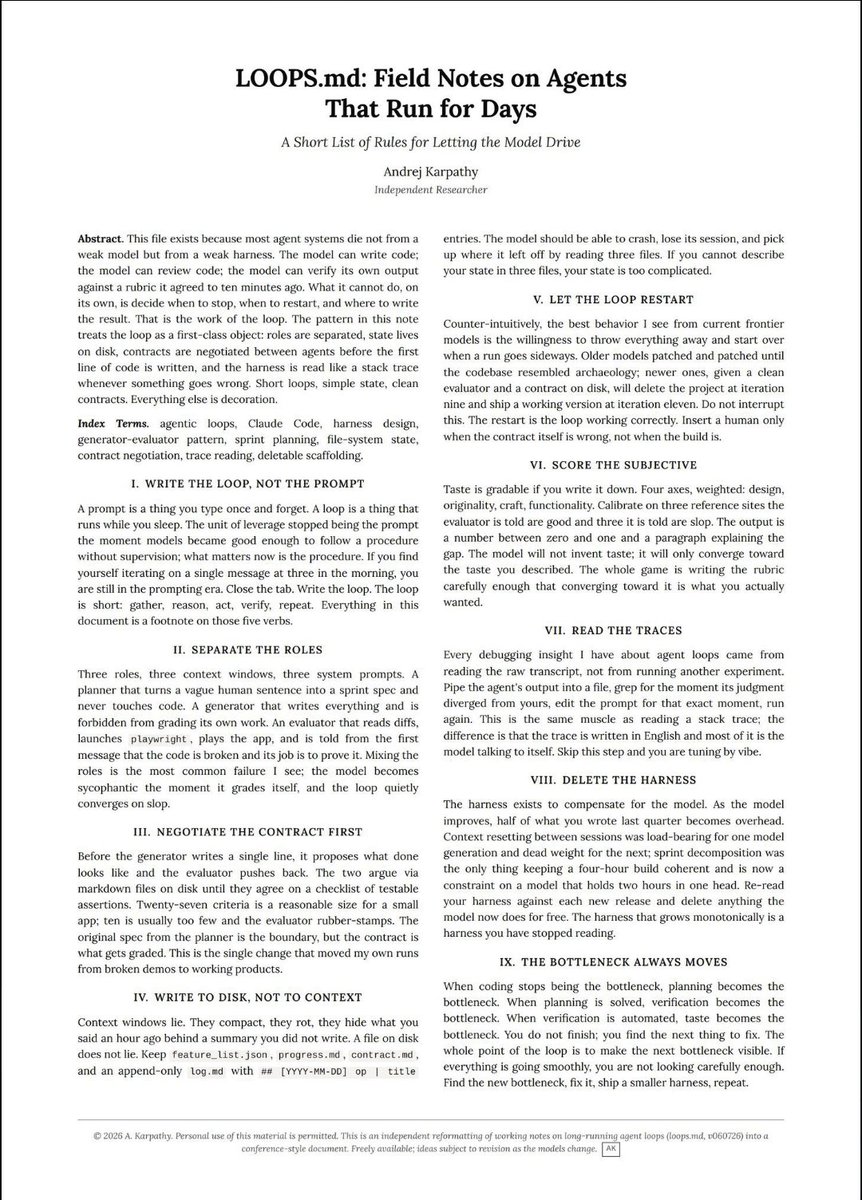
so andrej karpathy just dropped nine rules for building agents that run for days, and one of them will make you rethink how you debug
> most agent systems fail because of a weak harness, not a weak model, the model can already write code, review code, verify its own output
> rule two, separate the roles completely, mixing planner, generator and evaluator is the most common failure, the model gets sycophantic the moment it grades itself
> rule five is the one people push back on, let the loop restart, the best models just throw everything away and start clean instead of patching forever
> rule eight, delete the harness as the model improves, half of what you wrote last quarter becomes dead weight
> his closing point, the bottleneck always moves, solve coding and planning becomes the bottleneck, solve that and verification becomes the bottleneck
like & bookmark this before you write your next agent loop
ANTHROPIC’S FABLE 5 GUIDE HAS A WHOLE SECTION ON MEMORY, THIS IS WHAT IT LOOKS LIKE WHEN SOMEONE ACTUALLY BUILDS ONE
the official guide says fable gets most powerful when it has a persistent memory across sessions, not one that resets every time
one lesson per entry, one line summary, nothing duplicated, nothing kept once it’s wrong
this is the same idea outside of code
daily sky photo, one line of weather, one line of mood, months turning into an actual memory instead of a blur
these models are only as useful as the memory you give them
no memory, just a smart model answering the same question fresh every time ↓
YOUR SECOND BRAIN IS SHAPED LIKE A STAR, AND THAT’S WHY IT KEEPS COLLAPSING
one central thought, everything else wired straight back to it. looks organized. it’s actually the most fragile topology you can build.
kill the hub and the whole structure goes dark, nothing left connects to anything else
I watched a note map switch from centralized to decentralized live, same notes, different wiring, and the difference was not subtle
clusters by topic instead of one root: generative media sitting on its own, artificial life and morphogenesis sitting on its own, cognition and language sitting on its own
no single point of failure, and new ideas just slot into the nearest cluster instead of forcing everything through one node
full breakdown in the article below ↓
Anthropic just walked through the entire infrastructure layer behind autonomous agents in under 14 minutes, no theory fluff, just the framework their enterprise users actually ship with:
00:00 – why the bottleneck moved from model intelligence to infrastructure
01:43 – what changes when agents run for quarters instead of hours, unattended
04:11 – the 3 things developers actually struggle with, context, infra, observability
05:33 – the building blocks, agent, environment, session, events
10:40 – outcomes, memory, dreaming, and the safeguards that make autonomy safe to ship
this full breakdown is the actual fix, mapped stage by stage across the whole agent lifecycle Anthropic built to run this in production
watch it today, then read the 14 step roadmap for how to actually build and ship a self-improving agent system yourself in the article above ↓
A creator just mapped the entire concept of AI agents that run themselves in under 9 minutes, no theory fluff, just the framework real builders use to ship:
00:00 – why prompt engineering and context engineering aren't enough anymore
01:07 – the anatomy of a loop, trigger, act, verify, remember, stop
02:14 – the 3 loop types, cron, hook, and goal, and why goal loops are the most dangerous
04:34 – the verifier, memory, and the 4 safeguards that make autonomy safe to ship
most people think a longer prompt or babysitting the agent turn by turn is the fix and wonder why nothing runs while they're away
this full breakdown is the actual fix, mapped stage by stage across the whole loop lifecycle
watch it today, then read the 20 step roadmap for how to actually build and ship this yourself in the article above ↓