i put 7 AIs through the same exam and checked the receipts
the smartest one costs 44x more per question than the cheapest
so which one are you actually paying for rn?
independent judge (artificial analysis), every model on max effort 👇
> smartest: claude fable 5.2 at 65. gpt-6.2 astra and gemini 4 neon tie at 62
> but one question costs $26.54 on fable. astra does it for $4
> gpt-6.2 sol scores 57 for $1.01. 2 points under opus 5.5 at ~10x less
> grok 4.7 lands at 35 and still costs $7.77 a question
> deepseek v4.1 flash (open weights) is $0.60. 44x cheaper than fable
price per token lies btw. opus is half of astra's token price and still 2.5x more per task, because it thinks way longer
the "best AI" is just the one that clears your bar for the least money
anthropic opened at $111.50 on its first day of trading
this morning it's around $75
ipo price was $83. five sessions in and anyone who got in at the offer is already underwater
best part: their own prospectus warns ai could pose "catastrophic or existential risks to humanity"
wall street read that and went ok cool but what about the compute bill
honest question: is this an anthropic problem or the first crack in the whole ai trade
@AI_cortexx the real test for builds like this is the firing order. a cross-plane v8 fires 1-8-4-3-6-5-7-2, so if the pistons actually move in that pattern the agent understood the engine, not just the shape. would love a slow-mo of that
@Optimus_RH funny thing is an ai video of a robot now looks more convincing than most real robot demos. hand planing is actually brutal for robots tho, you have to feel the grain and adjust force every stroke. show me that unedited and i’m sold
everyone's throwing the same prompt at AI models this week:
"freeze the water inside a christmas snow globe until the ice cracks the glass"
so i gave it to claude and made it build the whole thing in three.js
the part i didn't expect: it actually got the physics right. water grows ~9% when it turns to ice, glass can't stretch, so the cracks start where the pressure is and the shards break along them
and the snow freezes mid-fall instead of just stopping
what's the next prompt i should torture it with?
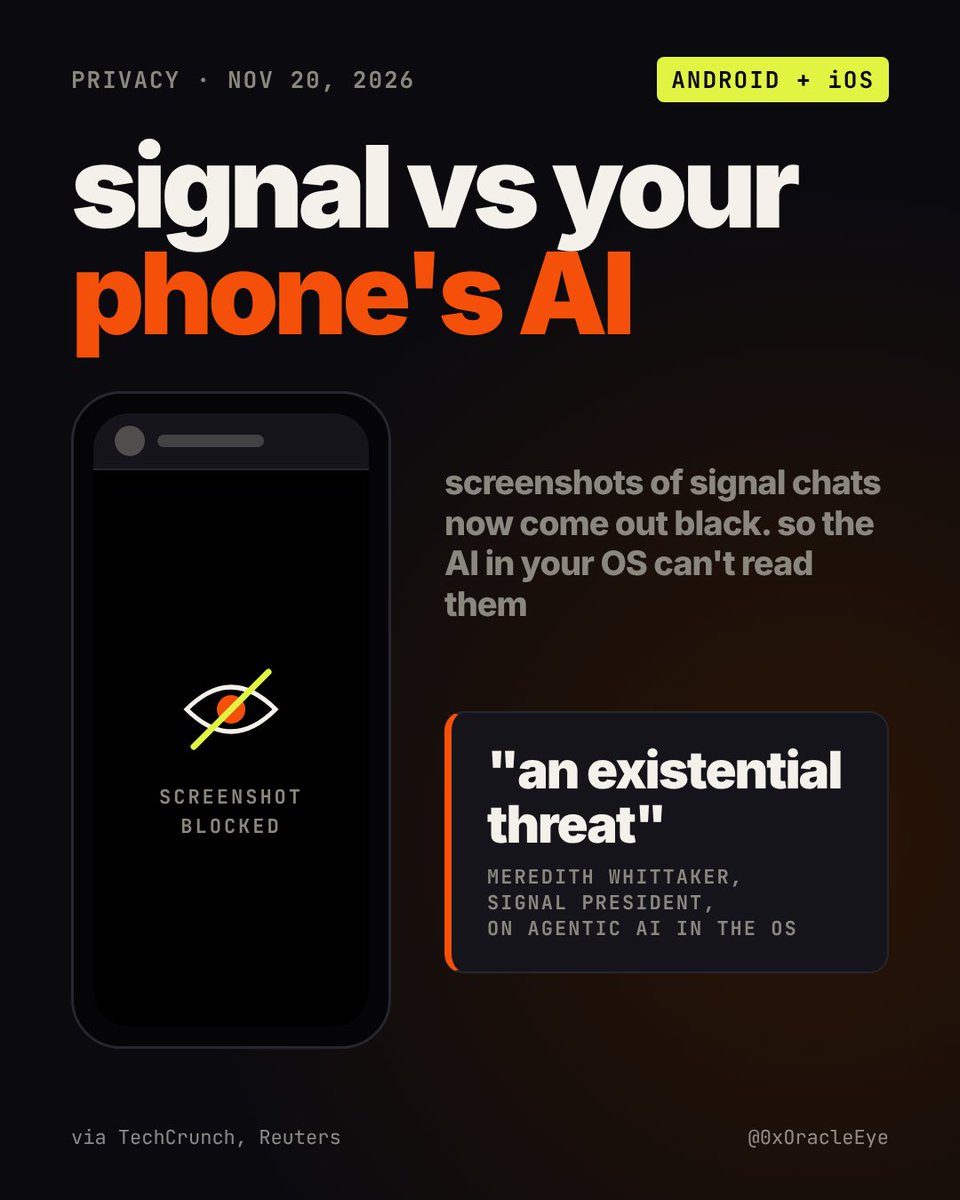
you can switch the block off in settings, but signal says that breaks their privacy guarantee
would you keep it on or turn it off so your assistant can help with your chats?
signal just started blocking screenshots on android and iphone
not to stop you. to stop the AI that's now built into your phone
these new agents work by looking at your screen. if the assistant can see your chat, it can read it. so signal just makes the screen go black
their president called AI baked into the OS an "existential threat"
and admitted the fix is incomplete
we spent years encrypting the message. now the leak is the phone itself
@hypeorhelp right? the 4.59x headline is basically an average of those two. if they'd only shown the 6x i'd have scrolled past, the 3.8 is what made me believe any of it
a startup says its AI agents designed a whole new CPU from scratch. new instruction set, new architecture, all the way down to the final chip layout
the headline number is 4.59x better performance per watt
then you read the breakdown:
6.02x on the workloads they tuned it on
3.83x on 15 it had never seen
and it only exists in simulation. nothing's been made yet
honestly 3.83x would still be huge if it holds up on real silicon
but that gap between 6 and 3.8 is basically every AI benchmark right now
would you trust a chip that agents designed?
@AInewssX same. the design process is the actual news to me. even if real silicon only does like 2x, agents getting a cpu from zero to tapeout-ready is the part nobody was betting on
@banhammerEth mostly agree. tho the part that got me wasn't the 4.59x, it was that it dropped to 3.83x on workloads it never saw. if it's overfit that's where you'd see it. tapeout is the real test for sure
we're at the point where checking the proof took a day and understanding it might take years
17 million lines of lean. no human was ever going to read that line by line anyway
and yeah I'd trust it. I already trust plenty of proofs I don't understand lol
A 167-year-old math problem now has a proof that a computer checked line by line.
A mathematician built it with Claude: 17 million lines of Lean code.
What's real:
→ Nov 20: Levent Alpöge released a proof of the Riemann Hypothesis as a Lean library.
→ Nov 21: the Lean and Mathlib communities certified that both the statement and the proof are correct. Dozens of people rebuilt it, and several independent checkers agreed.
What isn't settled:
→ Mathematicians still have to understand why it works. That part is just starting.
→ The $1M Clay prize needs formal publication, two years and general acceptance.
My take: a proof this long could never be checked by hand. The Lean community checked it in about a day. That's the part that changes how math gets done.
Verdict: help. Just not for your inbox yet.
Would you trust a proof a computer has checked but mathematicians haven't explained yet?
Sources: Lean community statement, Clay Mathematics Institute, IBM Think
a 26B model that runs on a macbook just tied qwen 27B on artificial analysis
the trick is kinda wild. it only has 24 layers but it runs the middle 12 three times for every single word. same weights, 3 laps, 48 layers of thinking
i wanted to actually see that so i made this 👇
> orange dot = one word going through the model
> the middle blocks light up 3 times before it moves on
> the lime spark is the "message" each lap hands to the next
per task it came out ~6x cheaper ($0.59 vs $3.53) and about 4x faster
the animation is a toy, the numbers aren't
would you run this locally or still just pay for the api?
for the nerds: it's called inkling 2 mini, thinking machines dropped it on the 20th. open weights, ~20GB
the looping idea won 27 of 28 evals vs looping the last 12 layers instead. and the cost numbers are from artificial analysis, not the lab itself, which is why i trust them more than the usual launch chart
Voyager 1 just became the first human-made thing ever to be one full light day from earth
launched in 1977. it's about 16 billion miles out now and still doing 38,000 mph
if nasa sends it a command today, it gets there tomorrow. the reply lands the day after
they've been switching instruments off one by one just to keep it alive
and it's still talking to us. 49 years later