You didn’t just spend money this year. You gave away thousands of data points.
As 2025 comes to an end, most people measure their year in spending: holidays, subscriptions, travel, groceries, upgrades. But money wasn’t the only thing exchanged.
Every purchase quietly created a trail: what you buy, when you buy it, how often, from where, at what value, and alongside what other items. Individually, each data point seems harmless. Together, they form a behavioral map of who you are, what you value, where you go, and how you live.
These insights don’t just disappear when the transaction clears. They’re packaged, analyzed, sold, shared, and retained, sometimes forever.
Credit agencies, advertisers, insurers, data brokers, risk engines, retailers, many of them know more about your habits than your closest friends.
What’s paradoxical is that the system doesn’t need all of this information to function.
The payment just needed confirmation, the merchant just needed settlement.
Everything beyond that is excess.
The next evolution of financial infrastructure won’t be about collecting better data,
it will be about collecting less of it.
Proving that a payment happened without attaching a lifetime of context to it & allowing commerce to move at full speed without turning every moment into permanent metadata.
Because in a digital world, privacy isn’t just about secrecy.
It’s about being able to live without being archived.
Congratulations & thank you to everyone who supported this launch 🙏
It marks the start of a new era, not just for Aleo, but for the entire industry.
Why is this different from other USDCx integrations? 🧵👇
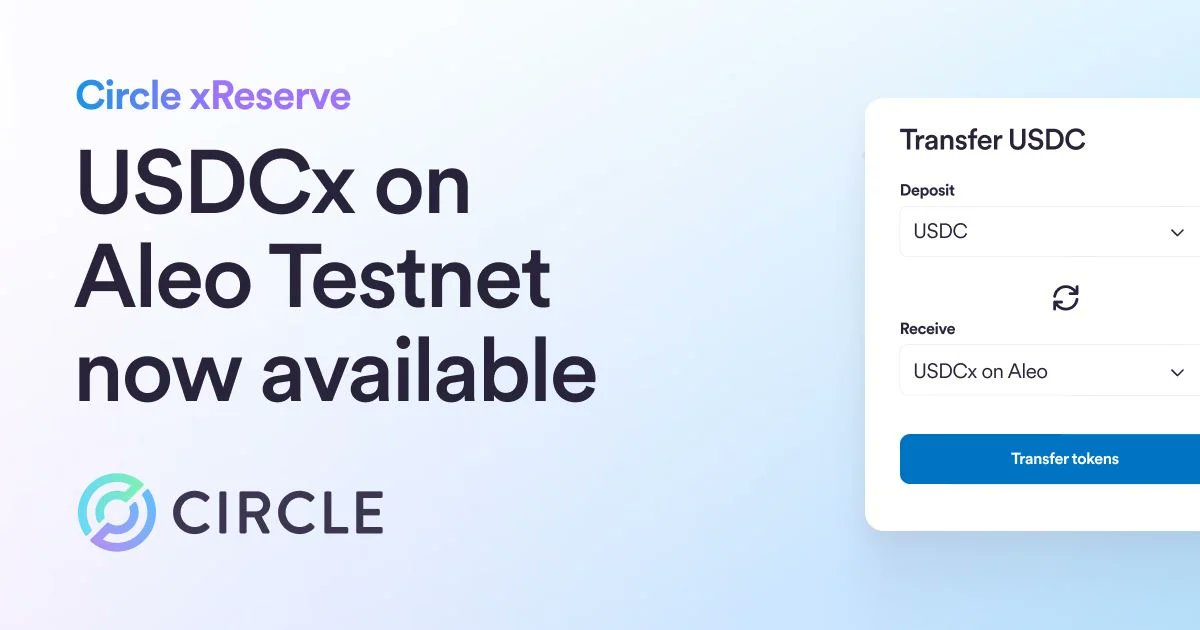
Aleo has launched USDCx on Aleo Testnet via Circle xReserve, a USDC-backed stablecoin for its privacy-first blockchain infrastructure.
USDCx on @AleoHQ enables a range of use cases including global payroll, critical aid distribution, global e-commerce, P2P payments & remittances, DeFi, and configurable compliance.
Key benefits:
→ USDCx on Aleo is 1:1 backed by USDC held in xReserve
→ Fully interoperable with USDC across supported chains
→ Trust minimized with no third-party bridges required
https://t.co/A2jPohzyJc
While I think Bitcoin will go to the 200W SMA ($60k-$70k) in 2026, there is a high probability it will have a bounce back to the 200D SMA before going that low.
All prior cycle bear markets were confirmed by a macro lower high at the 200D SMA.
I don't know what's the most retarded between:
• Being proud of doing no airdrop
• Asking KYC first thing first for a privacy protocol
• Setting 350M as min valo while no one cares about Aztec
Even the announcement video is completely off: what are the terms of the sale / what's the token utility??
Zero.
The $AZTEC token sale is live.
An onchain, community-owned sale where you set the terms.
No airdrops. No mysterious allocations.
https://t.co/wlRDDzJvU6
أنا أنتظر بما مايسمى بموسم العملات وأنت أيضًا وهم لكن ننتظره يحدث كما كان شكله، وهو قد حدث وليس كشكله، وتأخر حدوثه بأكثر من 350 مقارنة بـ 2017/ 2021 لكن سيحدث وهنا شارت أعجبني يجب أن نشير إلى مصدره.
https://t.co/vhuhME6jqc
خبرة +8 سنوات من النسخ واللصق تخلوها فكرتي.
https://t.co/XTG5Yqqsm2
كذلك خبرة امتطاء آراء حتمية ليست من قناعتي.
(✔️ وقتها رسميًا ندخل سوق هابطة، بدون مجاملات، بدون تلطيف)
🔥🚨 السؤال اللي الكل خايف يسأله: متى نعرف إن البيتكوين دخل رسميًا في سوق هابطة؟ 😳📉
خلّوني أبسّطها لكم…
📊 تكلفة دخول الناس اللي اشتروا بيتكوين قبل 6–12 شهر
تقريبًا حوالي 94,000$ 💰
⚠️ الخط الأحمر:
إذا نزلنا تحت 94K واغلقنا شمعة أسبوعية تحت هذا المستوى…
✔️ وقتها رسميًا ندخل سوق هابطة، بدون مجاملات، بدون تلطيف.
No transparent chain can deliver real privacy. We had to build an end-to-end stack purpose-built for it.
Why not fork Ethereum or build on what already exists? Because ZK doesn't work with an architecture designed for public execution. It requires an entirely different foundation, one that traditional blockchains aren't built to support.
It starts with the virtual machine. The EVM was designed for public, on-chain execution, while snarkVM compiles programs into zkSNARK circuits that execute off-chain and verifies the proofs on-chain.
They’re fundamentally different computational models.
Leo exists because we needed a language where privacy is enforced at the type system level. When you declare private data, the compiler guarantees it stays private through execution.
Solidity and Rust can’t do that because they were never built with privacy as a core concept.
National or federal governments can't bail it out a 1929 level crash this time, without causing hyperinflation, because government debt is the biggest bubble of all, at far higher levels than in 1929. So if a crash does happen all the lessons "learned" by Keynesians in 1929 will make things worse not better.
$1.22T moved onchain.
0.0013% moved privately.
The biggest players in crypto are settling billions in the open, turning every transaction into market-moving intel.
The new Stablecoin Privacy Gap Report breaks down why selective-disclosure privacy isn’t optional anymore. Read it here ↓
https://t.co/NzzTF8SKPK
Privacy should never be isolated.
For a private ecosystem to truly work, every component of the chain must preserve privacy by design.
Our main focus at Aleo is building a complete ecosystem where a private foundation is the default environment for all our users' financial activity.
We're going to witness a major shift from CeFi to DeFi.
As crypto projects like ours introduce privacy for all tokens, we're going to see a massive shift, especially by businesses, to using private tokens as the default.
If these coins aren't welcome in CeFi, then businesses will take their business to DeFi. This is a huge opportunity for new DeFi projects to grow TVL & market cap.
@cz_binance count your days. Privacy is coming.
We’ve spent decades trusting intermediaries, banks, platforms, institutions, to manage information on our behalf.
Then blockchain arrived and replaced trust with transparency.
But transparency alone doesn’t scale into a functional, private economy.
No one wants their salary, business dealings, or data visible to the entire world.
Aleo bridges that gap by introducing cryptographic truth, the ability to prove something happened without revealing the details behind it.
This is the essence of zero-knowledge computation.
Instead of trusting entities to say what’s true, Aleo lets mathematics prove it.
It’s a system where privacy and verification coexist, enabling new kinds of digital cooperation, global, programmable, and secure by design.
The future of digital trust won’t be based on visibility.
It’ll be based on provability, and Aleo is building that foundation.