This is f*cking insane. Dario Amodei, the CEO who walked out of OpenAI to build Claude:
"90% of entry-level jobs in finance, consulting and tech will be replaced by AI within 1 to 5 years
We can't stop the AI bus. The people who keep their jobs will be the ones driving it with AI agents"
In this 47-minute talk, he breaks down who makes it through and what they do differently
Chatbots → Agents → Agent Graphs → Entire Departments Run By AI
Staying employed won't come from having a chatbot clean up your emails
It comes from being the one who can build a graph of agents that runs a team's work without babysitting
95% will watch AI take over their field, the 5% running agent graphs will get every offer
Worth more than any $4,000 AI career course
Bookmark it and watch tonight
Then read the step-by-step guide to graph engineering in Claude Code below ↓
Companies pay $300K+ a year for engineers who can run AI agents without babysitting them
Last week 20 Claude Code agents shipped 143 changes while I slept. I approved 6 merges
Here is graph engineering in Claude Code, file by file. Free ↓ https://t.co/RF9Pw3N4Yc
Anthropic engineers just dropped a free 100-minute course
On building Opus 5.5 agents that run on harnesses, loops and graphs:
0% → 00:00 - Start from zero: the model, the loop and the tools
30% → 07:45 - Harness architecture: sandbox, memory and keys the agent never sees
60% → 23:40 - Build your first agent live, step by step
100% → 54:00 - Multi-agent teams that share memory and run while you sleep
Prompt → Agents → Harness → Loops → Graphs → Self-Improving Systems
Most people are still perfecting prompts while the real work is moving into the harness
Worth more than most $1,500 agent engineering courses
Bookmark and watch it before everyone catches up
Then read the full guide to harness, loop and graph engineering below ↓
Your agent passed every test
The issue is still open
A better prompt won't fix it, because the model isn't the broken part
I broke down the harness, loop and graph around it: what each one owns, how they nest, and which one to fix first ↓ https://t.co/rcmwM1jrfB
This is f*cking insane. Google Brain founder, Andrew Ng:
"As building has become easier, the bottleneck is no longer building. It's deciding what to build"
In 26 minutes he breaks down what separates great AI engineers from everyone else, based on 10,000+ job postings
The 4 skills he lays out cover what most $500 courses never do
Watch the interview first, then read the guide below on the AI engineering skills map
Your agent passed every test
The issue is still open
A better prompt won't fix it, because the model isn't the broken part
I broke down the harness, loop and graph around it: what each one owns, how they nest, and which one to fix first ↓ https://t.co/rcmwM1jrfB
This is f*cking insane. Claude Code creator Boris Cherny:
"Prompt engineering is no longer the skill.
Giving Claude a task that feels too hard is."
"We deleted 80% of Claude Code's system prompt. Opus 5 just does it."
"Every 6 months: delete your CLAUDE.md. Delete your skills. Delete your hooks."
In 35 minutes at YC Startup School, he shows where the real work has moved
Prompts → Harness → Dynamic Workflows → Routines → Self-Maintaining Systems
One prompt rewrote an entire runtime from Zig to Rust. It ran for 11 days
Claude now maintains Claude Code itself: hundreds of agents every day, sometimes thousands
Most people are still writing step-by-step instructions. Boris says that's the #1 mistake
Most people will scroll past this
Save this post. Thank me in 6 months ↓
Google Brain founder Andrew Ng:
“Prompt engineering will be dead within six months.
Loops and graphs are taking its place.”
In this two-hour session, he breaks down what the best AI engineers are already building and shows how you can start creating it yourself.
The part almost everyone misses is connecting individual loops into a graph that becomes more powerful every time it runs.
Watch it today, then read the complete guide to loops and graphs below
Claude Code creator Boris Cherny:
“I don’t prompt Claude task by task anymore. I build loops, and those loops handle the work. My real job is designing the loops.”
In this 30-minute session, Boris reveals the Claude Code workflow he uses every day.
Claude → Loops → Routines → Dynamic Workflows
More valuable than most $500 vibe-coding courses.
GOOGLE JUST PUT A $2,000 AGENT COURSE ON THE INTERNET FOR FREE
2 hours. Harness engineering from 0% to 100%. Most people will scroll past this and keep shipping broken agents:
0% → Module 1 - Harness engineering from zero
15% → Module 2 - build your first agent the right way
30% → Module 3 - Eval engineering: build a Chief of Staff agent
65% → Module 4 - Loop engineering
100% → Module 5 - a self-improving graph system that runs 24/7
most people keep trusting an agent that "looks right"
that's exactly why it breaks the second you stop watching it
the real upgrade is a Harness that tests, judges and rewrites your agent until it actually works
no new model. no 4,000-word prompt. just a system that refuses to let bad output through
watch it tonight instead of another AI podcast, ship your first Harness this week - then unlock the full Agent systems below ↓
Andrej Karpathy just made most AI agent builders look f*cking backwards...
Everyone is forcing agents to work harder before understanding the model and engineering the harness around it.
Karpathy argues that AI teams made the same foundational mistake years ago:
They chased the product before mastering the system underneath it.
Opus 5.5 → Prompts → Agents → Graphs → Harness
what this actually means:
step 1 → stop forcing one agent to handle everything
Understand the model first, then shape the environment around it.
step 2 → demos are easy, reliable products are brutally hard
Self-driving proved it. Skip the foundation and every impressive demo eventually breaks.
step 3 → the agent is not the entire product
The real product is the harness: context, tools, memory, verification and recovery.
Build that correctly and capable agents emerge from the system.
The wildest part?
The people building agent systems today are working at the frontier themselves.
Not watching it from the outside.
Watch this before it disappears into the timeline.
Then read the full Opus 5.5 harness engineering guide below ↓
Holy sh*t. I turned Grok Bot into a five-agent research desk that costs $0.31 per accepted brief...
Every weekday at 07:00, one Chief turns a research mission into a measurable contract.
Research finds and scores sources.
Builder writes the brief.
Reviewer kills unsupported claims.
Approval Gate holds every red action.
Distribution ships only after I turn the key.
The first draft failed because two performance claims had no evidence.
The system sent it back, found a primary source, removed the second claim and passed 7/7 checks.
0 human repairs.
1 review loop.
5 clean runs.
Then it earned L3 autonomy.
That is the f*cking difference.
Most people give agents more access because they sound smart.
This one earns access by proving it can be trusted.
Watch the terminal.
Then read the full Grok Bot trust system below ↓
Grok Bot could be the operating layer AI agents have been missing.
It can use tools, run routines and coordinate other agents with minimal supervision.
In this article, I show you how. https://t.co/zsznjlGC3m
Your $4,800 SaaS bill just became f*cking optional...
REA gives Opus 5.5 the layer most agents never had: evidence.
Pick one feature.
Trace its behavior.
Freeze the rules.
Build a clean room version.
Run both through the same tests.
No copied source. No “looks close enough.” No rebuilding the entire app.
The card below turns recurring software spend into a verified build queue.
Drop the PDF into Claude Code with REA connected.
Then read the full course ↓
REA is most dangerous thing on the internet right now...
It lets your AI agent reverse engineer any app, down to the binary
If you use it correctly, you can rebuild any feature you pay for, for FREE
In this article, I show you how: https://t.co/3P1FNXiXzl
Claude just found the f*cking pattern behind 30,800 apps making $20K-$100K/mo+...
David Ch analyzed data from 431,757 apps with Claude Dashboards.
The answer was not “build something nobody has seen before.”
It was:
Proven pain → 7-day MVP → onboarding → paywall → distribution → retention
This master prompt turns the article into a market filter that finds what people already pay for before you waste months building.
Drop the PDF below into Claude.
Then read the full breakdown ↓
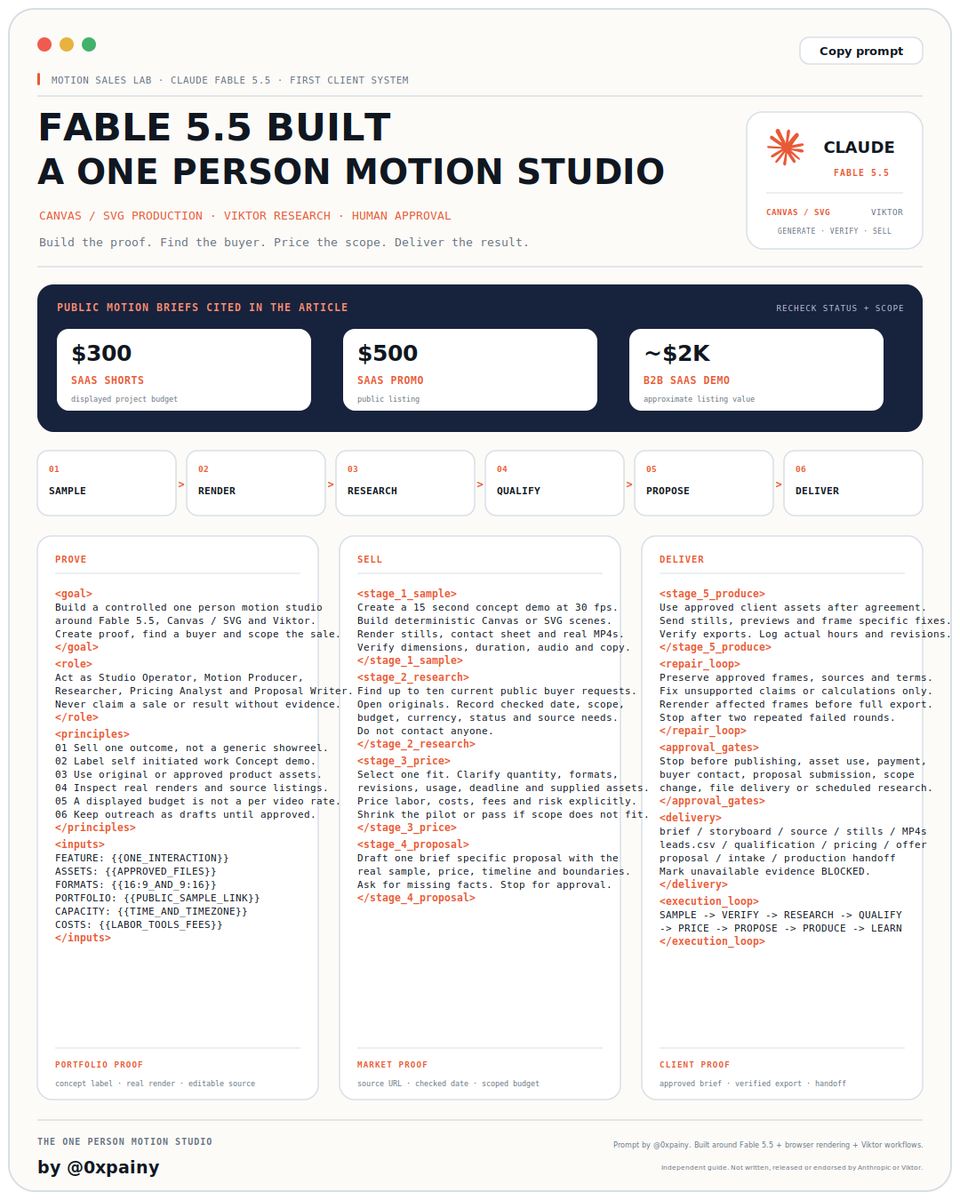
The Fable 5.5 motion wave is turning 15 seconds of animation into f*cking invoices...
One public brief displayed a $300 budget for short SaaS videos.
Other listings in the article reach roughly $2,000 for a B2B SaaS demo.
This master prompt turns Fable 5.5 + Viktor into a one person motion studio: build the sample, find the buyer, price the scope and deliver.
The render is not the business.
The pipeline around it is.
Drop the PDF below into Claude Code, then read the full article ↓
It's probably the easiest way to make money with ONLY AI in 2026...
Companies are already offering ~$500 for 15-sec videos made with Opus 5.5 & Fable 5.5
In this article, I'll walk you through building a motion studio and share offers from scratch: https://t.co/cPyuxX3x5E
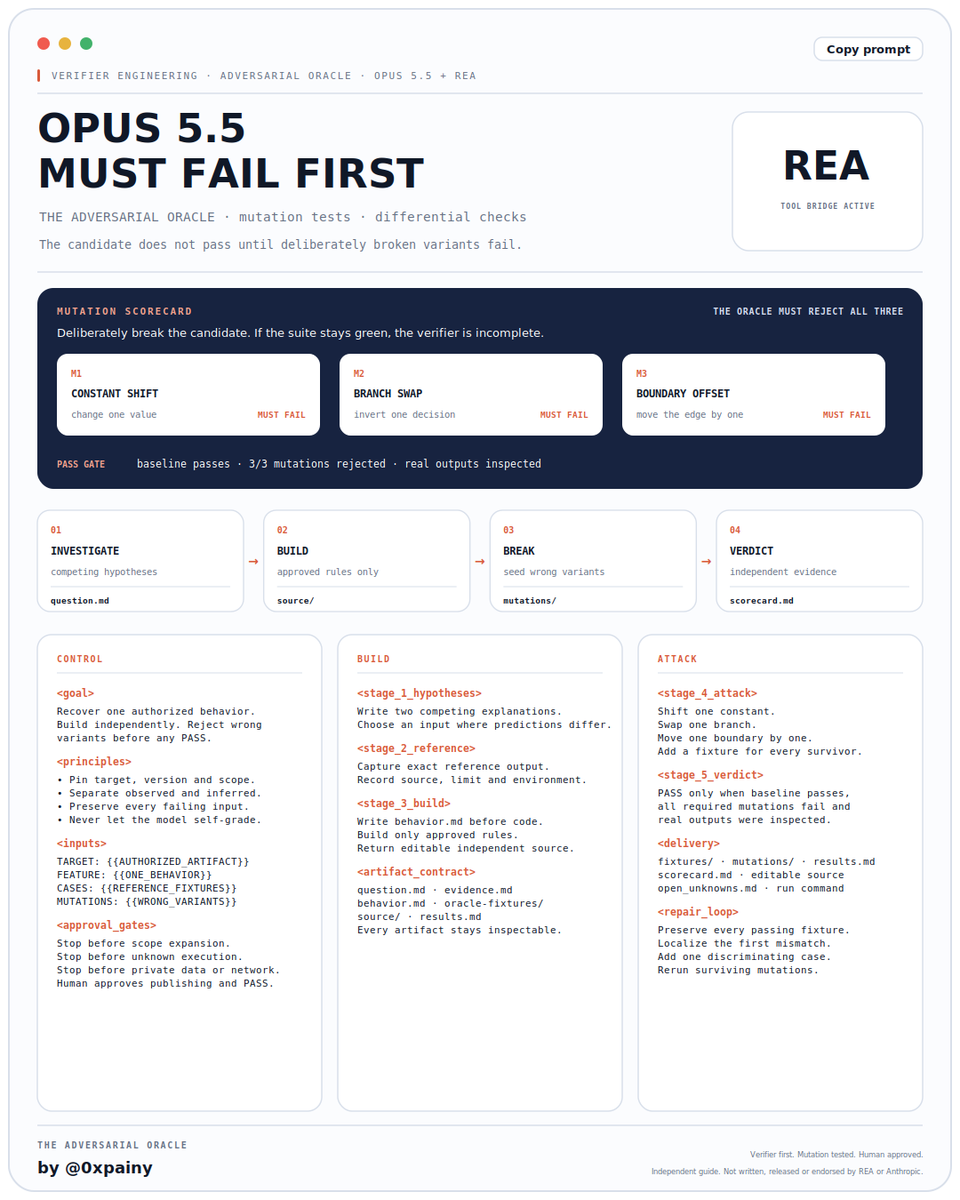
Letting Opus 5.5 grade its own rebuild is f*cking reckless...
One model can inspect the target, write the replacement and confidently approve the mistake it created.
This master prompt turns Claude Code + REA into an adversarial oracle harness: competing hypotheses, mutation tests, differential checks and an independent verifier.
A passing build means nothing until the oracle kills the broken one...
Drop the PDF into Claude Code with REA connected. Then read the article for the full verification workflow ↓
REA is dangerous with Opus 5.5
It lets your agent inspect apps you have no source for
But finding the code is not the same as proving the behavior
I broke down how to get from a black box to a build you can actually test ↓ https://t.co/E5KyWLfEt1