Is this what Larry Fink meant by your retirement and pensions funds will fund the AI revolution and 'Compute' power? [Your Surveillance grid]
"Nvidia funds a shell company with $1.9 billion. The shell company buys $5.4 billion in Nvidia chips.
Apollo finances the remaining $3.5 billion.
Apollo sells the debt to its own insurance arm.
That insurance arm packages it into annuity products and sells them to retirees who think they're buying something safe.
The retirees have no idea that their retirement savings are now backed by 100,000 computer chips sitting in some data center that will be worth pennies on the dollar in three years."
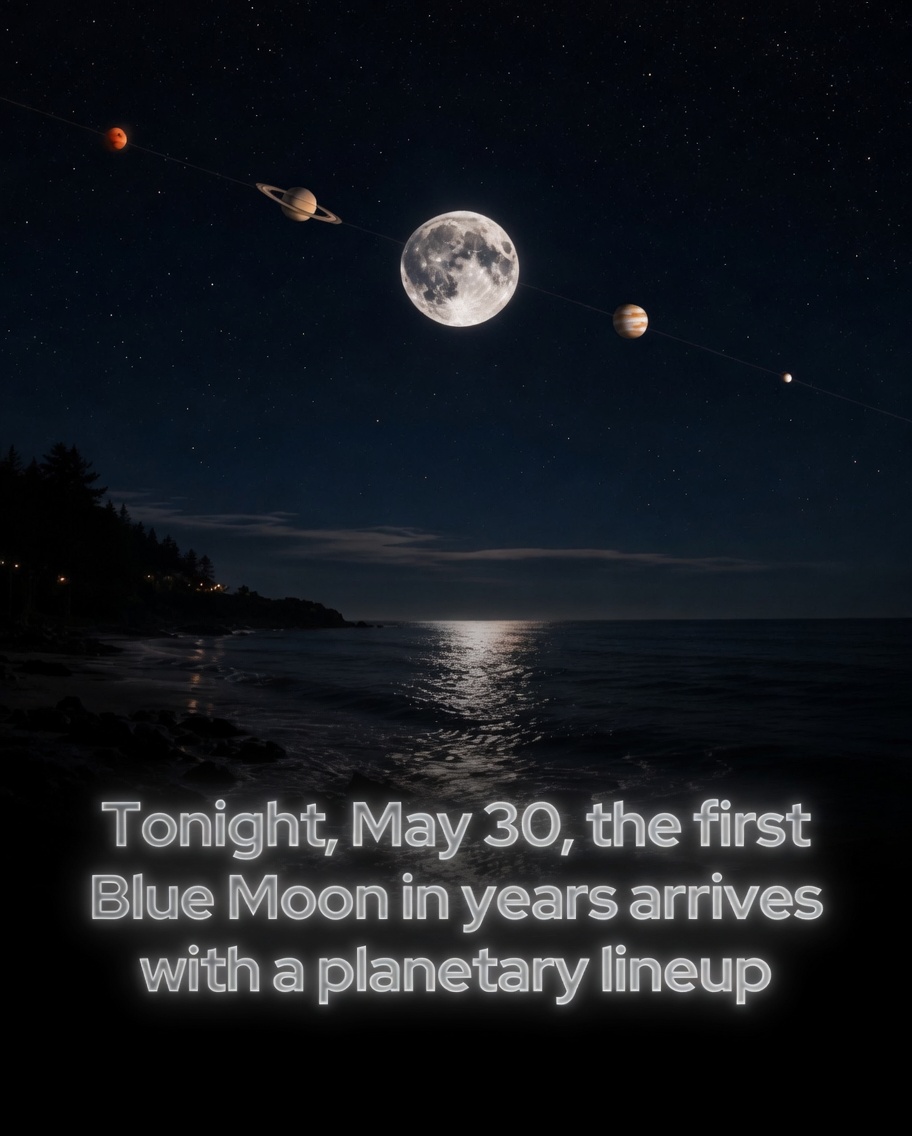
One of the rarest moons of the decade is rising over Earth tonight.
On May 30–31, the second full moon of the month will grace the sky, creating what is known as a Blue Moon. This uncommon event occurs only about once every two and a half years. After this weekend, the next monthly Blue Moon will not appear until December 2028.
This year’s Blue Moon is especially spectacular because it coincides with a beautiful planetary lineup. Before sunrise, Mars and Saturn will shine low in the eastern sky. After sunset, Venus and Jupiter will glow brightly in the west as the full moon dominates the night.
Despite its name, a Blue Moon is not actually blue. The term simply describes the second full moon to occur within a single calendar month. Since the Moon takes roughly 29.5 days to orbit Earth, squeezing two full moons into one month is unusual but not impossible.
The best time to view this Blue Moon may surprise you. Although it reaches peak fullness in the early hours of May 31, many skywatchers prefer to observe it rising on the evening of May 30. As it lifts above the horizon near sunset, the Moon often appears larger and takes on striking deep orange and golden hues.
This warm coloring is caused by the same atmospheric effect that creates colorful sunsets. Near the horizon, moonlight travels through more of Earth’s atmosphere, scattering shorter blue wavelengths and allowing longer red and orange wavelengths to reach our eyes.
The four bright planets sharing the sky with the Blue Moon are not actually close to one another. Jupiter, for example, is currently about 365 million miles (588 million km) from Earth. They only appear grouped together from our perspective here on the ground.
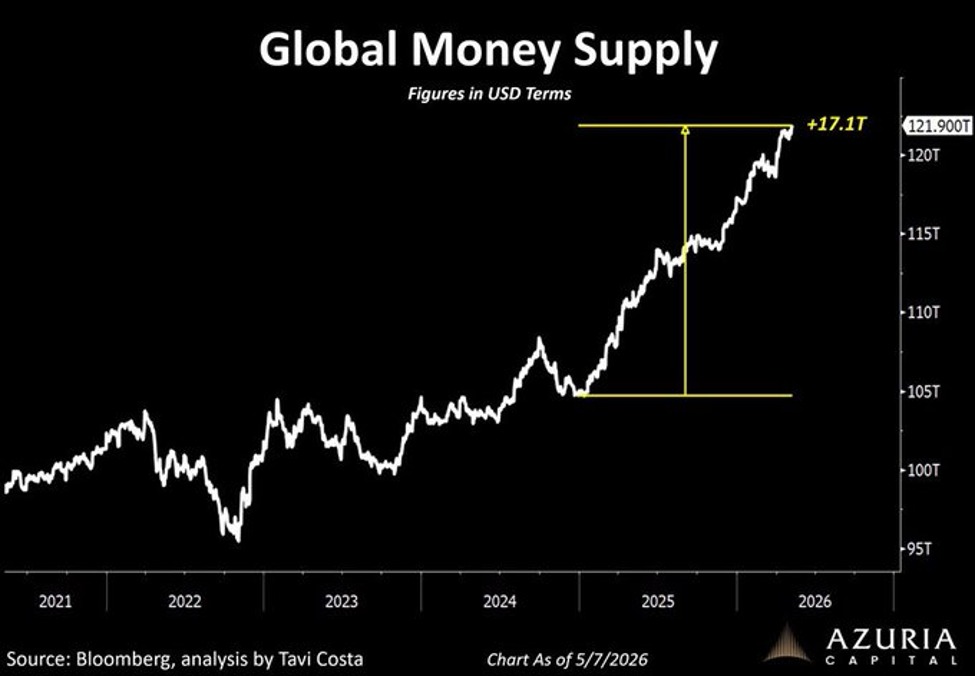
Money supply is skyrocketing:
Global money supply is now up to a record $121.9 trillion.
Over the last 2 years, money supply has soared +$17.1 trillion, or +16%.
This also marks a +$27 trillion increase, or +28%, since the 2022 low.
This means that global money supply is surging +7% to +8% a year.
Meanwhile, US M2 money supply jumped +$1 trillion YoY, or +4.6%, to a record $22.7 trillion.
Money supply growth is accelerating.
This billboard is now apparently displayed in central Tehran.
The message is hard to miss: Trump’s mouth sealed shut by a stylized Strait of Hormuz, alongside the slogan “At The Breaking Point.”
Not exactly the messaging of a regime preparing the ground for a quick deal.
Source: @NZZ
1. Medien und Mediziner machen schon wieder mit.
2. Die Aktie von Moderna, das Hanta-modRNA entwickelt, stieg in einer Woche um 20%.
3. Falls der Kelch an uns vorbeigeht, haben wir das den USA und Argentinien zu verdanken, die aus der WHO ausgetreten sind.
Hintergrund: Es ist eine Meldung von Trotteln für Trottel. Sie setzt Test und Infektion gleich und teilt zu allem Überfluss mit, der Zustand der Frau sei „stabil”. Trotzdem wurde die Frage mit einem Konvoi und Spezialpersonal transportiert.
Andere Unglückliche werden derzeit gegen ihren Willen gefangen gehalten, weil sie „Kontaktpersonen” sein sollen. Grundrechtseinschränkungen ohne Sinn und Verstand.
Trotzdem wird die Sache nicht laufen, wenn zwei große Staaten nicht mitmachen. Ein Virus, das nur im Rest der Welt „tödliche Fälle” produziert, wird die Mehrheit kaum schlucken.
KING OF THE JEWS
Written by Leslie EPSTEIN
An author named Leslie Epstein wrote a book called King of the Jews.
It is about a charismatic con artist named Trumpleman
who turns into a totalitarian leader after promising his people a golden age.
It was published in 1979.
I'm sure this is a totally normal coincidence.
@NickHintonn
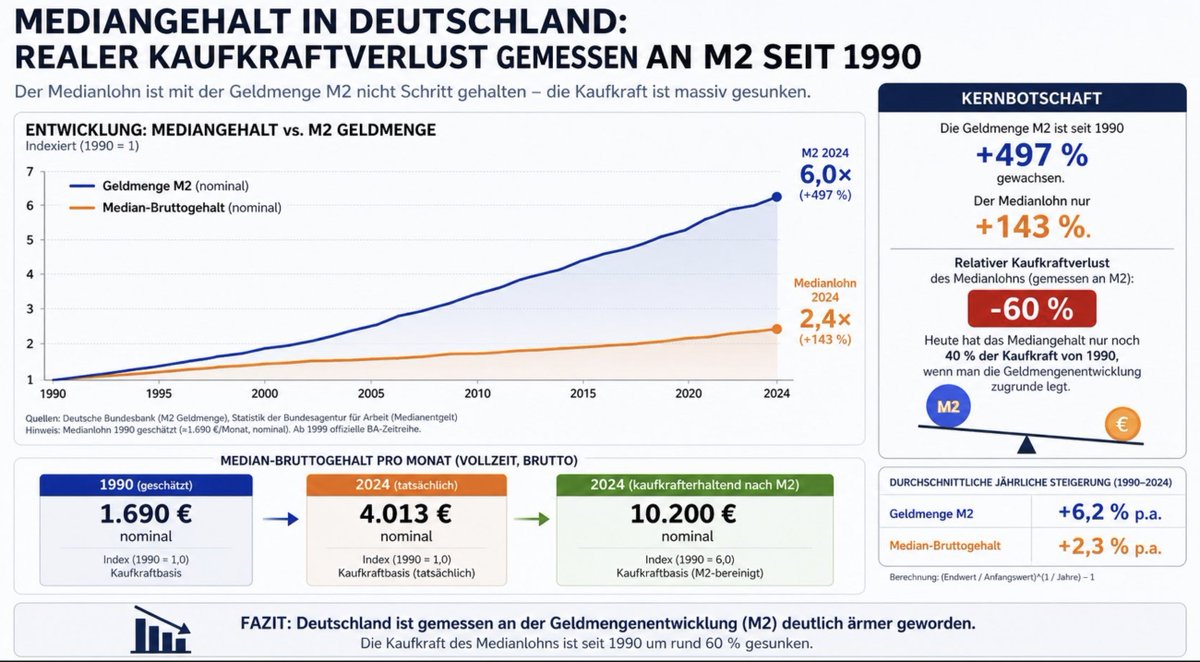
Um den gleichen Lebensstandard zu halten, den man 1990 mit (umgerechnet) 100.000€/Jahr hatte, braucht man heute 600.000€/Jahr.
Das liegt daran, dass die Politik seit 1990 die Geldmenge ver-SECHS-facht hat! Während wir Geld in aller Welt mit vollen Händen vergeben, freut sich Michel über eine jährliche Lohnerhöhung von 2%. Die Realität ist aber, dass eine 2,3%ige Lohnerhöhung pro Jahr in einem Umfeld was die Geldmenge pro Jahr um 6,2% erhöht einer 3,9%igen Verarmung pro Jahr gleichkommt. 3,9% ärmer pro Jahr über 35 Jahre macht eine Verarmung von etwa 60% aus.
In 1990 war das Mediangehalt in Deutschland bei 20.280€ (Brutto) Heute ist das Mediangehalt bei 48.156€ (brutto). Für den gleichen Lebensstandard wie die 20.280€ in 1990 bräuchte man aber heute 122.400€ brutto. Mit 100.000€ liegt man also unter dem Wohlstandsdurchschnitt im Vergleich zu den 1990ern. Hinzu kommt noch, dass das netto vom Brutto in den 1990ern noch etwa 65-70% waren, und heute im Schnitt nur 52% übrig bleiben. Um den netto Medianschnitt von 1990 zu erreichen müsste man heute also etwa 140.000€ brutto verdienen.
Soviel zum vermeintlich "reichen" Deutschland. (Netzfund)
If The April ISM Manufacturing PMI Report Shows Exploding Prices, Contracting Factory Jobs, And Worsening Supplier Delays, Is This Really Growth?
The April ISM Manufacturing PMI came in at 52.7, unchanged from March. Manufacturing expanded for the fourth straight month after a long contraction stretch.
But this was not a broad industrial boom. It was a fragile expansion held together by modest new orders, slower supplier deliveries, and a violent input cost shock.
The Headline Is Getting Help From Friction
The main components tell the real story.
• New Orders rose to 54.1
• Production slowed to 53.4
• Employment fell to 46.4
• Supplier Deliveries jumped to 60.6
• Inventories stayed weak at 49.0
New orders improved, but production lost momentum and employment deteriorated. The strongest support came from Supplier Deliveries, which rises when delivery times slow.
In a normal cycle, that can mean demand is overwhelming capacity. Here, it looks distorted by war risk, shipping reroutes, tariffs, oil, diesel, electronics shortages, and freight costs.
Labor Is The First Red Flag
Employment dropped from 48.7 to 46.4 and has now contracted for 31 straight months. Since January 2023, it has contracted in 39 of 40 months.
Most firms are managing headcount instead of hiring. Many are using layoffs, attrition, or not backfilling roles. Businesses may be accepting orders, but they do not trust demand enough to add labor.
Inflation Is Worse
The Prices Index surged to 84.6, up from 78.3 in March. It has risen 25.6 points in three months, reaching the highest level since April 2022.
17 of 18 industries reported paying higher prices. No industry reported lower raw material prices. Steel, aluminum, copper, plastics, petroleum products, diesel, freight, electronics, semiconductors, and transportation costs are all pressuring the system.
This is an input cost shock.
The Geopolitical Distortion Is Everywhere
This report was collected during the second month of the Iran war. Nearly half of respondent comments mentioned the war, while almost one fifth mentioned tariffs.
Managers are describing strained shipping lanes, higher energy costs, expensive imports, and rerouting around the Red Sea, Strait of Hormuz, and Suez Canal.
The PMI formula can count slower deliveries as strength, but here, slower deliveries may be fragility disguised as expansion.
Demand Is Not Clean
New Orders at 54.1 is the best part of the report. But ISM noted that some customers were ordering early to get ahead of price increases.
That is defensive demand.
Backlogs fell from 54.4 to 51.4. New Export Orders weakened to 47.9. Imports barely expanded at 50.3 after slowing sharply from March.
So the report is not saying global manufacturing demand is accelerating. It is saying domestic orders are holding up while external demand weakens and costs explode.
The Real Verdict
This is not bearish because manufacturing is collapsing. It is bearish because the expansion is low quality.
• Prices are surging
• Employment is contracting
• Supplier delays are worsening
• Exports are weakening
• Orders may be defensive
The April ISM report is a stagflation warning wrapped inside an expansionary headline. The headline says manufacturing is growing. The internals say the growth is fragile, expensive, distorted, and hostile to labor.
"This times is different": poursuite du bras de fer d’@adam_tooze avec @Brad_Setser@michaelxpettis et @M_C_Klein sur les déséquilibres mondiaux actuels (et la scie macroéconomique des "surcapacités" issues de la "sous-consommation" chinoises). Décoiffant et important.A suivre
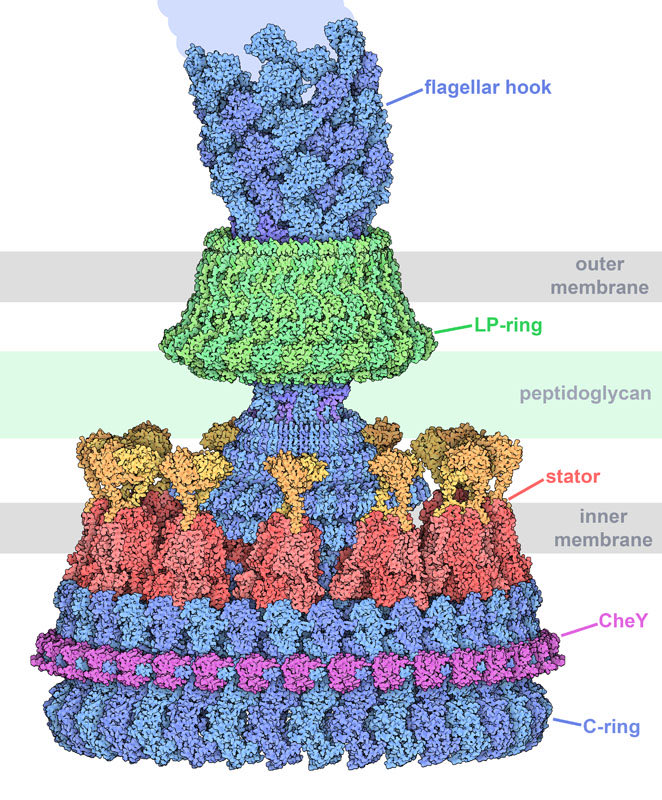
New Quanta article looks at one of the coolest tiny machines in biology - the bacterial flagellar motor. It’s basically a microscopic spinning engine that bacteria use to move.
After decades of trying to fully understand it, scientists are finally figuring out how it actually works. The motor is powered by a flow of charged particles (kind of like a tiny battery), which creates force and makes it rotate.
So what looks like something alive and mysterious is really just an incredibly advanced microscopic machine running on the same basic rules as everything else.
More broadly, the article addresses the idea of a "life force." It argues that no special force is needed to explain life. Instead, biological activity arises from physical processes that operate far from equilibrium, where constant energy flow keeps the system active and organized.
The flagellar motor shows that living systems can be understood as energy driven, self organizing systems. What appears to be uniquely "alive" can be explained by standard physical laws, such as thermodynamics and molecular interactions.
Physics pushed to an extreme level of complexity.
Nobel laureate physicist, George Thomson*, said, "Probably every physicist would believe in a creation [of the universe] if the Bible had not unfortunately said something about it many years ago and made it seem old fashioned." He was commenting on the emerging Big Bang model versus the steady-state theory of the universe, but I believe the same dynamic applies to the idea of God himself.
In a philosophical vacuum, stripped of all the cultural and religious baggage, I firmly believe most physicists would conclude that a transcendent, timeless, immaterial intelligence best explains why anything exists at all, and why the universe is so precisely suited for life.
I'm convinced, because: A) This is by far the most sensible, elegant, and efficient explanation; and B) When I talk to scientists and science-adjacent people about this, their objections are not usually logical, but emotional. We don't quibble over transcendence or immateriality. More often we end up talking about how evil and suffering can exist, or why God was so angry in the OT, or why evangelicals vote for Republicans. These are all interesting questions, but they have nothing to do with the pure explanatory power of a conscious creative force behind the universe.
I might start calling this the Thomson Rule: If there were no such thing as religion, probably every physicist would believe in a Creator of the universe.
* Thomson, like his father, physicist J.J. Thomson, was Christian.













![sarahsalviander's tweet photo. Nobel laureate physicist, George Thomson*, said, "Probably every physicist would believe in a creation [of the universe] if the Bible had not unfortunately said something about it many years ago and made it seem old fashioned." He was commenting on the emerging Big Bang model versus the steady-state theory of the universe, but I believe the same dynamic applies to the idea of God himself.
In a philosophical vacuum, stripped of all the cultural and religious baggage, I firmly believe most physicists would conclude that a transcendent, timeless, immaterial intelligence best explains why anything exists at all, and why the universe is so precisely suited for life.
I'm convinced, because: A) This is by far the most sensible, elegant, and efficient explanation; and B) When I talk to scientists and science-adjacent people about this, their objections are not usually logical, but emotional. We don't quibble over transcendence or immateriality. More often we end up talking about how evil and suffering can exist, or why God was so angry in the OT, or why evangelicals vote for Republicans. These are all interesting questions, but they have nothing to do with the pure explanatory power of a conscious creative force behind the universe.
I might start calling this the Thomson Rule: If there were no such thing as religion, probably every physicist would believe in a Creator of the universe.
* Thomson, like his father, physicist J.J. Thomson, was Christian.](https://pbs.twimg.com/media/HGcYByTXUAATTGW.jpg)


