One of the reasons the earliest attempts at Islamic banking in Nigeria, such as the dedicated Islamic banking windows in the old Bank PHB or Habib Nigeria Bank, faced so much scrutiny was because people kept asking this exact question you've just asked. They couldn’t understand how a financial institution could survive without the crutch of interest.
As time went by, scholars and financial experts needed to find a way out of this recurring problem. They had to prove that Islamic banks could cover their significant operating costs, infrastructure, and personnel without taking or giving a single naira of Riba (interest).
To do this, they developed authentic, asset-backed, money-making mechanisms that are foundational to Islamic banking today.
Please note that these are not just "interest with a different name," they are different entirely from the conventional interest-based banking.
Here is exactly why they are completely different from conventional banking:
1. Murabahah (Cost-Plus Financing): In a conventional bank, if you want a car, they give you a cash loan with interest, and you pay back cash for cash with an added percentage. That is Riba.
In an Islamic bank using Murabahah, the bank actually buys the car from the dealer themselves, owns it, and then sells that physical car to you at a disclosed profit margin, allowing you to pay in installments. The profit comes from a real trade transaction, not from renting out money.
2. Mudarabah and Musharakah (Partnership Models): Instead of just pooling deposits from savers and giving them a fixed, guaranteed interest rate, an Islamic bank acts as a partner.
In Mudarabah, the bank manages your funds in halal ventures, and the profit is shared based on a pre-agreed ratio, while the customer bears the financial risk.
In Musharakah, both parties pool capital for a business, sharing both the profits and the losses. The bank puts skin in the game. They earn by working and taking risk, not by exploiting a debtor.
3. Ijarah (Leasing): Instead of lending money to buy equipment, the bank buys the equipment and leases it to the customer for an agreed rental fee. The bank retains ownership and bears the risk of the asset, making the rental income entirely halal.
Having said this, now, let us talk about the reality of navigating a conventional financial ecosystem.
Because Islamic banks have to operate under the Central Bank of Nigeria (CBN), they are sometimes forced by regulatory compliance to participate in clearing systems or transactions that inadvertently generate Non-Permissible Income (NPI), such as penalty fees or unavoidable interest-bearing statutory reserves.
Islamic banks do not use this money to cover their infrastructure or staff salaries. Instead, they have a strict purification process. This NPI is completely segregated and channeled directly to charitable causes, such as funding public health clinics, building schools, or helping the poor. The bank derives zero corporate benefit from it.
One thing Islam prioritizes is striving toward the best, and not absolute perfection. We live in a highly imperfect, conventional financial world. These institutions are doing their best to be upon the truth, creating a halal alternative for millions of Muslims, and leaving the remaining gaps for the Almighty to pardon.
But to throw your hands up, capitulate completely, and allow Shaitan to trick you into thinking Riba is unavoidable just because banking has costs? What will then be the difference between us and them?
Allah knows best.
Before LLMs, we’d watch video tutorials and have the illusion of knowledge until we sat in front of a blank file in an IDE and realised we don’t know anything.
Now we don’t even realise we don’t know anything until it’s too late. These days the finding out stage is in live demos when key stakeholders expect their '10x engineer' to deliver value but the engineer can’t answer a simple question about the features they built.
Well, there was no reality check of starring at a blank file in an IDE.
The Hausa are having to negotiate whether they have a culture, history, morality or whether there’s anything called Hausa at all.
Do we realize how much disrespect we need to have for people before thinking them as such?
It’s basically denying their existence at all.
The textile dominance of the Hausa was so significant that from as early as the 14th century, much of the Central and Western Sudan from Senegal through Mali, Niger, and Northern Nigeria was largely clothed in trousers, robes, and shirts produced in Hausa cities by the Hausas.
Hello Lola, I am a Muslim, and our spiritual tradition has a very deep approach to raising children. I want to share some tips from our scholars that will be beneficial to you regardless of your faith.
First of all, our theology teaches the concept of Fitrah. This means that every child is born with a pure heart. At six years old, she is not a criminal mastermind. She does not have a wicked soul.
If she doesn’t have all these, then what is happening? The truth is that she is just lacking impulse control and testing boundaries. By this, if you look at her as a manipulator, you will fight her. However, if you look at her as a pure soul making mistakes, you will be able to guide her.
Secondly, for every problem anyone faces today, it has been solved in history. The only problem is how to locate them.
A classical scholar named Al-Ghazali wrote about child psychology over 900 years ago in his famous book “Ihya Ulum al-Din.” In his section on disciplining children, he gave a practical rule I want you to adopt going forward.
He advised that parents should never push a child into a corner where they are forced to lie. When you ask a question you already know the answer to, her survival instinct kicks in. She cries and she lies to defend herself because she is scared of you. Stop interrogating her. Just look at her and state the fact. Say, I know you took this, and we are going to return it right now.
Again, another scholar and sociologist Ibn Khaldun addressed this exact behavior in his masterpiece titled: “Al-Muqaddimah.” He warned that when a child is raised with harsh punishment, they learn deceit, trickery, and lying to protect themselves. This is why she is covering her tracks and crying to manipulate you. The fear of a harsh reaction is making her a better liar.
Lola, do not attach a label to her. Do not ever call her a thief. If you attack her identity instead of her action, she will internalize it and grow into that dark label. Tell her the action is wrong but protect her dignity.
Make her return the item. Do not fall for the tears. Hold her hand, walk her back to wherever she took it from, and make her hand it back and apologize. The discomfort of returning a stolen item teaches a much better lesson than beating her will ever do.
Finally, I don’t know if you are a Muslim, but never underestimate the power of your own words. In our faith, we believe the prayer of a parent for a child goes straight to God without any barrier. Pray over her. Pray for her heart to be content and for her character to be straight.
Keep doing this consistently and the habit will break.
Allah knows best.
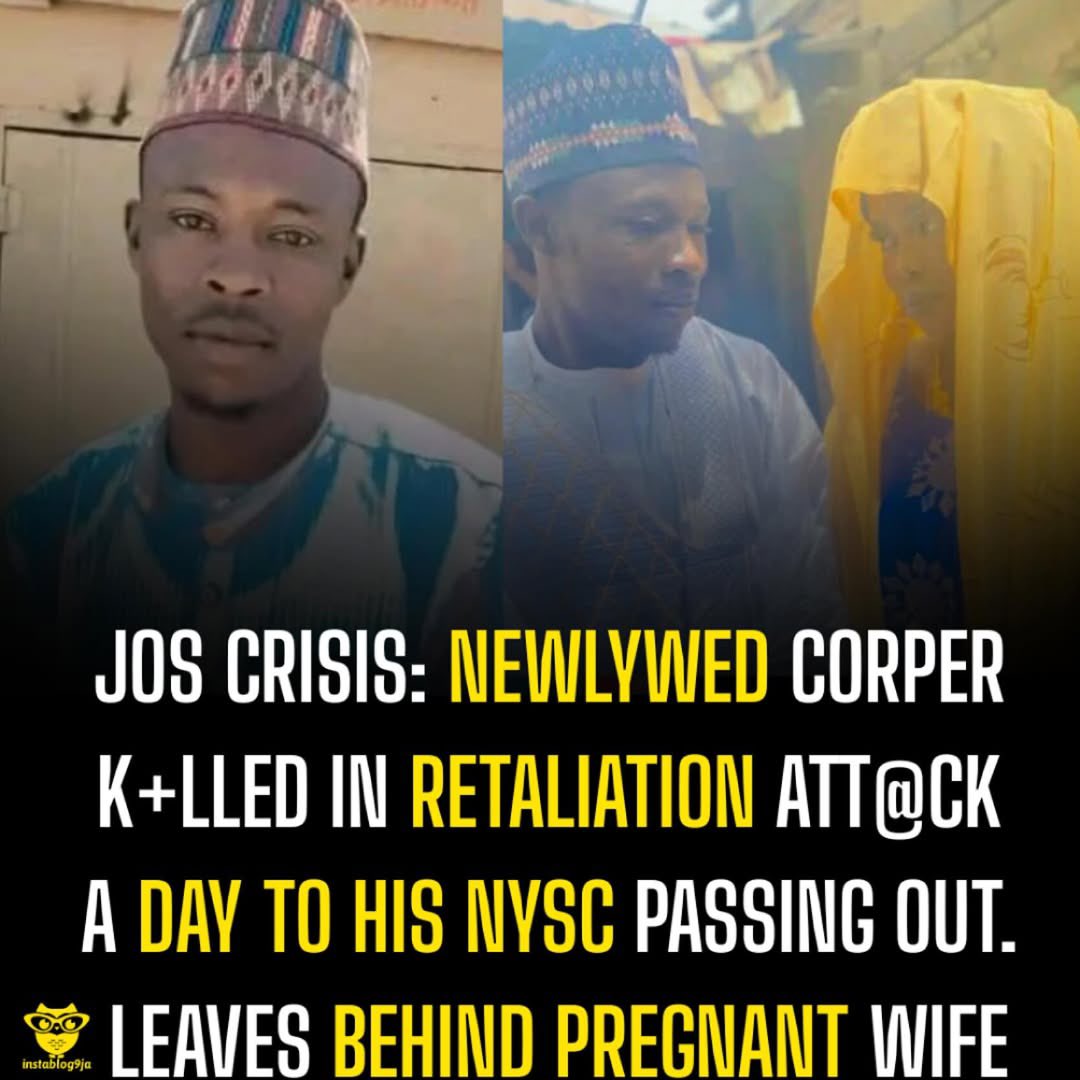
Jos Crisis: Newlywed Corper k+lled in Retaliation Att@ck a Day to His NYSC Passing Out. Leaves Behind Pregnant Wife
An att@ck in Jos North Local Government Area of Plateau State has claimed the lives of two people, including a newlywed Corps member, following an earlier d+adly a§§ault on Gari Ya Waye community in Angwan Rukuba.
The initial att@ck, which occurred on Sunday, March 29, 2026, left 40 people d+ad. In the tense aftermath, some aggrieved residents reportedly targeted unsuspecting passersby on the Jos-Bauchi highway, resulting in two additional fat@lities.
Among the victims was Ibrahim Haruna, a Corps member who had recently married and was scheduled to complete his National Youth Service on Tuesday, March 31. His d+ath has heightened grief and anxiety in the community as he leaves behind a pregnant wife.
The vi%lence triggered fears of further escalation in the area. In response, the Plateau State Governor imposed an immediate 48-hour curfew to restore order and prevent additional att@cks.
Authorities continue to monitor the situation and have urged residents to remain calm while security agencies investigate the incidents.
✅ Your Governor is a Christian.
✅ The Deputy Governor is a Christian.
✅ 21 Commissioners are all Christians.
✅ 9 Directors across ministries are all Christians.
✅ 20 of the Governor's special advisers are Christians.
✅ 99.9% of the 8 Security Agencies are dominated by Christians.
✅ Heads of all the security agencies are Christians.
✅ The majority religion is Christianity.
✅ The minority religion is Islam.
YET YOU CLAIMED MUSLIMS ARE KILLING YOU. I don't think there is any human with rational thinking who will believe that. My advice to Muslims of Plateau State is that I think it's high time you stood up and fought for your rights. Get yourself into politics. Stop this nonsense mentality of saying, "We left the political offices for them for peace to reign." Get yourself a better candidate who will protect your lives because, from the way things are going, these people will never allow you to rest. They slaughtered travelers, but they were pardoned.
They slaughtered themselves and still push the blame on you, seeking their government to prosecute you, even though most of them testify that the perpetrators are unknown. But when the culprits are caught and it happens that they are Christians, they turn a blind eye because it doesn't fit their narrative.
Why are they not saying anything about the Reverend Father arrested for supplying firearms to terrorists?📌
What happened to the church treasurer who kidnapped his pastors along with his friends?📌
What happened to the pastor who hired people to kill the Governor's father?📌
What happened to the killers of General Alkali Ali? 📌
What happened to the killers of the 26 Maulud travelers in 2021? 📌
What happened to the killers of the Zaria wedding travelers in 2024? 📌
What happened to the killers of 5 Muslim traders killed during fasting in 2026? 📌
What happened to the killers of 5 Muslims killed in a filling station?📌
May Allah be with the Muslims of Plateau State and Nigeria 🇳🇬
In my view, the structure Nigeria actually needs is presence, layering, and response that works in real time.
Start from the bottom. Every LGA should have a state owned auxiliary unit (Amotekun type) of not less than 100 properly armed and trained personnel. Their job is not to “win battles” but to remove empty / ungoverned space. Right now, too many communities exist without any consistent armed presence, which is why attackers can move in, operate for hours, and leave.
Then you have the forest layer. The NFSS or forest guard should not be treated like a conventional fighting force. They are not there to dominate forests. Their value is in tracking movement, watching known routes, and feeding information. Forests are not invisible. There are entry points, grazing paths, supply routes. Anyone who understands how these groups move knows they do not just appear randomly. A functioning forest unit should be reading that pattern daily.
Above that is where the police tactical units come in. If you cannot guarantee that a properly equipped tactical team can reinforce any LGA within a short time window, then everything below it is weak. But if that response is reliable, those 100 men on ground become a serious problem for any group trying to operate. They do not need to eliminate the threat. They only need to hold long enough for escalation to arrive.
The military should not be doing presence policing. That is part of the problem today. The military should be running offensive operations based on intelligence. Strike camp, disrupt logistics and break networks. Once you stretch them into static roles everywhere, you lose what they are actually good at.
What people don’t seem to understand is that these groups survive on time and freedom of movement. That is the real advantage they have.
Bandits do not need to win fights. They only need to operate without interruption.
NIGERIA UPDATE - Nigeria’s Growth Crisis Is a Talent-Allocation Crisis - by: Nasir Ahmad El-Rufai - 1st April, 2026 - Part 1
Nigeria is often described as a paradox. We are a nation of extraordinary human capital—energetic, inventive, resilient—yet our economic outcomes fall persistently short of our potential. Growth remains shallow, productivity weak, firms struggle to scale, and prosperity does not spread widely enough.
Today, I want to advance a clear and uncomfortable proposition:
Nigeria’s growth problem is not primarily a shortage of talent, capital, or ideas.
It is a problem of where our best talent goes—and why.
This is not a moral argument about individuals. It is a political-economy argument about incentives.
1. The Core Insight: Talent Follows Returns
Across societies and across history, highly capable people choose occupations that offer the highest returns to ability, especially where small differences in skill translate into large rewards. Economists describe this as increasing returns to talent.
When those returns are highest in entrepreneurship, innovation, and production, economies grow.
When those returns are highest in rent-seeking—activities that redistribute existing wealth rather than create new value—growth slows or stalls .
People do not wake up intending to harm their country. They respond rationally to incentives.
So the right question for Nigeria is not “Why are people corrupt?”
It is: “What activities does our system reward most handsomely?”
2. Nigeria’s Current Incentive Structure
Let us be honest about Nigeria’s reality.
•GDP growth was about 4.1% in 2024, respectable on paper but insufficient for a country with our demographics.
•GDP per capita remains around US$1,084, placing Nigeria among lower-income economies despite our scale.
•Informal employment accounts for roughly 93% of the labour force, meaning most firms are small, fragile, and defensive rather than scalable.
•Nigeria’s tax-to-GDP ratio is only about 8.2%, one of the lowest in Africa—signalling weak fiscal capacity and heavy reliance on discretionary collection rather than broad, rule-based taxation.
These numbers are not abstract. They describe an economy where scale is risky, visibility attracts predation, and long-term investment struggles to compete with short-term access.
In such an environment, the most capable Nigerians often find that the fastest and safest returns come not from building large, productive enterprises—but from proximity to state power, regulatory discretion, political brokerage, or legal and administrative contestation.
This is exactly the mechanism identified in the economic literature: when the “market” for rent-seeking is large, talent flows there .
3. Why Rent-Seeking Damages Growth
Rent-seeking harms an economy in three cumulative ways.
First, it absorbs labour and capital without creating output. Resources are spent competing over existing wealth rather than expanding the economic frontier.
Second, it acts like a tax on productive activity. Businesses face delays, uncertainty, informal payments, and arbitrary enforcement—raising costs and discouraging investment.
Third—and most damaging—it diverts the very people who would otherwise be the most productive entrepreneurs and innovators.
When the brightest minds are pulled away from production, the quality of entrepreneurship falls, technological progress slows, and the economy’s long-run growth rate declines .
This is why rent-seeking does not merely lower income levels; it can permanently reduce growth.
I am curious why people target Nigerian infrastructure when there’s barely much value in those datas.
The only issue here is that a large number of agencies and organizations were compromised by a single hack within a short period of time.
Look at it this way, even if you have the data of Nigerians, you can hardly use it to secure a tangible loan or carry out anything meaningful with the average person’s information. Compare this to targeting an average American, where it is much easier to obtain thousands of dollars using their identity. So the valuable stuff here remains data of UHNI, HNI which the bank will easily initiate actions to protect.
So the market value of Nigerian PIINs is very low, but this situation still highlights how poorly secured our infrastructure is.
Those who need our data for intelligence collection already have it 🤷♂️
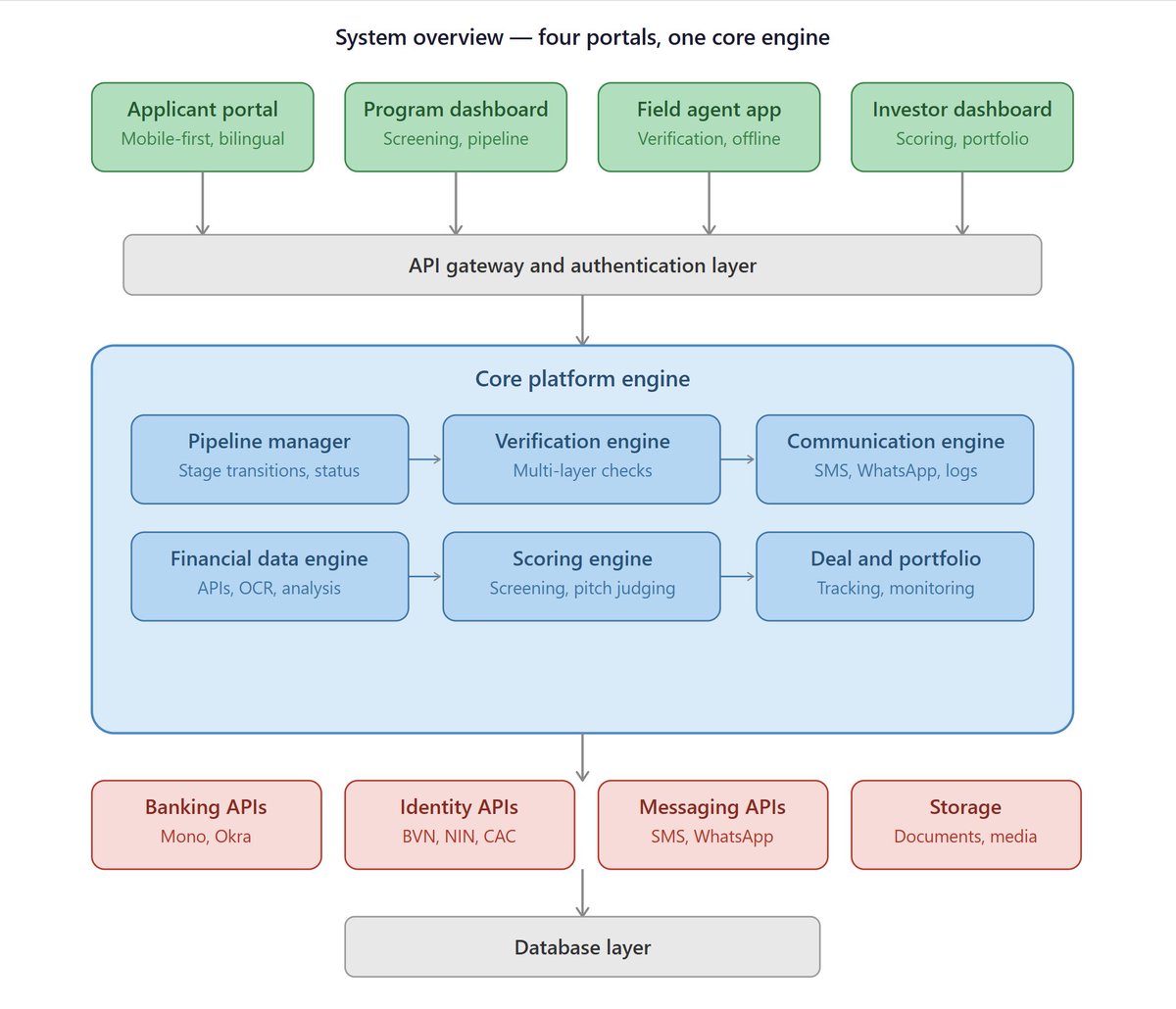
Prototype of Arewa Business Fund Support Technical Architecture.
Dear @CaptJamyl@AM_Saleeeem if no one have seek or awarded the contract of building a robust platform to house this program. I hereby declare interest on behalf of my company to build it.
Public: I seek your support
Note; Ready for any tweaks or changes base on your needs.
1/ I designed the complete potential technical architecture for the pooled-investment program targeting businesses across northern Nigeria.
An full operational blueprint from how a business signs up to how investors track their portfolio.
Here's what it covers:
@Surayyah__ahmad
Sufism (all forms of Darika) are the gatekeepers of Northern Sociocultural/Economic backwardness.
Lets not throw this false ambiguous all encompassing "Sunni" term for this thing today or ever if we having honest honorable conversations.
Once posted that had Northern Nigeria been majority Shi'a, the region wouldn't suffer from her current poverty, illiteracy and general socio-cultural backwardness..
This does not condemn our majority Sunni theology, rather, an appreciation of the revivalist spirit in Shi'ism!
One of the best ways to be stagnant in life is by not moving on with life after graduation—stop trying to live in a nostalgia, you are not child… you must move on.
This campaign about insecurity being only solvable by northerners is outright insulting, and a damning concession of not just state failure, but a deliberate dereliction of duty by its responsible officials. It is preposterous, to say the least.