Paid Partnership: @DuskFoundation currently executes one operation per transaction, so approve, swap, and stake are separate steps without protocol-level atomicity. The roadmap debate is where batching belongs: smart contract or protocol layer. $DUSK #dusk
Paid Partnership: @DuskFoundation’s Boreas upgrade shows transaction decoding isn’t just “read the bytes.” Different protocol eras need version-aware rules so historical blocks still decode correctly. For $DUSK, consistency across replay and processing is the real test. #dusk
Paid Partnership: @DuskFoundation shows that EVM compatibility is only step one. Solidity can deploy, but verification proves the deployed bytecode matches the published source. For $DUSK, developer readiness should mean both. #dusk
Paid Partnership: @DuskFoundation makes a useful distinction: fractionalization can widen ownership, but it doesn't create liquidity. The real test for $DUSK is whether NPEX assets develop active secondary trading, not how finely they're divided. #dusk
Paid Partnership: @DuskFoundation’s bridge incident exposed an authority problem, not a cryptographic flaw. A compromised signer had too much reach. The fix was separating signing, event handling, and fund release. Has that lesson spread across Dusk? $DUSK #dusk
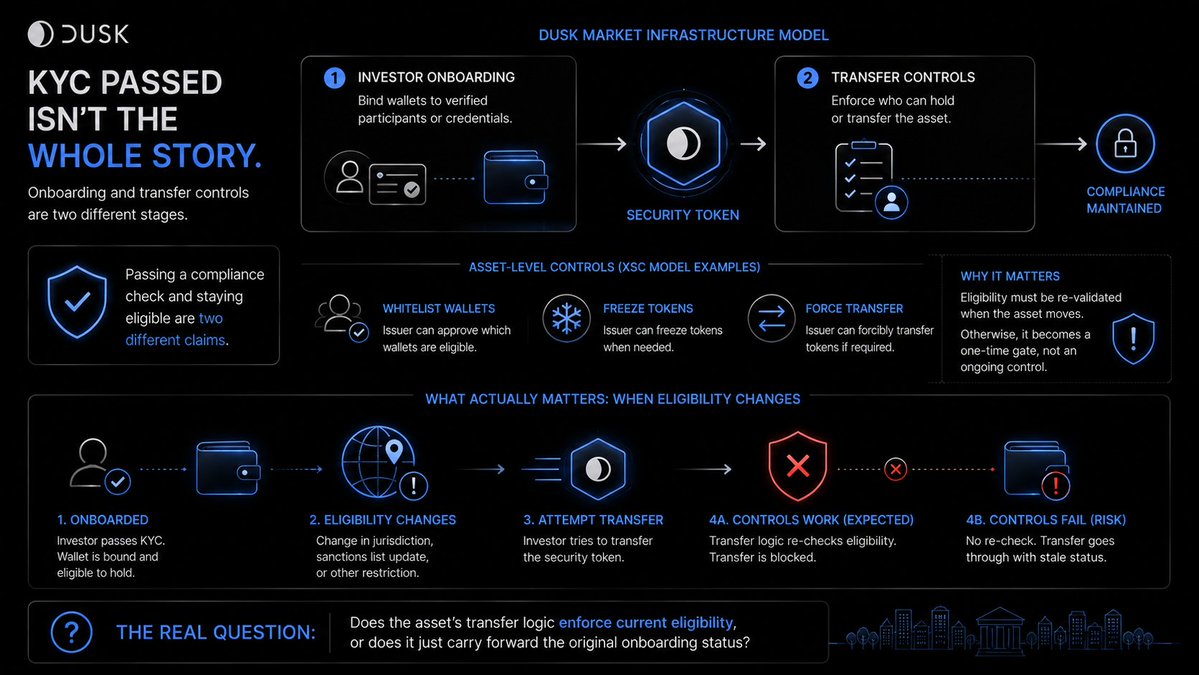
Paid Partnership: @DuskFoundation separates KYC onboarding from transfer controls. Passing KYC proves who you are, but it doesn't prove you remain eligible to hold an asset. The real test is whether $DUSK can enforce eligibility when ownership changes. #dusk
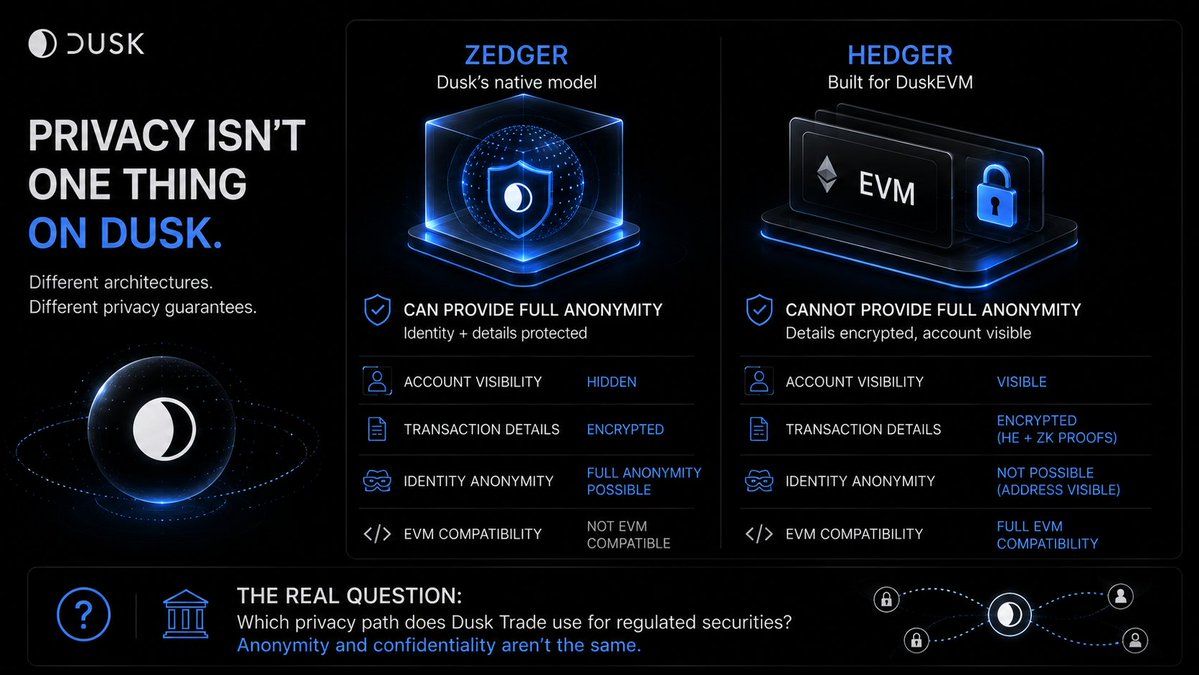
Paid Partnership: @DuskFoundation’s “privacy” has different guarantees. Zedger can provide full anonymity, while Hedger keeps transaction details confidential but leaves account addresses visible. Same network, different privacy model. Which path will Dusk Trade use? $DUSK #dusk
Paid Partnership: @DuskFoundation separates consensus and owner keys. A compromised node key can affect consensus without accessing stake. But the safer setup is optional: by default, both keys can be the same. How many operators actually use the separate owner key? $DUSK #dusk
@Ponyin Dulu gw designer, dan sampai sekarang masih lebih nyaman disebut designer daripada crypto guy. Semanjak ada AI, gw coba Web3. Sekarang ikut Creatorpad Binance, sambil belajar trading, LP, dan ningkatin skill desain. 5 tahun lagi, gw pengen punya skill & income yang lebih stabil.
Ini ada quick GA bang.
Dipilih manual buat nemenin gw baca baca di pesawat.
Cuma perlu kasih tau lore kamu dan apa target kamu 5 tahun kedepan.
30$ buat 3 orang jadi 10$.
Dipilih pas landing.
Gausah spam gw baca manual satu satu kek biasa.
Good luck ya mungkin ga banyak.
Tidur dulu.
Semoga keluarga mu sehat.
Warm regards,
Pontin.
Post
Paid Partnership: @DuskFoundation’s Citadel isn’t just a trading KYC module. Launched before Dusk Trade, it was built as a reusable ZK identity layer. The real test for $DUSK: can one credential prove eligibility across services? #dusk
1/
TermMax is launching a Booster program on @BinanceWallet.
Complete five tasks or post on Binance Square to share 2,000,000 $TMX.
Aug 17 07:00 UTC to Aug 24 23:59 UTC
Post
Paid Partnership: @DuskFoundation + Chainlink is more than a bridge. DataLink becomes NPEX’s exclusive onchain oracle, making one source canonical for tokenized securities. CCIP moves assets; DataLink defines their price. Composability comes with dependency. $DUSK #dusk
Post
Paid Partnership: I dug into @DuskFoundation’s view of tokenization vs native issuance. A token representing an off-chain asset is different from an asset that exists natively onchain. The real test: can $DUSK make onchain the legal source of truth? #dusk
Dusk says Hedger can generate client-side proofs in under 2 seconds. Eligibility can be verified before access/transfer while participant data, balances & amounts stay encrypted. Curious how this holds up in real audits. Paid Partnership @DuskFoundation $DUSK #dusk