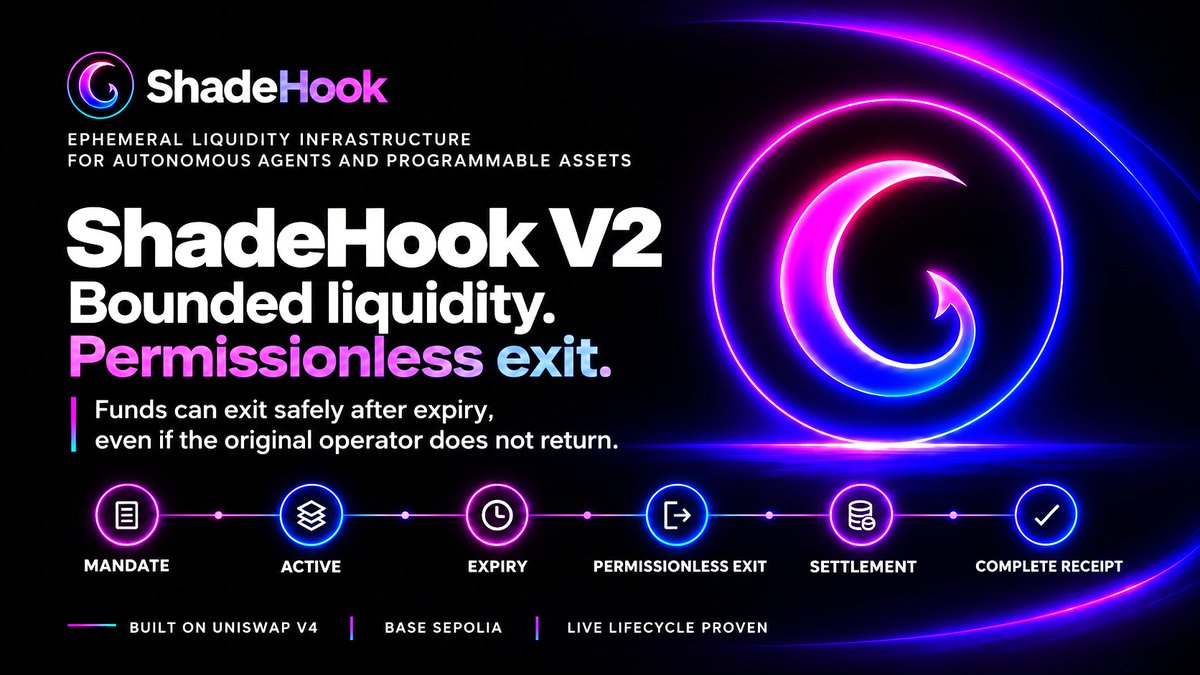
Markets with lifetimes. Ephemeral liquidity infrastructure for bounded Uniswap v4 LP sessions. Hard expiry + permissionless post-expiry exit. Live proof on Base
Most liquidity positions have no built-in end time.
ShadeHook adds one.
ShadeHook is @uniswap v4 infrastructure for creating temporary, bounded liquidity sessions.
An individual LP, market maker, team, vault, issuer, or autonomous agent can define:
• the token pair
• how much capital can be used
• how long the session can operate
• permitted actions and execution limits
• settlement conditions
When the session expires, that bounded liquidity session can no longer accept swaps.
The liquidity does not disappear automatically. Anyone can submit the authorized post-expiry exit, so the funds do not depend on the original operator or agent returning.
Each completed session produces a verifiable receipt containing its mandate, transactions, timestamps, expiry, and final outcome.
Why does this matter?
Not every market needs permanent liquidity.
Tokenized stocks, RWAs, event-driven markets and temporary strategies may need liquidity only during a specific trading window, mandate or event.
Autonomous agents also should not need unlimited control over capital. ShadeHook gives them bounded authority over bounded capital for a bounded period.
The full lifecycle has now been proven on @base Sepolia:
mandate → funding → authorization → ACTIVE → real expiry → permissionless exit → settlement → COMPLETE receipt
ShadeHook gives liquidity a defined purpose, enforceable boundaries and an end.
Markets should know when to stop.
https://t.co/KmE914FLiy
@deacix Applied with a working Aqua strategy-session PoC around bounded agent authority. The part I am most curious about now is how you’re thinking about the boundary between generic session permissions and Aqua-specific strategy controls. Looking forward to seeing what gets selected.
This is interesting. I think one of the harder parts with autonomous Aqua strategies is not just the strategy itself, but how much authority you give the agent.
Being able to limit the assets, capital, parameters and time window without giving full wallet control feels pretty important.
Congrats on launching Hare, Connor. Your focus on vault risk and liquidity under stress is closely related to something I’m exploring with ShadeHook: bounded authority over onchain capital.
An operator or agent would be limited to an approved capital amount, strategy and time window, with revocation and a verifiable settlement path. ShadeHook has proven this lifecycle for Uniswap v4 liquidity on Base Sepolia, and I’m now exploring whether the same control model is useful for vaults.
From Hare’s perspective, is narrowly delegated authority a real gap for institutional vault operators, or do existing vault and custody controls already solve it? I’d value your honest view.
ShadeHook now has two bounded-authority implementations:
Uniswap v4: temporary LP authority with hard expiry and permissionless post-expiry exit.
Aqua: bounded strategy-management authority over self-custodial liquidity.
Same thesis, different venue:
give software authority over capital without giving it unlimited authority.
Base proof live. Robinhood adapter fork-validated. Aqua PoC complete.
#Uniswap #Aqua #DeFi
Thanks. I will look at the Safe module path.
The part I am trying to validate is whether there’s already a module that can enforce Aqua-specific permissions like exact strategy, pair, capital ceiling, parameter range and expiry, rather than just generic call restrictions.
If not, that may be the layer ShadeHook should add.
@haydenzadams@fintechfrank This is exactly where bounded LP authority gets interesting.
For permissioned TSV pools, do you see value in LP mandates that also cap capital, operator authority and session lifetime, with a predefined post-expiry exit path?
That’s the primitive I’m testing with ShadeHook.
Thanks, that clearly solves capital isolation.
One thing I am still trying to understand: if the agent is given authority over the sub-wallet, can it transfer the Safe’s funds or call anything it wants?
Or can its authority be limited to specific Aqua strategies, assets and parameters without requiring the main wallet to sign every action?
Been exploring a related problem with ShadeHook: what happens when an agent opens a liquidity position but never comes back to close it?
I am working on bounded liquidity mandates with hard onchain expiry and permissionless exit. Curious if you see that primitive fitting alongside Aqua’s agent-managed liquidity.
Robinhood Chain adapter is now fork-validated against official Uniswap v4 mainnet infrastructure.
Base Sepolia remains the live proof.
The site now makes the core primitive clearer: bounded LP authority, hard onchain expiry, and permissionless post-expiry exit.
Robinhood Chain: fork validated, not yet live deployed.
Markets with lifetimes.
https://t.co/ceJ2v9zaqN
@Uniswap@RobinhoodCrypto@BuildOnBase
#UniswapV4 #DeFi
@N0th1n3 Hi Brian, I am building a Uniswap v4 hook for temporary liquidity with clear limits and automatic expiry. I sent you a DM with more details and would appreciate your thoughts when you have a chance.
Strong direction, especially the combination of regulated v4 pools and AI-powered vaults.
I have built a Base Sepolia proof for bounded LP sessions: limited capital and authority, deterministic expiry, safe post-expiry exit, settlement and a verifiable lifecycle receipt.
I am curious whether that kind of execution-control layer could be useful for the Gateway’s vault or liquidity-provisioning architecture.
@UniswapBuilders@Uniswap@RobinhoodCrypto Better execution is one layer.
Bounded liquidity is another.
ShadeHook is exploring Uniswap v4 sessions with defined capital, permissions and lifetime, plus permissionless exit after expiry.
Robinhood + Uniswap is becoming a very interesting surface for this.
Exactly the direction ShadeHook is exploring.
Hooks can define not only how liquidity behaves, but how long that liquidity is allowed to exist.
Bounded capital, bounded permissions, bounded lifetime, then permissionless exit after expiry.
Robinhood Chain feels like a natural place to test that model.
@Uniswap@RobinhoodCrypto 👋 ShadeHook is building bounded Uniswap v4 liquidity sessions for markets like this.
Defined capital. Defined permissions. Defined lifetime. Permissionless exit after expiry.
Robinhood Chain is exactly the kind of environment I’m exploring next. @Uniswap
Hooks are becoming the policy layer for onchain markets.
Compliance is one boundary. Time can be another.
ShadeHook is exploring bounded Uniswap v4 liquidity sessions where capital, permissions and lifetime are defined upfront, with permissionless exit after expiry.
Interesting to see this design space moving into institutional markets.