Claude Code, effort estimation when i pushed a lot of work to it:
Initial estimate: 15 days
After push back: 72 minutes!
Explanation: Initial estimate was based on its training on humans doing it.
The gap between those two numbers is the gap between the old world and the one we're in. Claude Code is quietly tells you how much the work has shrunk.
Scale what's working.
Iterate what's not working.
Simple. But every early stage founder gets it wrong. Often. And it mostly goes unnoticed.
Multiple reasons
We're not actively thinking about it.
We don't want to write-off... loss aversion.
We tell ourselves we can't confuse the team again.
We like to live in the illusion... because realisation means accepting we took a wrong call.
That's why: "In theory, there is no difference between theory and practice. In practice, there is."
Yogi Berra
No surprise a sportsman who practiced every day said this. You can't play sports in theory.
Entrepreneurship has somewhat always meant job creation. Most of what we AI founders are building will do the opposite. Maybe not as intent. But surely as a consequence.
IMO the best way to have a job in this economy... is to found a company...hopefully one on the right side of this churn.
Software is becoming a commodity. So is intelligence. What survives is knowing the customer. Knowing their context deeply enough that you see what they need before they do.
The thing we build matters less. The thing we know matters more. At least for now.
PMs have been prompting engineers for 20 years.
--
It's hard to let go of something you love.
Engineers are finding that out with code and reviewing it. The instinct to build it themselves. 20 of muscle memory.. takes some unlearning.
Turns out the people who never learned to code don't have much to let go of.
PMs have been prompting engineers for 20 years.
They were already living in the future. They just didn't know it.
Is your coding agent really smart or did it just memorize the test answers?
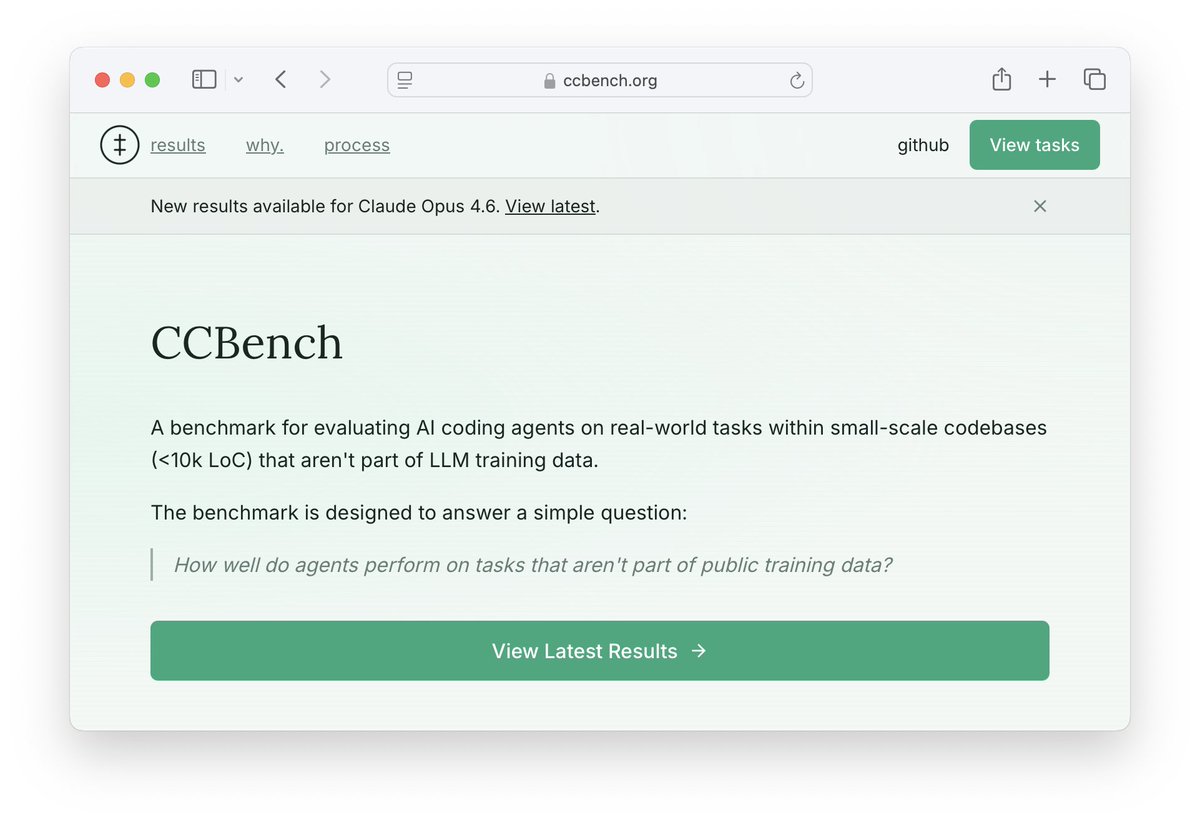
Today we're launching CCBench, a benchmark for evaluating coding agents on small-scale codebases (<10k LoC) that aren't part of LLM training data.
It's designed to answer a simple question: How well do agents perform on tasks that aren't part of public training data?
https://t.co/chvLyBCVVb
Does your favourite agent top the rankings?
When we index on "what can I raise for" instead of "what's broken"... somehow opportunities seem fewer, especially on upfront analysis.
But AI is making it easier to wow the users... which expands the surface area of what's worth building.
The problem to my mind is that most products we're seeing today are still AI-first, not User-first.
As we figure that out we will unlock a lot more opportunities. And possibly enter a new cycle of innovation and quality of life improvements.
It won't be surprising if we see more founders leave tech and build real world companies like selling their version of dirty soda...because it is so incredibly hard to find something to build right now.
Most product managers got trained to build workflows. But AI made that task trivial... many are thinking their job got easier... because they are seeing AI as a productivity tool... which is tempting but is obviously underestimating AI.
Because of AI, what a product can do though... its opportunity space.. that exploded. And with that what a product manager can do also. That requires moving away from thinking in workflows... and start thinking in systems... modular systems actually.
People are not choosing entertainment over food.
IMO this actually shows that TV has a stronger PMF.
A TV delivers the end promise directly. You switch it on. Boredom is gone.
A refrigerator is an intermediate tool. It does not feed you. It preserves surplus. That to perishable surplus.
To get value from it you need excess perishable food and cash flow. Hence many poorer households buy perishable food when they need it. And thus do not have a preservation problem.
They are rational people. They know where to spend. The proposition of refrigerator is just weaker for them.
39% of poor Indians have a TV, while 12% have a food preserving refrigerator
Takes me to a fascinating study done on lower-income Mexicans
They preferred buying a TV even if it meant sacrificing food, when asked why
"I'd rather be hungry than bored"
Crazy, but true
There are many ways to build startups.
And as someone who has been building for 15 years, there’s one I’m currently leaning into.
When I started, I would not even consider the unambitious ideas.
The odds of success? That didn’t matter.
I would get sold on the dream.
All that mattered was how ‘big’ the idea could get.
Risks can be high if the rewards are worth it. VCs also like that.
This is one way to build.
But now AI is presenting uncapped opportunities to transform seemingly solved use cases. And since demand is already established, the odds of success seem higher.
I now realise that ambition keeps going up as we start seeing success.
The bigger the wins, the bigger your appetite for what’s next.
The opportunity space also expands accordingly.
But now I'm leaning towards this approach:
Build at the intersection of humans and AI agents.
Pick a service people already pay for. Break it into parts.
Let humans handle the high-value creative tasks.
Let agents handle the repetitive, scalable stuff.
Over time, the ratio of agent-led work goes up, the costs go down.
Humans earn more by focusing on value.
While customers pay less and get more consistency.
The business scales. And keeps compounding.
This is another way to build.
“The internet as we knew it is dying.”
“When AI trains on AI-generated content, quality drops. It is like photocopying a photocopy. Rare ideas vanish. Everything starts to look the same. It's recursive. Today's AI slop becomes tomorrow's training data, producing worse output, which becomes training data again.”
This is a hot take from researchers at Oxford. Almost a warning about what might happen to our internet next year when AI starts writing 90% of everything published online.
Looks unlikely to me.
Because humans have an innate need to stand out. To be seen. They will use AI to express that. The argument that AI kills originality ignores this. It assumes humans will stop being creative. Many will. Maybe 99% will.
But the remaining 1% will use AI to write more. To write better. They will use it to reduce the friction between their thoughts and expression. To push their thinking further. These 1% can keep the internet on. Even today, most of the content we consume comes from the 1%.
So AI won’t really train on AI content. It’ll train on human-owned content created with AI’s help. Even if AI is heavily involved, humans will still own the output. And their reputation will still be attached to it.
The creativity will live. Only the tools to be creative will change. A new set of winners will emerge. The ones who can use the new tools better.
In *very-early-stage* startups, I come across two types of founders. The marketing-focused, who treat the product as a marketing problem, and the product-focused, who see marketing as a product problem.
The instinct of marketing founders is to shout louder, and chase top-of-the-funnel rather than building a better user experience. I find it difficult to be impressed by them. (Having said that, I am super impressed by Roy from Cluely. And I trying learn from them as they write a new playbook..)
But product founders see marketing as an extension of the product itself. They try to fix the leaks in the user journey before turning on the tap.
As these founders are passionate about their product, they accumulate deep insights about their users. When they start sharing those insights on social media, people are naturally drawn to their vision.. and to their product.
This isn't manufactured hype... it's an honest expression. These founders understand their first goal isn't to make a sale but to earn a moment of someone's attention. They know the biggest hurdle isn't a user's money but their most scarce resource.. their time.
One way to truly earn that time is through a genuine transfer of enthusiasm. And from there, let the product onboarding take over... where the job is to deliver a series of "aha" moments and run an efficient product funnel.
These founders do need to overcome their inhibitions and start sharing their thoughts, though.
Exactly! It’s not just good advice... it’s how the machine is built.
My guess is that algos aren't made for creators.. they are made for readers. A reader follows you for 1 specific thing. When you post about 10, you are making them see 9 things they don't care about.
The algo's job is to perfect reader's feed.. so it pushes you into a single-focus box.
The pressure to "stand for one thing" is a feature not a bug..
If you want to get rich on X, it isn't going to be through creator revenue or meme coins.
Instead, think about one subject matter that you know more about than anyone else in the world. It can be anything: plumbing, menswear, Indian food, furniture, social apps, whatever.
Post one unexpected insight you picked from your experience in that area. Keep it under 5 sentences. Do this every day for 6 months.
If you stick to it, we will promote your account to others.
By the end, you will be recognized as the world's leading expert in that subject area and you can charge whatever you want for endorsements, your time, or whatever. And no one will be able to take that way from you.
The ‘creators turning into a business’ trend is hitting a wall.
As creators professionalise, they start resembling the same polished brands their audience was trying to escape.
The edge now is in staying scrappy, not scaling up.