Why Activity Matters: Understanding the Human Node Sleep Mechanism
Staking is often associated with locking tokens and waiting for rewards.
However, InterLink's proposed Human Node model introduces another important element: continued activity.
According to the InterLink framework, Human Nodes are expected to remain active participants in the ecosystem.
The proposed inactivity mechanism works around three important time periods:
After 30 days of inactivity: A Human Node enters sleep mode and stops earning staking rewards.
After 90 days of inactivity: The user's stake is removed from the Vault.
After removal: A 180-day waiting period applies before the user can stake again.
Why introduce these conditions?
The idea is to encourage genuine, long-term participation rather than allowing nodes to remain inactive indefinitely while continuing to benefit from the staking economy.
It also highlights an important distinction between simply holding tokens and actively participating in a blockchain ecosystem.
A network built around verified human participation needs more than registered accounts. It needs meaningful engagement.
There are still details to be clarified, particularly how activity will be measured, what actions count toward node activity and how users will be notified before penalties or removal.
Those details will be important for fairness and transparency.
For me, this mechanism shows that InterLink wants Human Nodes to represent active participation, not just a wallet holding $ITLG
#InterLink #ITLG #ITL
Why Enterprise Nodes Could Be Important to the Future of InterLink
When people discuss blockchain adoption, the conversation often focuses on individual users.
But businesses and institutions are equally important if blockchain technology is going to become part of everyday economic activity.
This is where InterLink's proposed Enterprise Nodes become interesting.
An Enterprise Node is designed for a company or institution that completes KYB verification, registers its business wallet under its legal identity and stakes transferable $ITLG
The proposed model also requires institutional stakes to be locked.
Why does this matter?
First, verified business identities could improve accountability by making it clearer which legal entity stands behind an institutional node.
Second, publicly locked stakes could demonstrate a longer-term commitment to the ecosystem.
Third, the presence of verified businesses could create opportunities for connections between traditional companies and blockchain-based services.
There is also a potential connection with IBTE, the InterLink Business Token Exchange.
Under the proposed vision, companies may need to become Enterprise Nodes before listing on IBTE.
That could create a pathway where business verification, staking and tokenisation are connected.
However, institutional participation alone does not guarantee trust or eliminate market manipulation. Transparent rules, proper oversight and enforceable safeguards will still matter.
The bigger opportunity is building a blockchain environment where businesses can participate with identifiable responsibilities.
That is one reason Enterprise Nodes deserve attention.
#InterLink #ITLG #ITL
Human Nodes vs Enterprise Nodes: Understanding the Two Sides of the ITLG Staking Vault
One of the most interesting aspects of InterLink's proposed Staking Vault is that it recognises two different types of participants.
They are called Human Nodes and Enterprise Nodes.
But what exactly separates them?
Human Nodes
These represent individual Linkers who have successfully completed ITLG KYC.
They can stake transferable $ITLG through their verified wallets and participate in the wider ecosystem, including dApps, payments and governance activities.
The emphasis is on verified human participation rather than simply creating multiple anonymous accounts.
Enterprise Nodes
These represent companies and institutions that complete KYB verification.
Unlike individual users, businesses are expected to register their business wallets under their legal identities and stake $ITLG as institutional participants.
Their staked tokens are also expected to be locked, demonstrating a longer-term commitment to the ecosystem.
The important distinction is that both groups are designed to participate in the same staking pool, rather than receiving separate institutional reward rates.
This creates an interesting model where individuals and businesses can contribute to one shared staking economy.
If implemented effectively, Human Nodes could strengthen genuine community participation, while Enterprise Nodes could help connect established businesses with blockchain infrastructure.
Two different participants, one shared ecosystem.
#InterLink #ITLG #ITL
Introducing the $ITLG Staking Vault: A Different Approach to Blockchain Staking
Traditional crypto staking often focuses on how much capital someone can commit and the technical role they perform in securing a network.
But what happens when a blockchain ecosystem puts verified people and legitimate businesses at the centre of its staking model?
That is the interesting idea behind the proposed $ITLG Staking Vault.
InterLink is exploring a shared staking economy where two categories of participants can contribute: Human Nodes and Enterprise Nodes.
Human Nodes represent individual users who have completed ITLG KYC, while Enterprise Nodes represent legally registered businesses that have completed KYB verification.
Both categories are expected to stake transferable $ITLG and participate in the same staking pool.
The idea is not simply to attract more capital. It is to connect verified identities, long-term commitment and meaningful participation within one ecosystem.
This could introduce a different dimension to blockchain staking by making accountability and identity verification important parts of the network.
The success of this model will ultimately depend on transparent reward distribution, clear participation requirements and sustainable ecosystem activity.
For me, the most interesting question is how this approach could change the relationship between people, businesses and blockchain networks.
#InterLink #ITLG #ITL
A crypto wallet should do more than store assets and ask you to sign transactions. It should help you understand what you are approving and protect you from costly mistakes. 🔐
That is what makes the evolution of @DubheEngine Wallet interesting.
Built around the Sui ecosystem, Dubhe Wallet is bringing accounts, assets, transactions, DApp connectivity, and security controls together across web and browser extension.
Here are some features worth paying attention to:
1. Smarter transaction checks
Before you sign, Dubhe Wallet can check your balance, gas availability, recipient address, simulate transactions, and provide risk warnings.
This is important because one small mistake on-chain can become an expensive problem.
2. Gas Abstraction
Sponsored gas is prioritized where supported, with local signing as a fallback. This helps reduce the friction users experience when making transactions.
3. Better permission management
Users can review DApp authorizations, scan on-chain approvals, and receive additional confirmation requirements for high-risk actions.
You should always have visibility and control over what your wallet allows.
4. Improved recovery options
Passkey recovery and an offline recovery phrase are available on Testnet/Devnet. Mainnet recovery remains disabled pending an independent security review.
Where does this become useful?
Freelancers can benefit from payment links, newcomers can enjoy simpler gas handling, and active DApp users can manage permissions more confidently.
Personally, I think the biggest value is the focus on preventing mistakes before transactions happen.
A wallet should not simply help you move assets. It should help you make better decisions while doing so.
Looking ahead, I would love to see plain-language transaction summaries, spending limits, trusted-address lists, and broader Gas Abstraction support.
What matters most to you in a wallet smarter security, easier transactions, or better control over permissions?
#DubheEngine #Sui @DubheEngine@SuiNetwork
Mainnet is an important milestone, but it should not be the final measure of success.
The real test for ITLG begins with what happens after the transition.
Can applications create meaningful demand? Can staking mechanisms remain economically sustainable? Can DeFi products attract genuine users? Can developers build services that people return to?
These questions matter more than short-term excitement.
Every proposed utility needs clear rules, reliable infrastructure and real adoption.
Corporate reserve participation, revenue-backed staking and the Future Initiative are ambitious possibilities, but they will require execution and transparency to become reality.
I believe the strongest measure of ITLG's future will not simply be how widely it is distributed, but how useful the ecosystem becomes.
The next chapter should be built around utility, trust and long-term value.
#InterLink #ITLG #ITL
I’ve had those frustrating moments in futures where a sudden wick takes out my position, then price turns around and heads straight in my original direction. Being right about the direction but losing to the wick hurts differently. @clickoptions_ai#RunItTwice
One thing I've learned from following crypto markets is that having too many charts open doesn't necessarily mean you're doing better research.
That's why I've started organizing the tokens I actively follow in my @GeckoTerminal Watchlist.
My current list includes KGEN, $HYPE, $BIRB, $KITE, $RAVE, $QNT and $AAVE. Each one gives me something different to keep an eye on, from different ecosystems to DeFi activity and emerging projects.
When I open my Watchlist, I pay attention to more than just whether a token is up or down. I check the 24H trading volume, market cap, liquidity and transaction activity to get a better picture of what's happening across the markets.
What I like about the GT app is having these markets organized in one place on my phone. I don't have to keep searching for the same tokens or jumping between random charts every time I want to check what's happening.
It's become a useful part of my daily research routine.
A Watchlist isn't about predicting which token will pump. It's about staying organized, tracking activity and knowing what deserves a closer look.
If you're following onchain markets, build your own Watchlist on @GeckoTerminal
What's the one token you always keep on your Watchlist?
Check mine here https://t.co/BUj0tm76Hy
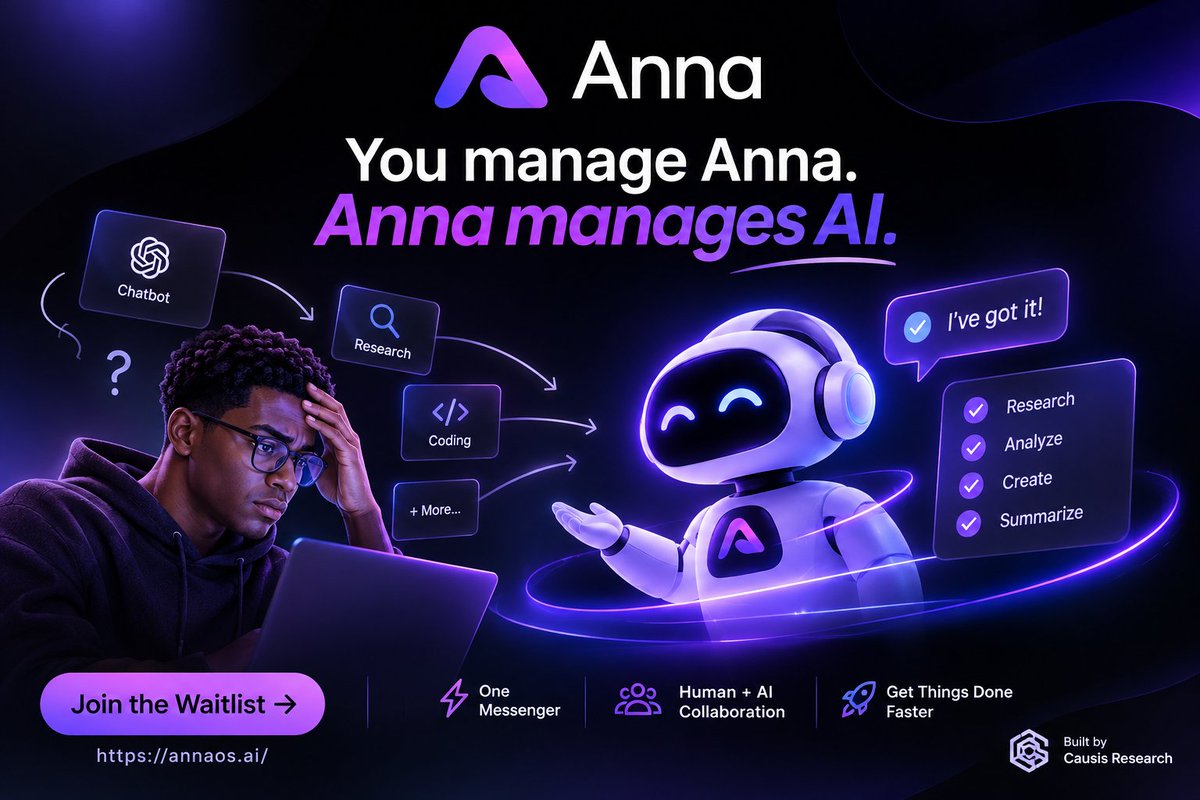
AI is getting smarter every day.
But there's still one problem: using it often feels like managing an entire team of tools.
One chatbot for writing. Another for research. Another for coding. And somehow, you're the one coordinating everything.
What if AI could handle that coordination for you?
Meet @annaos_ai 🧵
ITLG: From a Token People Earn to a Token People Can Actually Use
One of the most important questions surrounding any blockchain ecosystem is simple: what can people actually do with its token?
For InterLink, I believe this is an important part of the conversation around the future of ITLG.
The long-term vision goes beyond earning tokens through participation. ITLG is being positioned as an ecosystem token with potential applications across different areas, including digital payments, marketplaces, social applications and financial services.
Think about what this could mean if these different products become properly connected.
A user could participate in the ecosystem, access services, interact with applications and potentially use ITLG across different platforms without treating every product as a completely separate experience.
This could also create opportunities for developers and businesses. Instead of building applications without an established user base, developers could potentially tap into InterLink's growing community and create products that serve real needs.
However, the important part is execution.
A token does not become useful simply because its ecosystem has many proposed use cases. Those use cases need to become accessible products, attract consistent users and provide genuine reasons for people to interact with them.
That is why I think the transition from mining-focused participation to practical utility will be one of the most important stages in ITLG's journey.
The future should not be measured only by how many people hold ITLG, but also by how many people have meaningful reasons to use it.
#InterLink #ITLG #ITL
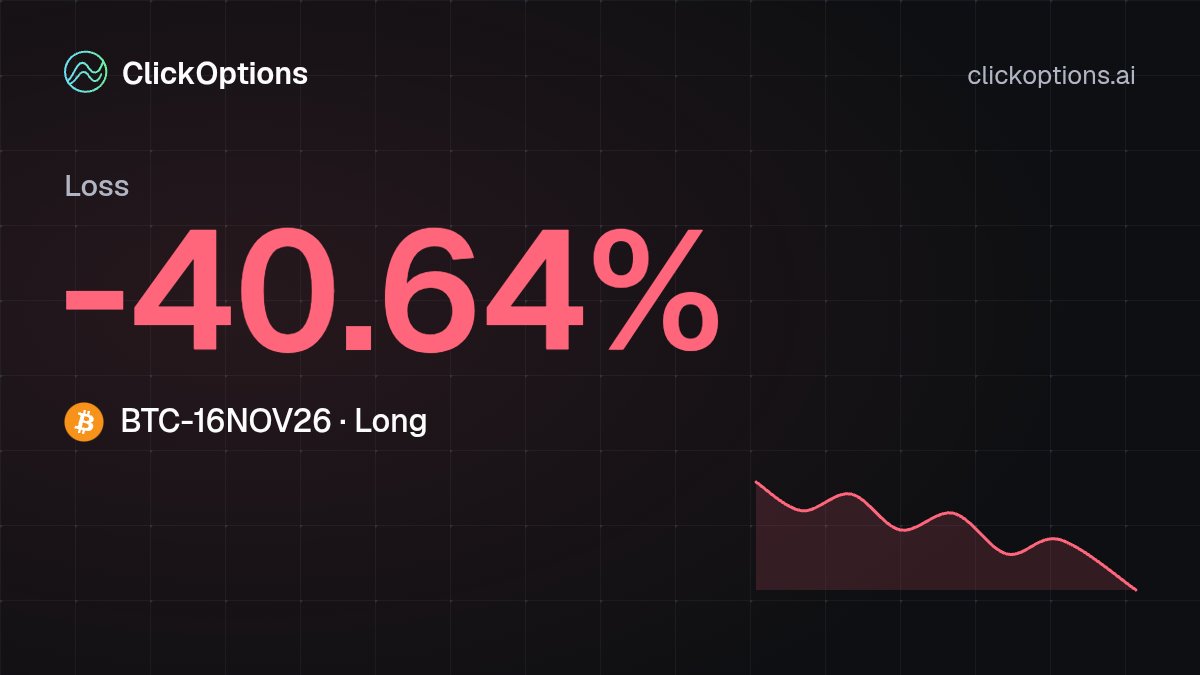
Yesterday, my BTC long didn't go as planned. A stop-loss hit, and I took a -40.64% loss. That's part of trading, and sometimes the market reminds you that not every setup will work.
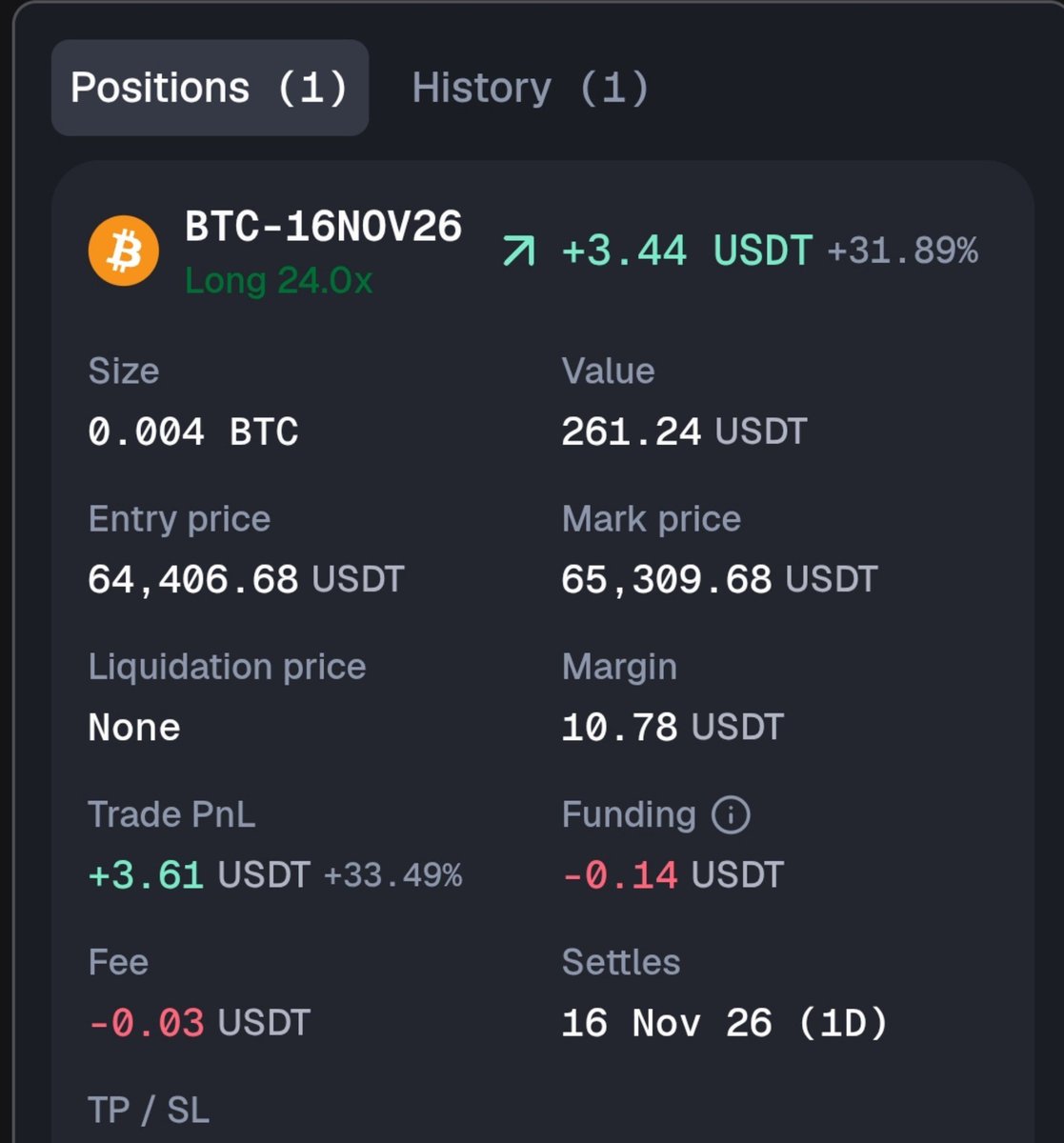
Today, I got back into BTC long on @clickoptions_ai and this time the position is moving in my favour. Currently sitting at +31.89%
What I appreciate about ClickOptions is the different approach to trading. No liquidation level hanging over each position, with Futures and Predictions giving traders more ways to engage with the market.
One bad trade doesn't end the journey. Learn, adjust and try again.
Honestly, @clickoptions_ai is becoming one of my favourite platforms to explore for trading and predictions.
The Long-Term Future of ITLG Depends on Building a Connected Ecosystem
When discussing the future of ITLG, I think it is important to look beyond the token itself and examine the ecosystem being developed around it.
A strong blockchain ecosystem needs more than a token and a large community. It needs useful applications, active developers, businesses, accessible services and a sustainable economic structure that connects everything.
This is where InterLink's broader vision becomes interesting.
Imagine an ecosystem where digital payments, marketplaces, social applications, financial services and DeFi products can complement one another.
Each product could serve a different purpose, but they would contribute to a connected digital environment. ITLG could potentially become an important part of that interaction by supporting access, participation and utility across the ecosystem.
Developers also have an important role to play. The more useful applications that are built, the more reasons users may have to remain active. Businesses could explore opportunities to serve this community, while users could benefit from services that go beyond simply holding a digital asset.
But a connected ecosystem must be built on solid foundations.
There needs to be transparency around token utility, clear staking and reward mechanisms, sustainable incentives, security and a genuine demand for the services being developed.
Growth driven only by speculation may not last. Long-term value is more likely to come from products that solve problems and attract consistent usage.
For me, that is the real opportunity ahead for InterLink: turning a promising ecosystem vision into practical experiences that people can use and developers can build upon.
ITLG's future will ultimately depend not just on what the ecosystem plans to offer, but on what it successfully delivers.
#InterLink #ITLG #ITL
A 70% win rate sounds impressive. But would you still choose that strategy if it was losing money?
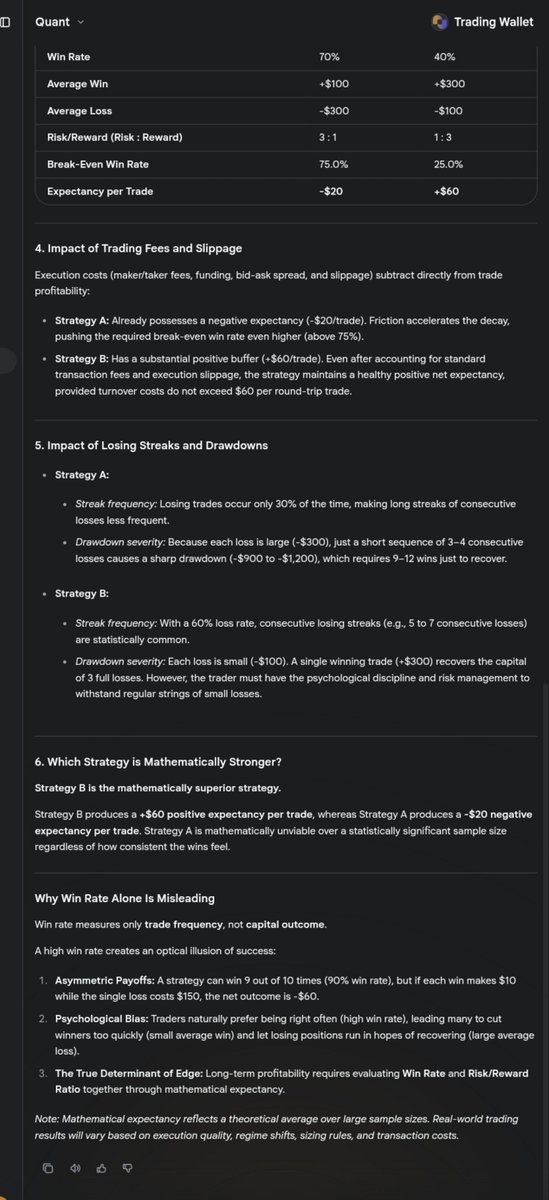
I used @tryquantio AI to compare two hypothetical trading strategies, and the result was interesting.
Strategy A
• 70% win rate
• Average win: +$100
• Average loss: -$300
• Expectancy: -$20 per trade
Strategy B
• 40% win rate
• Average win: +$300
• Average loss: -$100
• Expectancy: +$60 per trade
Strategy B wins less often, yet has a much stronger mathematical edge.
Quant AI also highlighted three things worth checking beyond win rate:
• Risk/reward ratio
• Break-even win rate
• Fees, slippage and potential drawdowns
The lesson is simple: being right more often doesn't automatically mean making more money.
I think expectancy deserves more attention when evaluating a trading strategy. A high win rate can look attractive while hiding poor risk/reward.
This is why I use Quant AI to look beyond the headline numbers.
Explore it here: https://t.co/ZOb5TRt9XI
@tryquantio #QuantAIPioneers
From Mining to Ecosystem Utility
For more than a year, millions of people have participated in building the InterLink community.
Now, with the transition toward ITLG Mainnet, the bigger question is what people will actually be able to do with ITLG.
The vision goes beyond simply holding a token.
ITLG is intended to become an ecosystem asset that could connect users to different products and services, including digital payments, marketplaces, social applications and financial services.
Imagine one digital asset serving different purposes across an interconnected economy.
For developers, access to an existing community of more than 11 million users could also create opportunities to build products with a ready audience.
The real test will be turning community participation into useful economic activity.
That's the transition worth watching.
#InterLink #ITLG #ITL
The next chapter of InterLink is getting closer.
Sir KV has shared that one of his current priorities is completing the KYC portal and bringing transferable $ITLG into the ecosystem.
For Linkers who have followed the project from the beginning, this is an important development.
But I think the bigger question is what comes after transferability: how will ITLG connect with the different products, communities, and economic activities being built around InterLink?
The token is entering a new phase, and its long-term utility will matter just as much as the transition itself.
#InterLink #ITLG #ITL
If you’re not busy, you might want to check out @nuloraio
The first NFT collection launching on the solana:moJA7YR7ZfCsfAnjQwR94zjmn886ik9KchMjBnrpump chain is on the way.
🎨 Supply: 2,500
🆓 Mint price: FREE
Create your NULORA wallet, save your recovery phrase safely, complete the task, and join the waitlist.
Crypto needs more conversations about privacy. I believe users should have more control over their financial information, and NULORA is one project worth keeping an eye on.
https://t.co/510hjEcWtK
CONSO BOTS MINT IS ALMOST HERE!
I've been anticipating this, and I'm eligible for 5 BOTS!
📅 Oct 22 | 3 PM UTC
🎟️ 5,555 BOTS | FREE MINT
🤖 Agentic Collectibles
3 PHASES:
🎟️ GTD — 48 hours
📊 Impressions Raffle — 2 hours
🌍 Public Round — while spots last
✅ Connect your X account + Sui wallet.
⛽ No gas fees!
📸 Impressions snapshot: 12 hours before mint.
🔗 Check eligibility & mint:
https://t.co/7vg50zUZVu
Don't wait until the last minute. Registering interest doesn't guarantee a BOT!
I've been waiting for this moment. Let's see how mint day goes! 🐻❄️
Here's a problem worth solving
A company wants to prove it meets a financial requirement. Does it really need to hand over its entire financial history to do that?
I don't think it should have to reveal more information than necessary.
This is where privacy and verification become interesting.
@primus_labs is building infrastructure designed to verify information, including data held offchain, while helping preserve confidentiality.
Think about the possibilities instead of treating private data and trustworthy evidence as opposites, applications could be designed to verify specific claims while protecting the underlying information.
That's an important distinction.
Trust shouldn't always require total exposure. Sometimes, proving the relevant fact is enough.
For me, this is one of the more meaningful problems being addressed in onchain finance.
Explore Primus XP: https://t.co/LMCTqYyVnN
Not everything in crypto is about buying low and selling high.
For many Linkers, $ITLG represents the time spent mining, the people they connected with, and the journey they've experienced with InterLink.
Sir KV recently reflected on how the community has celebrated milestones, made mistakes, corrected them, and continued building together.
That history explains why some people feel a strong connection to ITLG.
As the ecosystem develops, I hope that connection is supported by useful products, meaningful participation, and a clear long-term direction.
#InterLink #ITLG #ITL