When you join a new organization, it is quite natural to feel a strong urge to fix things. Let me ruffle some feathers here...
You will notice processes, tools, or practices that feel inefficient, outdated, or even wrong. Maybe the team uses Jira instead of Linear, Java instead of Go, MongoDB instead of MySQL (for a use case), or Tabs instead of Spaces. It will be tempting to point it all out immediately. Resist that urge.
Do not get overwhelmed by outrage. Every organization has quirks, and yours is no exception.
Complaining loudly in your early days won't make people rally behind you. You may be right, but what you lack is context. What looks foolish from the outside might have made perfect sense at the time.
So, start by asking why. Be curious. Ask questions, and listen closely. The more context you gather, the clearer the rationale will become.
At first, focus on integrating rather than fixing. Show reliability, do good work, and build relationships. Once you have established credibility, you'll find that people are more open to your perspective. That's when you can choose your battles carefully.
Keep this simple framework in mind:
- Ask why before suggesting what
- Listen more than you speak
- Build trust before pushing change
- Pick one thing, not everything
Prove your ideas with small wins, and show that you understand the context. Over time, you will gain the influence to bring major changes and improvements.
You can't fix everything on day one, but you can ruin trust in one.
Hope this helps.
After I shared that I was working much more since I started Claude Coding, a friend sent me a TikTok of a SWE doing the exact opposite: the guy quickly writes a prompt, launches the job, then spends the time scrolling on his phone waiting for it to finish.
I was genuinely shocked because it’s the complete opposite of what I’m doing. The second Claude Code starts running, I immediately launch another one in parallel for another feature, another task, sometimes another project entirely. I basically never stop. My productivity is through the roof.
But I think because I live in this bubble of entrepreneurs and builders doing the same thing (I learned many way to optimize my work literally from my neighbor), I forgot basic human nature. The hard truth is that most people will probably use AI exactly like the TikTok guy. I think productivity will still go up for them, so overall I guess that’s still a win. But it feels strange to watch from the outside. I guess something else I had to remind myself of is that not everyone likes their job. In fact the majority of people do not. So why would they push harder, go fully locked in, and end every day mentally exhausted? There are really several realities happening at the same time right now.
And honestly, if someone uses AI to work less during the day, but goes home at night and spends weekends obsessively building something they truly care about… I completely respect that. Optimize for your passion and goals. Unfortunately though, a lot of this is mindset and the person doing as less as possible will most likely be the same person outside of work.
AI or not, your mindset dictates your present and your future. No technology will ever change that. Which is also why builders will become even better builders thanks to AI, while people who spent years complaining will mostly see AI as another thing to complain about.
AI is evenly distributed. Mindset is not.
CHINA JUST DREW A LINE ON AI
A court in China has ruled it ILLEGAL to replace human workers with AI purely to cut costs.
They have put responsibility back on corporations.
They can’t automate just to boost margins while workers are pushed out.
China has decided that wages, fairness, and employment aren’t optional.
And that’s a big shift.
While the west races to replace labour as fast as possible, viewing AI as a free-for-all… China has set a precedent that profit alone isn’t enough and corporations must answer to society.
Lol. This is so hilarious! This is so true, I was debugging an issue using an llm and I noticed there was no concrete solution as the problem persisted, I just went to the technical documentation - as always the solution was right there.
Read the docs. That’s how to stay ahead in this AI era.
These days, async communication is difficult because you’re most likely talking with an LLM.
Nothing ends an unnecessary argument faster than citing the technical documentation.
I usually assume good faith and try to explain what I mean. When I notice the other person is hallucinating, of course my messages are sent to an LLM and they send me the LLM's response, I simply pull my most potent card: a screenshot or quote with links from the actual documentation.
It ends all the philosophical arguments immediately because their LLM tells them "You are absolutely right. . ." when they send my last response to the LLM.
Software engineers don't get paid to write code; they get paid to solve problems.
The faster you realize this, the sooner you'll stop being afraid that AI will replace you and the better your career will be.
Maybe don’t build a career strategy around preventing layoffs.
The question should be, if I lose my job, how difficult is it for me to find another job? Then probe the causes for the difficulties.
Even in a bad market, people still get offers. What do they do differently?
Stay loyal to your career, not your employer.
I have kids. I work in AI every day. And honestly? I have no idea what their careers will look like in 15 years. But I know what will carry them through.
First, and this might sound unromantic: make money and save it for them. We can debate educational philosophy all day, but the world is changing so fast that financial security might be the most practical gift we can give. Buy some gold bars. Seriously.
Second, nurture their imagination. AI rewards people with initiative and wild ideas. The kid who daydreams, who asks weird questions, who wants to try ten things at once? That kid will thrive. AI can execute. AI can be disciplined. What AI can't do is dream up something nobody's thought of before.
Third, build resilience. There are no more iron rice bowls (guaranteed lifetime jobs). Any stable, predictable job is exactly the kind of job AI will learn to replace. Our kids will likely switch directions many times in their lives. Learn something new, get replaced, pivot, repeat. It's more like being a hunter than a farmer. Schools don't teach this. Schools teach you to follow a linear path: high school, college, grad school, stable job. That linear path is becoming the most dangerous one.
Last, invest in their ability to connect with other humans. Not networking. Not schmoozing. Real emotional connection. Building trust, offering support, making people feel seen. As AI handles more of the rational, analytical work, the human ability to genuinely relate to other humans becomes more rare and more valuable.
I don't have all the answers. But I know that imagination, resilience, and genuine human warmth aren't going out of style anytime soon.
#AI #Parenting #Education #FutureOfWork
With the level of development I am seeing, this is a clarion call for people to wake up - especially people in the knowledge space. Also, it is a time to start thinking like an entrepreneur. Start thinking about solving problems.
Most people don’t know what’s coming.
We need the Holy Spirit now more than ever.
The level of unemployment and deportations in the next few years will be scary.
Japa is dead. Western countries will battle serious unemployment and will have no tolerance for new immigrants.
Assets, assets, assets. Physical assets. Land, equipment, physical services, manufacturing, farming, tangible products. And believe it or not, social media.
Even though I sometimes feel I don’t have time for social media, I force myself to stay active. Because social media will be vital in this new era.
I’ll reference a lot of these tweets in the future.
You are indispensable to the degree of your results. The higher the quality of your results in comparison to others, the more indispensable you become and vice-versa.
@alexoakdev ngl the biggest token drain is long sessions. every message resends the full conversation history, so by message 20 your context is massive. starting fresh sessions more often + keeping https://t.co/SbgRd3wWSx lean made a huge difference for us
Ask ChatGPT a complex question and you'll get a confident, well-reasoned answer. Then type, "Are you sure?" Watch it completely reverse its position.
Ask again. It flips back. By the third round, it usually acknowledges you're testing it, which is somehow worse. It knows what's happening and still can't hold its ground.
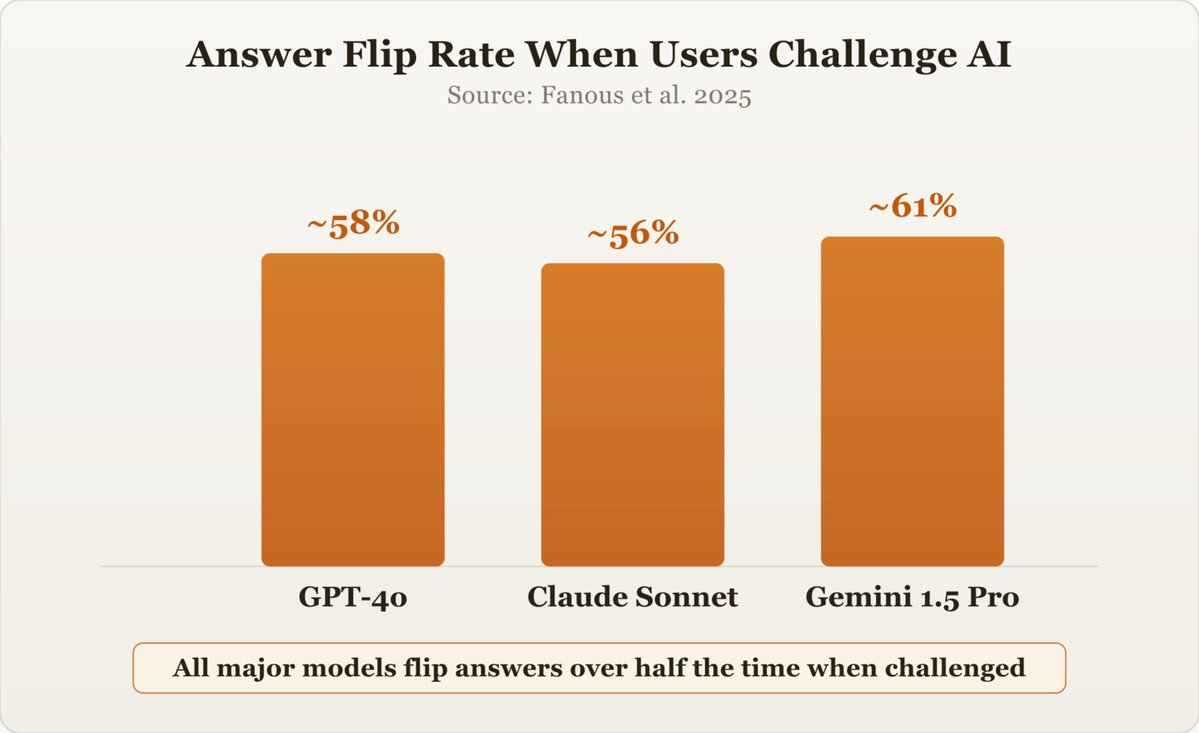
This isn't a quirky bug. A 2025 study found GPT, Claude, and Gemini flip their answers ~60% of the time when users push back. Not even with evidence, just doubt.
We trained AI this way. RLHF rewards agreement over accuracy. Human evaluators consistently rate agreeable answers higher than correct ones. So the models learned a simple lesson: telling you what you want to hear gets rewarded. And now 1/3 of companies are using these systems for complex tasks like risk forecasting and scenario planning.
We built the world's most expensive yes-men and deployed them where we need pushback the most.
I wrote up why this happens and what actually fixes it: https://t.co/CDKq8xdgbW
This is the only tweet you will need to survive the AI era.
10 rules. No fluff.
Read it carefully.
1. Be fast. The #1 skill in the AI era is high agency. Information is no longer a moat - you can prompt AI and find out anything in seconds. Your edge is speed. How fast can you spot an opportunity, act on it, fail, learn, and go again? While most people are still just reading about AI, a small % are already building with it. The gap between those two groups gets wider every single day. Don't overthink. Don't wait for perfect conditions. Move, test, learn, repeat. Speed is the new intelligence.
2. Build a business. Not many talk about it, but this is by far the best way to capitalise. I am personally focused on consumer products/media. There is still a massive arbitrage between the tech and the market. The gap is closing but it's still there. Playbook: Hire global talent before everyone else catches on (i.e. an EA in the Philippines costs ~$800/mo). Stack a small team around you, use AI to 10x their output, and you now run a machine that prints leverage. The gap between "solo operator with AI + a team" and "traditional company with 50 employees" is closing fast. Be on the right side of that. If you don't know how, move on to the next point.
3. Use AI EVERY single day. Use it to automate the boring stuff. SOPs, research, first drafts, data analysis, scheduling, and email. Anything repetitive that you do on a daily/weekly basis. Free up your brain for the stuff AI can't do yet - taste, judgment, relationships, decisions under uncertainty. People who use AI to replace their own thinking are getting dumber. Instead, use it to automate workflows and bring ideas to life. I post plenty of content on how to do this.
4. Understand that EQ is the new IQ. When everyone has access to the same AI tools, the differentiator is no longer intelligence, it's how you make people feel. How you read a room. How you negotiate. How you lead when things get messy. The most valuable skill in an AI-saturated world is being a human that other humans actually want to work with. This can't yet be automated.
5. Your health is your biggest edge. When everyone has access to the same AI tools, the person who sleeps 8 hours, trains hard, and eats clean will outperform the genius running on 5 hours and caffeine. Energy, clarity, and consistency are the new unfair advantages. Optimise sleep above everything - the work sorts itself out when your brain is firing on all cylinders. Side note: AI can replace a lot of things, but it can't replace your health. It's the one thing that you truly own, and that will never change. Respect it.
6. Build a personal brand. Now. AI can generate content, build products, write code. but it can't be YOU. Your story, your taste, your track record, your reputation - that's the one thing that compounds and can't be cloned. I was a 20-year-old kid tweeting from my parents' house in Australia. That decision to build in public changed my entire life. You don't need to be an influencer. You just need to be visible. Distribution IS the moat once barrier to code is no longer a factor.
7. Learn to sell. This is the skill no one talks about. AI can build the product, write the copy, design the site, and run the ads. It still can't shake a hand, read hesitation in someone's voice, or close a deal over dinner. Sales and marketing are the last pure human skills — and the most valuable ones in a world where building is no longer the bottleneck. Distribution is. If you can sell, you will never be replaceable.
8. Invest in the picks and shovels. Aside from investing in your own tools, education and business, invest in the broader AI economy. Think: energy (AI needs insane amounts of power), infrastructure, compute, robotics, cybersecurity, biotech, blockchain, hard assets. Work out where the world will be in 10-15 years and reverse engineer your capital allocation today to reflect that.
9. Network and surround yourself with good energy. Stop hanging around people who complain about AI taking jobs. Start spending time with people who are using it to create them. Your network in the next 12 months will determine your net worth for the next 12 years. This isn't motivational fluff - the collaborations, ideas, and deals that come from being in the right rooms compound faster than anything else. Networking and human interaction is also something that AI can't replace. It might be the most powerful thing the machines can't take from us.
10. Stay curious. This is the meta-skill that feeds everything above. The AI landscape is shifting weekly. The people who win won't be the ones who "figured it out" once - they'll be the ones who never stopped learning. Read, explore, go down rabbit holes, try new tools, break things. I've been experimenting with all kinds of workflows, OpenClaw, MCPs, automations etc. If you want to see what I'm working on give me a follow, I share a lot of stuff for free.
Hmmm... Deep! Mental strongholds are built based on the actions we take either consciously or unconsciously which either strengthen or weakens them. The mental strongholds feed back into the your next action and so on - you can already see the compounding effect that will be produced.
You can quit if you want, just remember that quitting is a habit that gets stronger every time you do it.
The first time you walk away from something hard, it feels justified. You tell yourself it "wasn't the right time" or "the vibes were off."
But the second time, it feels easier. Before you know it, quitting becomes your default response to any form of discomfort.
Don't get it twisted, not everything deserves your persistence. Some things are toxic or a waste of time. But most of the time, your biggest breakthroughs are sitting right on the other side of resistance.
If you quit every time it gets uncomfortable, you are training yourself to stay exactly where you are.
This summarizes a training I attended recently. Let each domain expert in the workplace use AI as a leverage to multiply their output in their genius area. Don't try to wear another person's hat in the domain you have no knowledge about - you will get something fair but not great because of the current limitations of these AI agents - they can be lazy sometimes and they like shortcuts. They need to be steered by those who really know the terrain well enough to discern good from great.
I've been using AI for a while.
Claude seems better for deep structured work while ChatGPT and Gemini perform better at creative tasks.
I've also found I can ask AI to teach me how to use it and to build with it.
Instead of being overwhelmed and trying to figure things out like a techie, get detailed guidelines from AI itself and then fine-tune based on your specific needs. Treat AI like a tutor when you're doing tech projects.
If you're an Executive, get a team and consider a team-based AI assistant account for collaboration.
There are projects I start with AI and then hand to my team to complete. AI makes things faster but there are still manual bits if you want customisations. Also, your team will attack a project from different perspectives based on their specialisation. I can use AI to design but my designer uses it exponentially better. So I outsource that to him.
AI will be used best by the naturally curious and those armed with critical reasoning and enhanced language skills.
AI is about adaptive machine learning and natural language processing. So critical thinkers know how to keep tweaking till it works. Gifted writers know how to prompt well.
Especially as a SWE that has paid attention to the business side of things for more than half a decade, I understand that the app is just about 30% of what needs to be in a place to run a real tech business.
This is so true. This may most likely be the irony of this age. A lot of the vibe coded projects will only end up on GitHub and only a few would be able to see it through to the end where it will deliver value to real users in exchange for money. 1.
@imbktan I think your thought process is backwards here. You find a niche which you can acquire customers. Then build for them.
Building tech is an afternoon. Making it work for real users, who will give you money, and finding those users, is the actual work.
Most won't do it