If you have deposits or loans in asdCRV LlamaLend market on Arbitrum - please exist ASAP out of precation.
The market is fine right now but its price oracle can become unstable due to the vsdCRV exploit which can cause liquidations.
I think the market is still fundamentally mispricing @CurveFinance and the long-term value accrual potential of $CRV.
What Curve is building with $crvUSD and PegKeepers is one of the most sophisticated forms of onchain monetary infrastructure currently operating in DeFi.
And I don’t think the market fully understands how important that becomes if stablecoins continue scaling globally.
One of the key innovation is the PegKeeper architecture.
Most protocols attempt to maintain stablecoin liquidity through emissions and external incentives alone. That approach works temporarily, but it usually creates unstable and expensive liquidity that disappears once incentives decline.
Curve approached the problem differently.
PegKeepers allow the protocol to algorithmically expand or contract crvUSD liquidity around the peg by interacting directly with Curve pools themselves. When crvUSD trades above peg, PegKeepers can mint liquidity into the system. When below peg, liquidity contracts naturally through repayment dynamics.
That mechanism matters because it transforms Curve from a passive exchange venue into an active liquidity coordination layer for stablecoins.
In my opinion, that distinction is extremely important.
The market still values many DeFi protocols based on transactional activity alone.
But the protocols that ultimately matter are usually the ones controlling the underlying liquidity rails and monetary plumbing.
Curve is increasingly positioning itself exactly there.
And the recent frxUSD integrations reinforce this thesis significantly.
Frax and Curve have already spent years building one of the deepest economic alignments in DeFi:
• Curve AMO integrations
• Deep FRAX liquidity on Curve
• Convex flywheel participation
• Gauge competition
• Shared liquidity incentives
• Stablecoin-focused market structure
Frax has consistently treated Curve liquidity as core infrastructure for maintaining efficient stablecoin markets.
Now with $frxUSD being integrated into Curve’s PegKeeper framework and broader crvUSD ecosystem, the relationship becomes even more structurally important.
To me, this is where the bullish thesis for $CRV strengthens materially.
Because if Curve succeeds in becoming:
• the dominant stablecoin liquidity venue,
• the coordination layer for decentralized dollar liquidity,
• and eventually a foundational layer for onchain FX and synthetic dollar markets,then the value of controlling Curve liquidity becomes substantially larger than what the market currently prices in.
This is also why @ConvexFinance became so important historically.
Convex did not emerge randomly.
An entire meta-layer formed around accumulating influence over Curve emissions and liquidity because Curve liquidity itself became economically strategic.
That is usually what happens around valuable infrastructure.
And unlike many DeFi protocols that relied heavily on narrative cycles, Curve has repeatedly demonstrated durability across multiple market environments:
• bear markets,
• liquidity crises,
• stablecoin stress events,
• changing yield conditions,
• and collapsing speculative demand.
Yet despite all of that, Curve liquidity remained deeply embedded across DeFi.
That resilience is not accidental.
It comes from the fact that stablecoin liquidity is one of the few sectors in crypto with persistent and recurring demand regardless of market direction.
People speculate less during bear markets.
But they still need liquidity.
They still need stable settlement.
They still need efficient swaps.
They still need collateral mobility.
Curve consistently sits at the center of those flows.
And if stablecoins continue evolving into a major global crypto primitive over the next decade, I believe protocols managing liquidity efficiency, peg stability, and capital routing will become disproportionately valuable.
That is why I remain bullish on $CRV, cause Curve looks like the financial infrastructure for onchain economy.
Curve's UI is scheduled for routine maintenance on May 25 at 9:00 AM CEST as part of a database upgrade.
Expected duration: 20 min to 1 hour.
During the upgrade, the UI will be unavailable. Underlying smart contracts will continue to operate normally
A free-market approach to have a recovery option for those who lent in CRV LlamaLend market and were affected by extreme volatility on 10/10/25
https://t.co/Uts5CVCRbt
Live for 7 months and our three BTC pools are the largest BTC pools on ETH mainnet with a cumulative TVL of ~277 million.
- 5.4-9.9% BTC APY, with TRD near 0% as of April 26, 2026
- $3.84M in protocol fees distributed to $YB lockers
- No security incidents across Yield Basis or its dependencies
- 99% TVL retention
If you haven’t tried borrowing on LlamaLend yet, I’m curious why.
Rates are very low right now, and in many cases it’s one of the cheapest places to borrow or long majors.
Need CRV to pump for better vlCVX bribe epochs (requires fundamentals or alt pump)
YB pools are currently balanced (finally) which provides much more volume to crvUSD
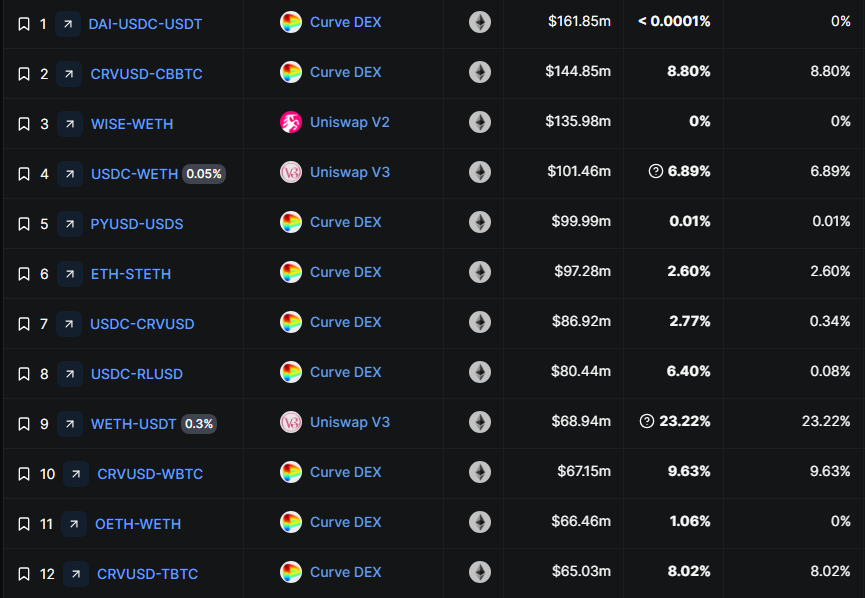
Pegkeepers are currently at their highest levels at nearly $150m providing less than 1% borrow rates, and a rock solid crvUSD peg. Better peg = more trade volume as well
Low borrow rates are starting to attract crvUSD mints again
Expansion of crvUSD will signal to the market CRV is back on track
Due to rsETH LayerZero infrastructure being hacked, we decided to pause Curve LayerZero infrastructure before more understanding about the root causes is obtained, out of precaution.
This affects:
* CRV bridging from chains: bnb, sonic, avalanche, fantom, etherlink, kava. Other chains use native bridging;
* crvUSD fast bridge (slow bridging for L2s still works).
Lending design is evolving fast in DeFi.
0xtutti (@0xtutti), Product Architect at @CurveFinance, will present Llamalend V2 and the next iteration of lending infrastructure.
JW Marriott · Cannes · 27-28 March