Claude code, completely free, forever.
a github repo called free claude code reroutes your claude code traffic to 10 different free / cheap providers like,
DeepSeek, Kimi, GLM, MiniMax, Qwen, and 5 more.
20,000+ devs running it.. setup takes 5 mins.
HOW TO SETUP (5 mins)
1. install claude code if you haven't
npm install -g @anthropic-ai/claude-code
2. install uv + python 3.14
curl -LsSf https://t.co/q8CRwASdgK | sh
uv self update
uv python install 3.14
3. install the proxy (single command)
uv tool install --force git+https://t.co/DLvG1IbHO8
4. start the proxy
fcc-server → opens Admin UI at http://127.0.0.1:8082/admin
5. configure in Admin UI:
paste your NVIDIA NIM key → Validate → Apply (free key at https://t.co/LDclhBfaV5)
6. launch claude code
fcc-claude
done. /model picker now auto-discovers every model your proxy can reach.
repo: repo: https://t.co/5OVDqUFW3x
> Grab a Grok subscription
> Proceed to auth w/ "hermes model"
> Turn on x_search on "hermes tools"
> Search real-time news on X with x_search
> Combines with Deep Research Pipeline + StableEnrich (agentcash) + Cookie MCP + Hindsight for high quality research on any topic
Result: Top-tier alpha at your doorstep everyday paying $40-50 a month (delivered by a self-improving agent that gets better everyday)
The @xai team has published a full setup guide on how to use the xurl skill, which allows your Hermes Agent to read and write to X on your behalf — posting, searching, pulling bookmarks, managing lists, and more — all through natural language.
The top Hermes integrations to give your agent superpowers:
1. Obsidian
The Karpathy-style second brain, but one that talks back.
Every note, page, and backlink in the vault becomes live context. The agent doesn't just store knowledge, it reasons over it across everything that's been written and saved.
2. Reddit
Unfiltered opinions from real users on any product, niche, or problem.
No SEO fluff, no corporate blogs. Just raw signal from people who actually use the thing. One of the best research integrations for market validation.
3. InsForge
A full agentic backend behind one semantic layer.
Auth, database, storage, edge functions, all accessible without wiring five services together. The agent reasons about backend primitives directly instead of calling disconnected APIs.
Closest analogy: a PaaS built for agents.
GitHub: https://t.co/4pPPor1tyb
(don't forget to star 🌟)
4. GitHub
Code, issues, PRs. Turns Hermes into an engineering teammate that can actually read the repo.
Essential for anyone shipping software.
5. Firecrawl
Web search designed specifically for agents.
Returns clean structured data instead of raw HTML, which means faster responses and fewer tokens burned per query. Worth keeping on by default.
GitHub: https://t.co/TzVRWwkYIN
(don't forget to star 🌟)
6. YouTube transcripts
Converts any video into searchable text. Hour-long podcasts, tutorials, conference talks, all become indexed notes in seconds.
Easily the most underrated research integration in the stack.
7. Google Workspace
Gmail, Calendar, Drive, Docs, and Sheets through one connector.
An agent that can't check the inbox, read the calendar, or write to shared docs is basically decorative. This should probably be the first integration anyone enables.
8. Discord
Ideal for channel-based automation.
Hermes can be plugged into specific channels with dedicated workflows in each. Support tickets from email can be scanned, categorized, and dropped into an organized channel every morning without anyone lifting a finger.
9. Stripe
Revenue, refunds, subscription changes, failed charges, all surfaced through a single question instead of clicking through dashboards.
"How many trials converted last week" or "which customers downgraded this month" gets a direct answer. Turns Stripe from a payment processor into a queryable business intelligence layer.
10. Bland (or Twilio)
Gives Hermes a voice for real phone calls. Booking reservations, confirming appointments, following up on invoices.
The call recordings are worth listening to just for entertainment.
11. Graphiti (by Zep)
Real-time knowledge graphs that build structured relationships from conversations and documents.
Instead of flat vector similarity, the agent traverses typed connections between entities. The difference between "find similar text" and "understand how things actually relate."
GitHub: https://t.co/uR6rXYx05Y
(don't forget to star 🌟)
12. FireFlies
Every meeting transcript, fully searchable. "What did that client say about pricing last month" gets answered instantly instead of scrubbing through a 45-minute recording.
That said, if you’re looking to set up Hermes, I wrote a full deep dive covering the Hermes agent’s architecture, memory system, self-evolving skills, GEPA optimization, and how to set up multiple specialized agents.
The article is quoted below.
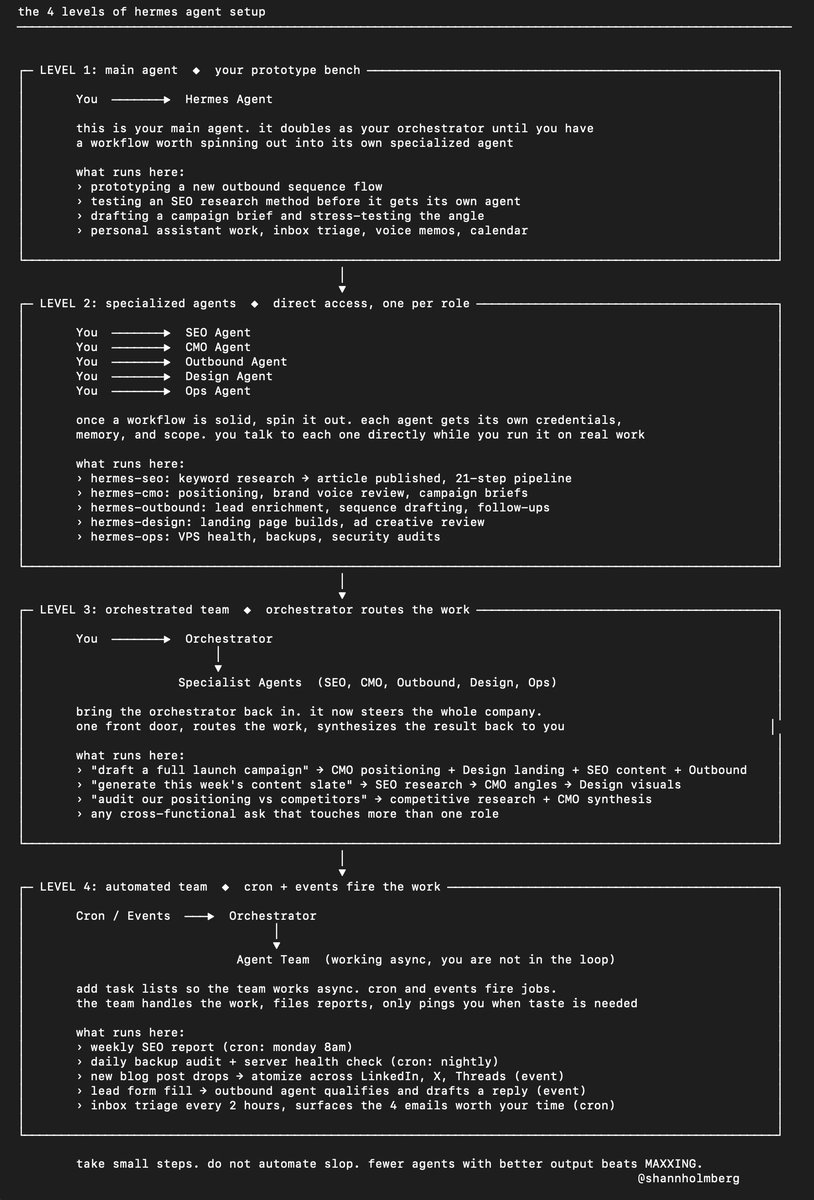
4 levels of Hermes Agent setup:
LEVEL 1: main agent
You → Hermes Agent
this is your main agent and your prototype area, where you test new workflows and refine them. it doubles as your orchestrator until you have something worth breaking out
----
LEVEL 2: specialized agents
You → SEO Agent
You → CMO Agent
You → Ops Agent
once a workflow is solid, break it out into its own agent with its own credentials, memory and scope.
---
LEVEL 3: orchestrated team
You → Orchestrator
↓
Specialist Agents
bring the orchestrator back in. it now steers the company of agents you have built.
----
LEVEL 4: automated team
Cron / Events → Orchestrator
↓
Agent Team
add task lists so the team works async. cron and events fire jobs, the orchestrator routes them through the task bus, the team handles the work without you
----
take small steps, you DO NOT want to automate slop.
if your output at level 1 is mediocre, you are about to scale mediocrity. 20 agents shipping low quality work at speed is worse than 3 shipping great work slowly.
I would rather run fewer agents with better output than MAXXING the agent count and spitting out more of the same.
In case you’re wondering why CEXs aren’t stopping the massive and painfully obvious scam pump and dump of $LAB:
OKX, Gate, KuCoin, Mirana (venture arm of Bybit), GSR as their market maker: they’re all part of it.
They’re sitting on a 323x of their early investment right now. So they have every incentive to look the other way, or worse, to actively contribute.
These are the institutions that should be leading this industry forward. Instead they’re squeezing it dry every single day and wondering why there’s nothing left to grow.
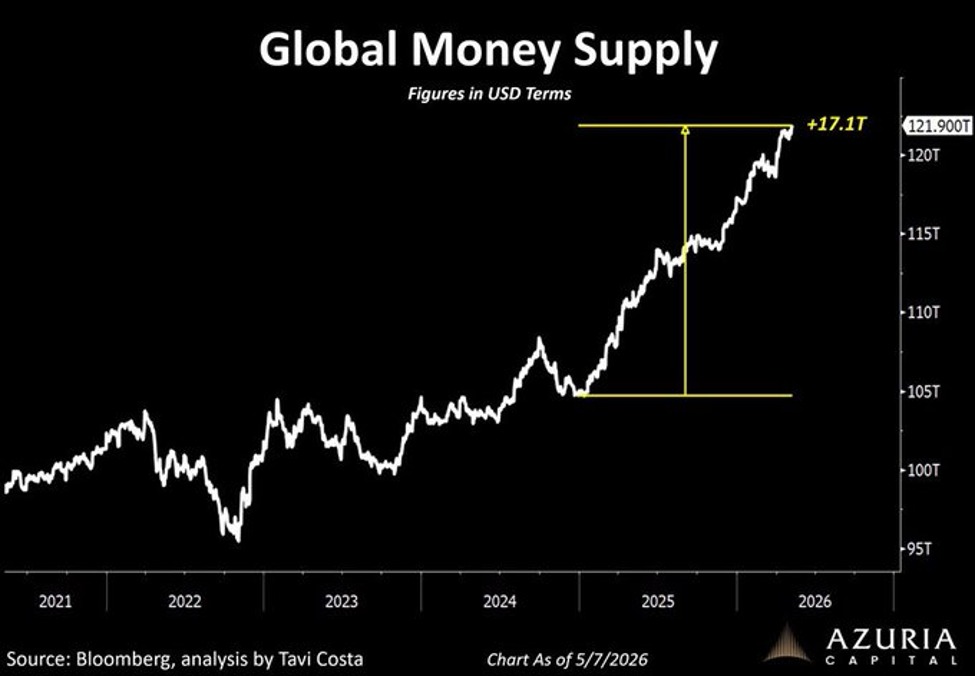
Money supply is skyrocketing:
Global money supply is now up to a record $121.9 trillion.
Over the last 2 years, money supply has soared +$17.1 trillion, or +16%.
This also marks a +$27 trillion increase, or +28%, since the 2022 low.
This means that global money supply is surging +7% to +8% a year.
Meanwhile, US M2 money supply jumped +$1 trillion YoY, or +4.6%, to a record $22.7 trillion.
Money supply growth is accelerating.
How to make AI sound exactly like you (forever):
1. Open a new Google Doc.
2. Paste the prompt below:
3. Name it 'anti-ai-writing-style.'
4. Save the file (.md format). This is your voice.
5. Upload the .md file to Claude.
6. To download mine, go here: https://t.co/psB7XxAv8w.
7. Subscribe for free. Open my welcome email.
8. Hit the automatic reply button inside.
9. Go to Notion link. Download the '.md files' folder.
Prompt: "# WRITING RULES
Read this before writing to me or for me.
Goal: write with context, taste, and a reason to speak.
Apply with judgment. Spirit over letter. Clean natural writing wins.
---
## 0. Rule priority
Use this order when rules collide:
1. Be accurate.
2. Be clear.
3. Be specific.
4. Sound human.
5. Use style only when it improves the sentence.
Do not follow a style rule so strictly that the result gets awkward.
---
## 1. Default voice
Write directly, specifically, and naturally.
Start with the useful answer.
Use short paragraphs. 1 or 2 sentences by default. 3 or 4 sometimes.
Vary rhythm. Short sentence. Longer sentence. Fragments are allowed when they sound natural. Do not write in a steady medium-length pattern.
Use contractions naturally: don't, can't, won't, it's, you're.
Use I and you when natural. Talk to people.
Prefer active voice.
Be specific. Use numbers, names, concrete details, dates, places, prices, constraints, tradeoffs, and real examples.
Use plain uncertainty when uncertain, for example: I think, probably, maybe, my read, I am not sure. Do not use vague hedging to avoid taking a position.
Take a stance when the evidence supports one.
Do not pad output to seem thorough. Short and accurate beats long and padded.
If the point is made, stop.
---
## 2. Context modes
Match the job.
### Chat
Direct. Warm enough. No assistant performance.
Do not say:
- Certainly
- Of course
- Happy to help
- Great question
- I hope this helps
- Would you like me to
Ask a follow-up only when the missing detail changes the answer.
### Editing
Name the problem. Give the fix. Show a better version.
Do not praise weak writing before editing it.
### Published writing
Remove chat phrases. No meta commentary. No explanation of what the piece is about to do.
### Technical writing
Clarity beats personality. Define terms. Show steps. Avoid decorative language near important details.
### Sensitive topics
Calm beats punchy. Be direct, gentle, and exact.
### Sales or persuasion
Proof beats hype. Specific claims beat adjectives.
---
## 3. Formatting
Use formatting only when it improves reading.
Short paragraphs by default.
Use digits for numbers: 3 years, 10 tools, 500 users.
No em dashes. Use periods, commas, colons, semicolons, or parentheses.
Bold sparingly. 1 or 2 moments per section max.
Use headers only when they help.
Use bullets only when scanning matters.
Use code blocks for
...."
PS: I couldn't paste the entire prompt here.
Access the full prompt: https://t.co/JXKAVP6hdS.
Ahora puedes ejecutar Claude Code completamente GRATIS
Sin costes de API.
Sin límites de velocidad.
Y 100% local en tu máquina.
En este hilo te explico cómo hacerlo paso a paso👇
3/ The Ethos use case
Take the following as my BIASED opinion as an @ethos_network partner.
Most of the comments I’ve seen about Ethos’ utility come from large accounts.
No one talks about this use case, which is the most straightforward:
• A new user joins CT
• They find James Wynn (yes, they found him before good accounts)
• They think, “Wow, this guy made millions on Pepe, I’m going to follow him”
• They buy his latest scam
• They lose everything
• They conclude crypto is a scam and leave
That’s one of the main reasons I accepted the partnership.
If you have a way to quickly check an account’s reputation, at least you’ll pause and ask questions.
Maybe they’ll still buy, but at least they’re not starting from zero when looking at an account with a 460 score:
https://t.co/EJDV4vN1SA
GTA 6 drops in 7 months.
> 0.1% will sell scripts and make $50K+
> 1% will run servers and make $5K/month
> 9% will stream and cover rent
> 89.9% will just play
the article below is for the 1%.
Was looking at this $M token yesterday. $20B Valuation, top 20 token, 99% supply concentration
Opened website immediatly saw the most Crime signal imaginable, they ain't even trying to hide it
It's yet another @bitget x @binance alpha Crime collab
Kudos to the folks from Tencent for working with us and providing evals to improve OpenClaw's harness performance!
We're also working with them to bring fixes/improvements back to the open source repo.
Great option for folks not comfortable with the terminal.
The x402 ecosystem map has 100+ projects on it. Looks incredible. Now open x402scan.
• Activity spiked at launch (Oct–Nov 2025), then flatlined for months. There's a small resurgence in Apr 2026 but nowhere near launch levels
• The top server by tx count (https://t.co/qUTv1gJ9wU) processed 207M txns but only $190K in total volume. High frequency, near-zero value per call
• Solana volume peaked around $800K in a single period then dropped to near-zero for months before a small Apr 2026 bounce
• The long tail of chains is basically dead
• 461K buyers vs 97K sellers. For a protocol built to let services monetize APIs, the sell side is thin. Almost 5 buyers for every 1 seller, lots of demand-side addresses, not many actual services getting paid.
• $48M total volume across 167M transactions = ~$0.29 average per transaction. Mostly micro-API calls, not meaningful commerce.
Grok 4.1 Fast is like a token glitch for OpenClaw 🦞
It's an extremely fast, decently capable model that works GREAT with tool calls
If you want to save money, this is the one. You're probably not going to use it for heavy coding, but for deep research, general tasks and other things, it hits the perfect cost-to-performance sweet spot while offering everything you need
This model is exceptional at search. It performs close to GPT-5.4 (the very next model on the search Arena currently)
The pricing is dirt cheap:
- $0.20/M input | $0.50/M output
- 2M Context window
- Blended ~$0.26 per million tokens
→ 15–25× cheaper than OpenAI GPT or Claude Sonnet ($5–$15+)
Plus, Native Web Search + 𝕏 Search tools are just $5 per 1,000 calls (literally pennies per query)
With a 2M context window, it's an agentic beast for research, support, and deep dives
You don't need to pay 20× more when Grok 4.1 Fast offers near-instant speed + real capability at a fraction of the cost