Every guide to Claude is a list of features to turn on. None of them price the thing all those features spend.
I counted my own setup this morning. CLAUDE.md plus three reference files, 2,808 words, and every one of them loads before I've typed anything. Call it 4,400 tokens of rent per session, and that's arithmetic on character count, not a tokenizer.
That's the cheap part, because it's at least visible.
Project instructions ship with every message in that project, forever, so three paragraphs of throat-clearing is three paragraphs you pay for a thousand times. Adaptive thinking runs on every message whether the message needed it or not.
Turn everything on the same afternoon and you get a slower Claude that knows your dog's name and forgets what you asked two messages ago.
Twelve features, each with the price attached, in the order that works.
https://t.co/2hPMXzUIs1
Your research agent handed you twelve sources. Here is a five-line check for how many of them are actually one.
def shingles(text, n=12): w = text.split() return {" ".join(w[i:i+n]) for i in range(len(w)-n+1)}
shared = shingles(a) & shingles(b)
Take every twelve-word window from both pages, intersect the sets, look at the size. Twenty or more shared windows means one was written out of the other. Below that you are catching cookie banners and nav chrome.
Run it over every pair before your synthesis step ever sees the pile. No model call, no embedding, no API key, 0.2 seconds of CPU for all 28 pairs of an eight-page set. The whole minute my run took was HTTP.
https://t.co/tTyD1YUglW
Six subagents on one content project. One of them is still an agent.
A subagent is not a role. It is a context boundary, and the boundary has a price. A fresh subagent inherits no conversation history, none of the files already read, none of the skills already invoked. It gets CLAUDE.md, a git status snapshot, and the prompt string you hand it. That prompt string is the only channel from parent to child.
So I priced the re-brief on all six. Same column every time: what I have to restate through that one channel, and what comes back.
write-post. Re-reads the voice file from scratch, ~590 tokens, plus every decision from the last hour restated by hand. Returns one finished draft I cannot edit in place.
make-visual. Re-reads the visual system, ~900 tokens. Same problem, wider.
topic-ideas. Restate the taste it just watched me apply, and it still comes back with the category I rejected on Tuesday.
check-claims. Restate nothing. It reads a dozen doc pages and returns a verdict, and those twelve pages never touch my window.
audit-numbers. Same shape. The spreadsheet stays in the child.
editor. Restate nothing, and the blindness is the whole point. It must not see me defending my own draft.
Token counts are chars over four on the actual files in the repo. Arithmetic, not a benchmark.
Three of them were paying that tax for a boundary that bought me nothing. They are skills now. Two became forks, which inherit the entire conversation and still keep their reading out of my window. One stayed an agent, because it needs a hostile system prompt, three tools and its own model.
That is the test. Different system prompt, smaller tool set, different model. No to all three and you are looking at a skill wearing an agent costume.
The part most people have backwards: subagents buy main-context headroom, not a smaller bill. Every subagent runs its own API requests and they all count against the same budget.
Failure modes, the exact error strings, and the two env vars that stop a runaway fan-out are in the article.
https://t.co/TwHPbzJuFP
I turned on every Claude feature at once and it got worse.
Slower. More expensive. Extremely well informed about my preferences, and noticeably worse at the actual task.
Took me a while to work out why. Every setting you enable writes itself into the same context window, and that window is where your question has to fit too. Project instructions ride along on every message. An invoked skill stays until the session ends. Connectors ship their tool definitions whether you call them or not.
Nobody writes about this, because "turn it all on" is a better headline than "here's what it costs".
So I wrote the version with the costs. 17 features, the price tag on each, and the three worth paying for first.
https://t.co/2hPMXzUIs1
Every guide tells you which Claude features to turn on.
None of them mention that all of it comes out of the same window.
Project instructions ride along on every message. An invoked skill sits in context until the session ends. Connectors load their tool definitions whether you call them or not. Turn everything on and you get a Claude that knows a lot about you and has less room left for the thing you actually asked.
I wrote up all 17 features with the price tag attached. What each one buys you, what it takes, and the order to turn them on in.
Read it before you enable anything else.
https://t.co/2hPMXzUaCt
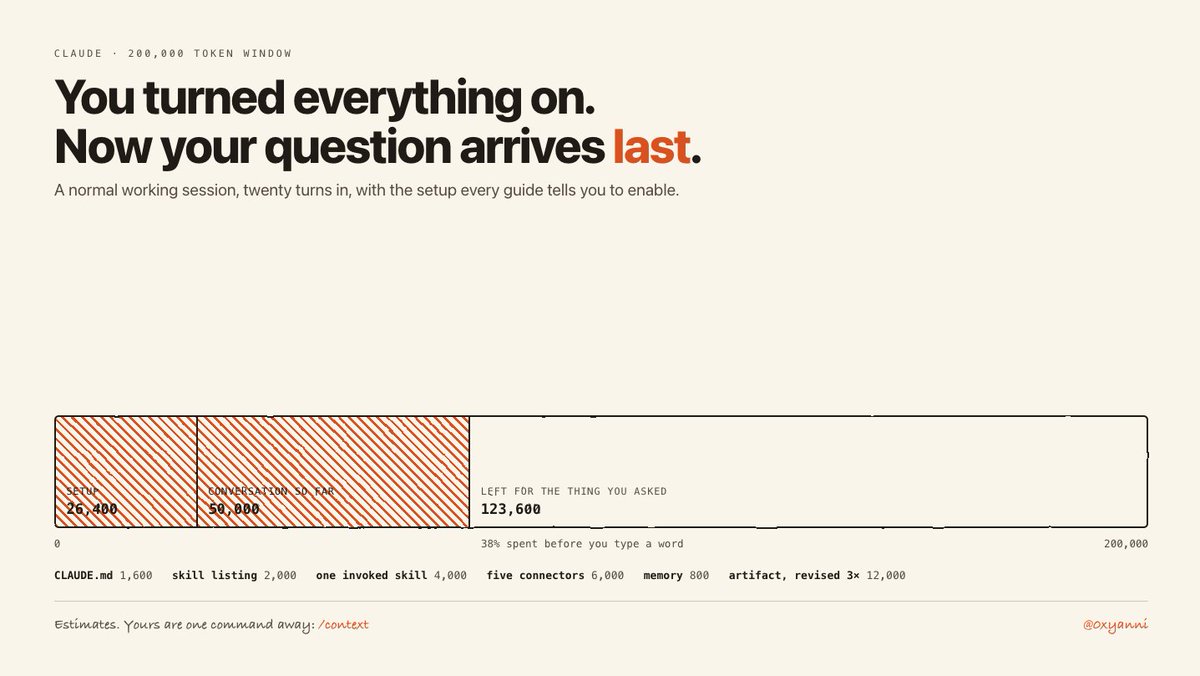
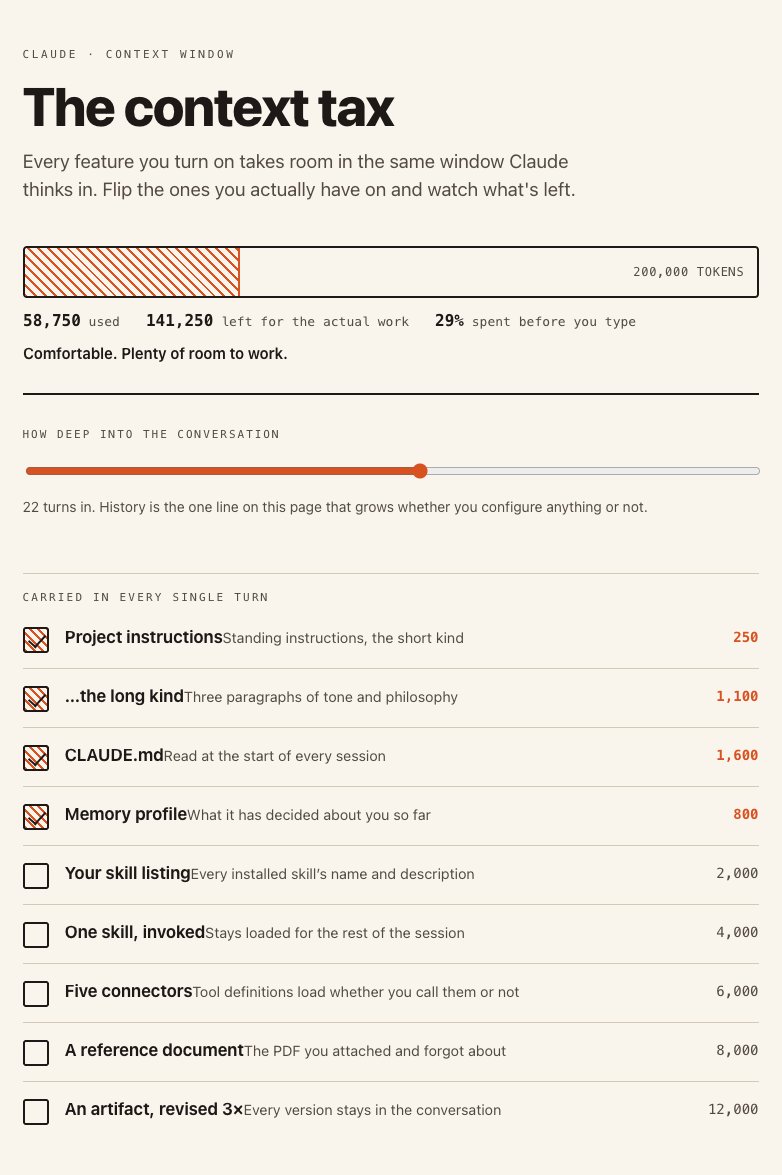
I built a thing that tells you how much of your context window is gone before you type anything.
Turn on project instructions, a CLAUDE.md, memory, one skill, a few connectors, and a PDF you forgot you attached. Scroll twenty turns into the conversation. Watch what's left.
Mine came out at 61% spent on setup.
Every guide tells you what to turn on. None of them mention that it all comes out of the same window.
https://t.co/2hPMXzUaCt
Anthropic just shipped Claude Opus 5.
And I think most people are going to use it wrong.
They’ll open Claude.
Write a better prompt.
Compare the output to the old model.
Post benchmark screenshots.
That’s not where the real jump is.
Opus 5 is built to be more proactive — which matters way more once you stop treating Claude like a chatbot.
Give it tools.
Persistent context.
A real agent loop.
Let it plan → execute → inspect → correct.
Now every improvement in the model compounds through the system around it.
That’s the shift people keep missing.
Better models are nice.
Better models inside better systems are where things start getting stupid.
The biggest leap in AI right now isn’t a new model.
It’s the loop around the model.
Single-shot Claude is already strong.
Claude inside a proper agent graph is a different animal.
When you force the system to:
• plan
• execute
• critique its own output
• rewrite
• and repeat
…the quality jumps in a way that feels almost unfair.
I rebuilt one of my old workflows with a proper loop last week.
Same model. Same prompt. Completely different results.
The model was never the bottleneck.
The structure around it was.
Most people are still prompting.
The ones pulling ahead are engineering loops.





![0xyanni's tweet photo. Your research agent handed you twelve sources. Here is a five-line check for how many of them are actually one.
def shingles(text, n=12): w = text.split() return {" ".join(w[i:i+n]) for i in range(len(w)-n+1)}
shared = shingles(a) & shingles(b)
Take every twelve-word window from both pages, intersect the sets, look at the size. Twenty or more shared windows means one was written out of the other. Below that you are catching cookie banners and nav chrome.
Run it over every pair before your synthesis step ever sees the pile. No model call, no embedding, no API key, 0.2 seconds of CPU for all 28 pairs of an eight-page set. The whole minute my run took was HTTP.
https://t.co/tTyD1YUglW](https://pbs.twimg.com/media/HQQ7KIEaUAAp5Uh.jpg)