@NegentropyorDie@oguzerkan thx for mentioning the Triffin Dilemma - everyone should read the wiki page, it has the most succinct explanation of the history and structural implications of USD as the global reserve currency that I have come across https://t.co/3XYOlcTqBt
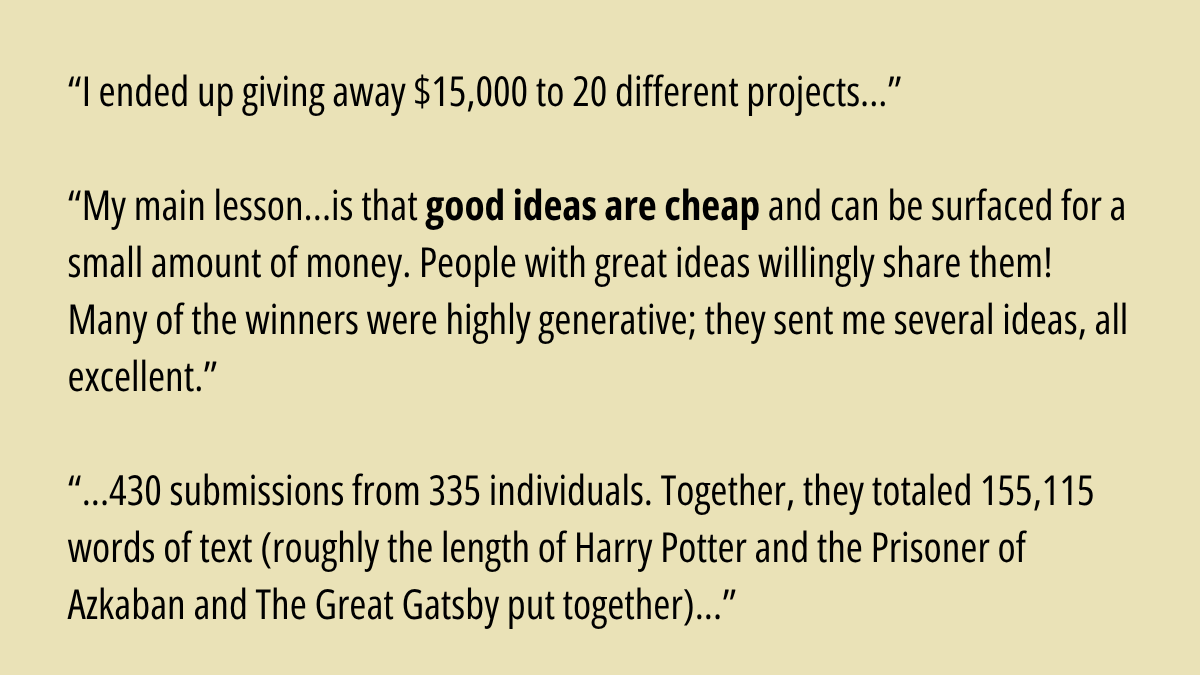
Announcing the winners for the "Fast Biology Bounties."
I ended up giving away ~$15,000 for 20 projects after reading 430 submissions from 335 individuals. Many winners were "highly generative," meaning they sent me 3-5 excellent ideas and were glad to have them shared freely and openly.
There were some major failure modes, too. Some ideas surfaced repeatedly, but I didn't do a good job of connecting "like-minded" people. I'll fix this next time.
Also, I managed everything manually using my personal email. This was tedious, and I'm working on building a platform that will automate a lot of this. I'd like to send feedback and scores for every submission in future contests.
Many more details in my blog post, which breaks down all the numbers, what I learned, and highlights some of the winners.
Some people who I gave money to:
- Sebastian Cocioba for a laser-based PCR thermocycler, in which infrared heating replaces aluminum blocks.
- Bryan Duoto for writing and publishing a colony-to-sequence cloning workflow that uses magnetic beads and Nanopore sequencers. Scientists can verify clones in 1–3 hours instead of waiting overnight.
- Jeff Nivala for an idea to synthesize proteins directly from DNA, without relying on any RNA intermediates.
- Sierra Bedwell for a clever automation system that uses off-the-shelf parts to screen thousands of environmental DNA samples in parallel.
- Xavier Bower for "IceCreamClone," an interactive cloning strategy ranker that looks at a scientist’s available “parts,” or sequences, and then determines whether they ought to use Gibson, Golden Gate, restriction digest, or another strategy to assemble them together. The software also catches likely cloning errors and estimates the cost and time required for each option.
- Andres Arango for multiple ideas, including using antifreeze to accelerate DNA ligation by 2-3 orders of magnitude, and an idea for computationally designed protein cradles for expressing membrane proteins in E. coli.
SLOTKIN: Have you given the order to be able to shoot at unarmed protesters in any way? I'm just asking -- don't laugh
HEGSETH: What is that based on?
SLOTKIN: It is based on Trump giving that order to your predecessor, who I give a lot of credit to because he didn't accept the order. He has more guts and balls than you.
I've been calling the Ukraine War the first "Maker War" because of how DIY it is.
Amazingly, Ukraine actually used the open source hobby drone software Ardupilot to execute the attack.
See the general WSJ article below for more details.
The most obvious way to tell that this was obviously an emergency walk back from Trump is that they can’t even all get their lie straight.
Bessent said it had nothing to do with bonds collapsing. Minutes later, Trump specifically said that is why he changed course.
Because it’s not about funding availability it’s about the terms and conditionality of funding when your debt underpins the entire global financial system. The U.S. isn’t like other sovereigns. It doesn’t just borrow to fund itself it issues the asset that anchors collateral chains, settles FX swaps, backs derivatives, and serves as margin for global risk-taking.
Other nations borrow in markets. The U.S. is the market.
And that’s the paradox: when your debt is systemically central, it must be perceived as stable, liquid, and low volatility or else the entire global leverage system begins to crack. That’s why a Treasury market failure wouldn’t look like a failed auction it would look like repo seizures, collateral fire sales, massive cross-asset volatility, and central banks scrambling to restore functionality not because the U.S. is insolvent, but because the plumbing can’t clear.
Other sovereigns can lose access to funding and markets absorb it. When the U.S. loses trust in its collateral quality, the entire global margin architecture collapses from swap books and dealer inventories to pension fund hedges and corporate bond spreads. This is nonlinear fragility: it moves fast, breaks things all at once, and can’t be fixed with a rate cut.
In this scenario, the real crisis isn’t whether the U.S. can print it’s whether anyone trusts the printed collateral to serve as a reliable foundation for leveraged global finance. When that cracks, it’s not a fiscal event. It’s a systemic trust breach and that’s how the most creditworthy issuer in history could face a “funding” crisis.
Not because it can’t find buyers.
Because the buyers won’t accept the terms anymore.
@NickDesnoyer Hahahaaaa good one! The direwolf coverage is so superficial - like saying if you and I share the same eye color, hair curliness & color, and voice pitch [1], we must be family.
So what makes changes make arabdop. -> Dire lotus?
[1] https://t.co/f3rJr2Q8JF
What unfolded in the past 24 hours was a textbook case of global liquidity fragmentation colliding with political signaling and desperate intervention. We saw a clear Treasury market fracture during Tokyo hours yields surged, dollar funding conditions wobbled, and the BoJ had to convene an emergency meeting. That alone signaled global cross-currency basis stress and hinted at a margin call ripple through JGBs and USTs. Then came Europe: GILTs blew out, the ECB started issuing verbal anesthesia, and still futures were oddly resilient. That disconnect between collapsing sovereign credit confidence and relentless equity bids. reeks of centralized intervention, likely via options books or indirect plunge protection.
The final act White House messaging felt more like a coordinated circuit-breaker than a market response. “Tariff pause” headlines functioned as a synthetic catalyst for liquidity injection, not a true fundamental repricing. But here’s the kicker: none of this repaired the damage under the hood. SOFR-OIS spreads are still unstable, swap spreads remain inverted, and bank CDS signals are flashing systemic. We’re witnessing what looks like a 2025 variant of March 2020 except this time, sovereigns are the weak link, not just banks. Risk is no longer cyclical it’s institutional.
@NegentropyorDie@oguzerkan@diybio@iGEM Ah that's why we found each other and enjoyed a mutually-beneficial convo! nice. For biotech maybe there is a @diybio lab nearby (https://t.co/YyYkrHXKgH); for AI check out https://t.co/wTqKYUnxkM
@JG_Nuke see @onechancefreedm's macro analysis (9 apr 25): "seeing market makers choking down risk premiums to prevent a cascade - system may be temporarily re-sedated, butunderlying dysfunction (collateral instability, credit stress, margin bleed)" not addressed https://t.co/DrYukLnpsv
This historic 35% drop in the VIX on the heels of a parabolic volatility spike raises red flags rather than easing concerns. On the surface, it might read as “risk is off the table,” but structurally, this reeks of forced volatility suppression, possibly tied to massive options dealer repositioning, central bank pressure on vol markets, or a one-time unwind of defensive macro hedges. It’s also worth noting this comes just after Treasury yields spiked, credit spreads widened, and gold and oil moved violently a very odd backdrop for VIX collapse.
My hypothesis is that this is a synthetic vol compression event, not an organic one. When liquidity evaporates in volatility products (as seen during sudden dislocations), small notional flows can drive extreme price changes. Combine that with heavy zero-day options gamma games, and we could be seeing market makers choking down risk premiums to prevent a cascade. The system may be temporarily re-sedated, but the underlying dysfunction (collateral instability, credit stress, margin bleed) hasn’t been addressed it’s simply been suppressed. This makes the next volatility eruption more disorderly, not less.
@NegentropyorDie@oguzerkan I build illuminated wearables with mesh networking capabilities. Currently scaling production of my LED scarf project, Gloas. Previously started @diybio and worked at @iGEM. Sort of a modern gentleman-scientist. I enjoy learning for the intrinsic joy of understanding