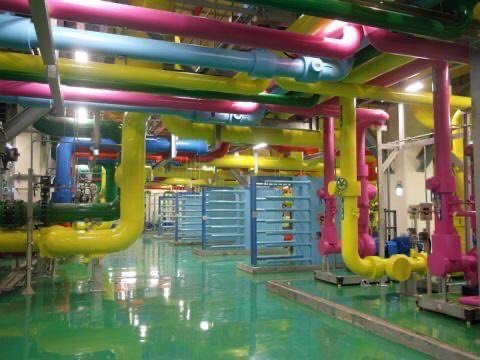
I dreamed I was working a low-paying job that involved dragging wool through kilometers of enclosed pipes and narrow tubing with an enthusiastic team.
The emotional tone of the dream was deeply depressing, but only for me. The work felt endlessly monotonous. The environment resembled a whimsical fun house from Charlie and the Chocolate Factory, yet there was nothing enjoyable about it. It paid very little, and I had the overwhelming feeling that I would be stuck doing the job for a very long time.
—Jungian Dream Amplification
You are losing trades because you are not building price narratives. Read this entire post twice. It will help.
Before you focus on aligning expansion candles through swings & cracks in correlation/SMT, you need to apply universal model logic.
Don't blindly search for a "2 stage" or a "strength switch" or a "Psp" do the following.
There are 5 components of my model; this is the order you must apply them in. Here's the logic as to why.
1. Draw on liquidity | Highs/Lows & Gaps
- This is derived directly from universal models
i. ERL > ERL (Order Paired Ranges) -> i.e. Reversal P.o.P
ii. IRL>ERL (FVG>Swing) -> i.e. Continuation P.o.P
iii. ERL>IRL (Swing>FVG) i.e. Retracement P.o.P
2. Profile [Protraction Profiles]
- How are we delivering to that ERL or IRL in context of a fractal OHLC/OLHC concept (Daily and H4 [session])
i. Asia Reversal
ii. London Reversal (Classic P or Delayed P)
iii. NY reversals
iv. Void Profiles (S&D)
3. Key Level | Also Highs/Lows or Gaps
- Where are we delivering to the draw from?
i. Reversals (External Ranges | highs & lows)
ii. Continuations away from Reversal (Gaps)
At this point we have established a Price Narrative, now we can apply FILTERS to qualify high probability swing formations, and specific price phenomena such as SMT Breaking, Decoupling etc.
Filter 1: Cracks in Correlation | Component 4 of Model
4. CiC | SMT & PsP formations
i. At a "True Reversal" we will see a 2-Stage CiC; this will confirm the swing formation as high probability and filter out relevant swings in the market that form in key levels.
- This can look like some variant of SMT + PSP (Part 1 of my YouTube masterclass on reversals, go study if unsure)
ii. In continuation from a true reversal we will see at least a 1-stage CiC forming within [ideally] a gap to qualify the redistribution swing [think MMXMS here, redistribution away from a fair value gap]
- This can look like some variant of SMT-Fill (Part 2 of my YouTube masterclass, go study if unsure)
Filter 2: Asset Synchronization | P.o.P Arguments
i. Decoupling | 6:00 H4 Candle on Indicies
- In the case of decoupled expansion at 9:30 I have a specific protocol to identify which assets are manipulating and which are in foreseen distribution. I also have a specific protocol using CiC to trade the resync.
- This is referred to as Algo 1 in my teachings.
ii. SMT Breaking | Leading/Lagging Asset Dynamics
- In the case of SMT Breaking I will mechanically use strength switch to qualify/time when assets will expand to previously diverged highs/lows.
- I will use SS-CiC's | Remember CiC is a FILTER on a swing. So if I am trading a lagging asset in continuation, I will demand a SS-CiC either a SS-SMT (SMT fill in gap) or a SS-PSP
- If you are unsure about this watch my YouTube lecture titled: Strength Switching Universal Frameworks)
-- --
Once you have
1. Established your Price Narrative
2. Qualified your swing points using CiC Logic
3. Established which Filters you are applying to the specific trade
you then demand the following:
5. Lower Time Frame Reversal Signature
- A v shape away from the key level + CiC + Filter
- CISD, the creation of LTF gaps
Now you have a complete trade idea. A narrative + swing formation. You now are trading a high probability Universal Model.
there's no audience to impress.
no people to please.
no applause to chase.
do everything for yourself.
stop comparing your journey to others and move at your own pace.
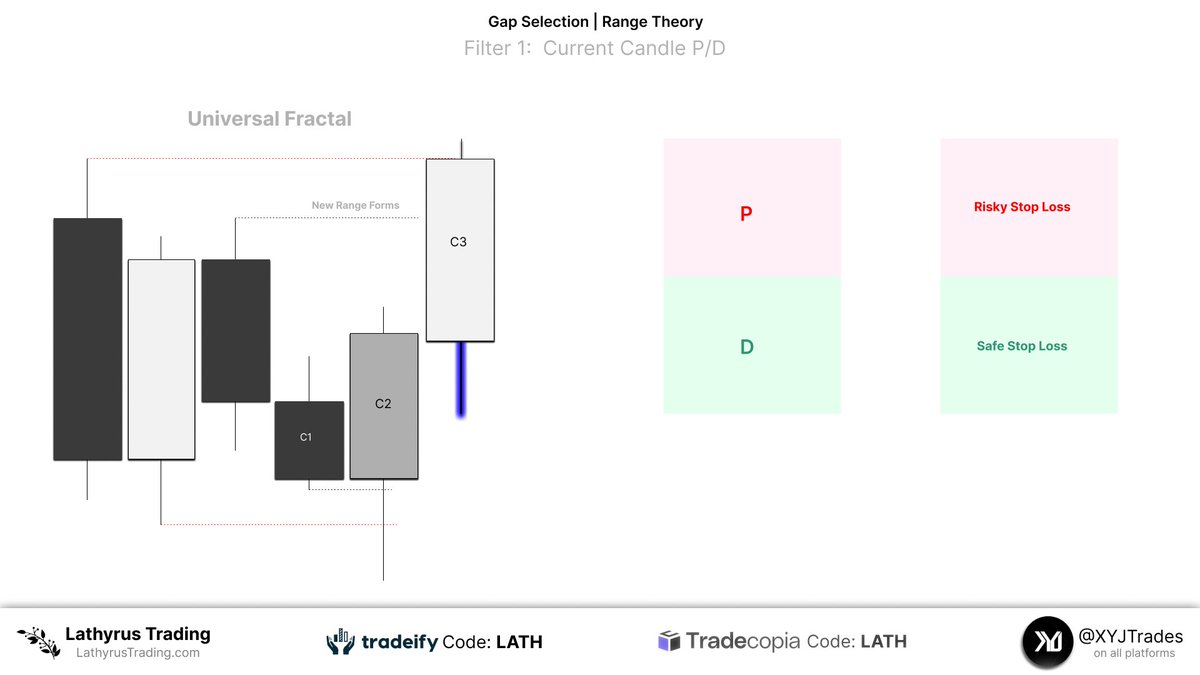
Gap Selection Logic | Three principle Considerations
1. Higher Time Range (Implied Dealing Range)
2. Current Candles Range
3. Relevant Swings / Structure to the left
__________________________________________
Consideration 1 & 2: Higher Time Frame Range (IDR)
& Current Candles Range
To define an implied dealing range you will anchor a P/D tool from the reversal area, which is the extreme of the universal model (IRL<>ERL) to the other side of the range, also known as the Draw on Liquidity.
If we are in premium of this IDR you are going to want the current candle you are trading (expansion candle) to be giving you a discount entry.
This is where you will incorporate the second consideration and look for a "local" discount. The logic here is simple; if we are in discount of the higher time frame Universal Fractal then most gaps will hold as price is expanding away from the reversal.
Price must expand after reversing, and the proximity to the reversal will lead to one sided movements away from that reversal.
______________________________________________
Consideration 3: Relevant Swings / Structure
When price engages a key relevant level in the market we anticipate a new phase of price. That is to say we do not wanting to be trading near the high of a range, after it has taken an old high, for example.
In this case, we will wait for price to show us a Failure to Manipulate signature of the current candle, and then trade a new swing formation above that old high.
What is Failure to manipulate? Two mechanical filters:
1. Closure through an opposing series of candles in that candle that trades into the key level i.e. a new IC-CISD
2. The creation and respect of a gap through a key level, forming a new valid continuation signature.