Content Registration: A creator or platform registers a piece of content (e.g., a video from a specific platform) with the https://t.co/GR5BIctJSu protocol.
The first step in the https://t.co/GR5BIctJSu ecosystem, Content Registration, is far more than a simple submission process; it is the foundational act of anchoring a piece of digital media to the immutable ledger of the blockchain. This is the moment where a fleeting piece of content—a YouTube video, a TikTok, a podcast episode—is transformed from a transient file on a centralized server into a verifiable, on-chain asset that can be interacted with, measured, and valued by the entire Web3 world.
When a creator or a platform initiates the registration, they are essentially creating a digital birth certificate for their work. This process involves submitting a unique identifier for the content, such as the video's URL or a specific content ID, to the https://t.co/GR5BIctJSu smart contract. This action triggers several critical functions. First, it logs the content's existence and its creator's wallet address on the blockchain, establishing an unchangeable and publicly auditable record of provenance. This immediately solves a major problem in digital media: provable ownership and origin. No longer can a platform claim ambiguous ownership over the data, nor can bad actors easily misrepresent content as their own.
But the registration goes deeper. The creator can also define the specific parameters they want the https://t.co/GR5BIctJSu network to observe. This isn't a one-size-fits-all system. A creator might want to track total views, while a financial platform backing that creator might be more interested in average watch time or the growth rate of subscribers within a certain period. By defining these metrics at the point of registration, the creator sets the terms of engagement for how their content will be measured. This puts the power back into the hands of the creator, allowing them to define the key performance indicators (KPIs) that truly reflect the value of their work, rather than being forced to conform to the opaque metrics dictated by a centralized algorithm.
Furthermore, the act of registration often involves staking a small amount of the protocol's native token. This serves a dual purpose. It acts as a spam deterrent, ensuring that only serious content is submitted for observation, thus preserving the integrity and efficiency of the network. More importantly, it aligns the creator's incentives with the health of the protocol. By staking, the creator becomes a stakeholder in the ecosystem, benefiting from the overall accuracy and growth of https://t.co/GR5BIctJSu.
Once registered, the content enters a queue to be observed by the decentralized network of nodes. It is no longer just a video sitting on a server; it is now a task, a data point, a verifiable event waiting to be witnessed by the collective. This registration is the gateway that allows off-chain media to be brought into the on-chain economy. It is the critical bridge that enables a creator's work to be seamlessly integrated into everything from decentralized finance (DeFi) protocols and DAO governance to NFT marketplaces and social tokens. Without this robust and transparent registration process, the entire vision of a trustless, data-driven creator economy would remain impossible. It is the single most important step in giving content true, verifiable value on the blockchain. @watchdotfun
Decentralized Validation is the cryptographic heart of the https://t.co/GR5BIctJSu protocol, the engine that transforms a simple data request into an undeniable, on-chain truth. It is here that the abstract promise of "trustlessness" is forged into a tangible, verifiable result. This process is not a single, monolithic action but a sophisticated, multi-layered dance of independent actors, cryptographic guarantees, and economic incentives, all designed to produce data that is more reliable than any single centralized source could ever be.
Once a content registration triggers a data request, that request is broadcast to the entire https://t.co/GR5BIctJSu network of node operators. These are not employees of a single company but independent, geographically diverse participants who have staked the protocol's native token for the right to perform work. This decentralization is the first line of defense against corruption and failure; there is no single point of control, no single server to be shut down, and no single CEO to be pressured.
The task for these node operators is simple to state but complex to execute: verify the requested data point. For example, the request might be "What is the current view count of video X?" To answer this, the nodes don't just blindly trust the first API response they get. Instead, they employ a multi-pronged verification strategy. This often begins with direct API access to the source platform, like YouTube or TikTok. However, a sophisticated network goes much further. Nodes might be programmed to cross-reference this primary data against secondary analytics services, third-party aggregators, or even other public-facing data points to look for discrepancies. If one API reports 1,000,000 views and another reports 950,000, the nodes are alerted to a potential inconsistency.
This is where the system becomes truly robust. To combat the ever-present threat of bot manipulation and synthetic engagement, https://t.co/GR5BIctJSu nodes can deploy advanced analytical techniques. They might analyze the velocity of views—a sudden spike of 100,000 views in one minute from accounts with no history is a red flag. They could perform heuristic analysis on commenter profiles, assess the geographic distribution of viewers, or even use machine learning models to detect patterns indicative of inauthentic activity. The goal is not just to count the number, but to validate the quality and authenticity behind the number.
As each node independently completes its verification process, it submits its findings, along with a cryptographic proof of its work, back to the https://t.co/GR5BIctJSu protocol. The protocol then aggregates these submissions. It doesn't just take a simple majority vote. It uses a consensus mechanism that weighs the answers of nodes based on their historical accuracy, their stake in the network, and other reputation-based factors. A node that has consistently provided accurate data will have its answer carry more weight than a new or less reliable node.
If a consensus is reached—meaning a sufficient threshold of high-reputation nodes agree on a specific data point—that result is finalized and recorded on the blockchain as the official, verifiable truth. Nodes that provided inaccurate or malicious answers are penalized, often by losing a portion of their stake, creating a powerful economic disincentive against bad behavior. This entire process turns data validation from a technical problem into a game with clear rules and severe consequences for cheating.
The final output is no longer just a number; it is a piece of information with an immutable, on-chain audit trail. Anyone can verify when the data was requested, which nodes validated it, and what the consensus result was. This radical transparency is what allows downstream applications—like a creator token platform or a DeFi lending protocol—to trust the data implicitly. They don't need to trust https://t.co/GR5BIctJSu the company; they need only trust the math and the economic incentives of the decentralized network. In this way, Decentralized Validation doesn't just provide data; it provides certainty in a digital world that is desperately craving it. - @watchdotfun
Incentive Alignment: The Economic Engine Powering the Konnex Revolution
In any technological revolution, the brilliance of the innovation is only half the equation. The other half, often overlooked but equally critical, is the economic framework that sustains and accelerates it. Konnex understands that to build a truly decentralized and thriving marketplace for Large Behavior Models, it must create an ecosystem where the incentives of every participant are perfectly aligned with the collective success of the network. This is not just about rewarding contribution; it's about engineering a self-perpetuating economy of innovation.
The Token-Based Reward System: Beyond Simple Payments
At the heart of Konnex's economic model is a sophisticated, multi-dimensional token-based reward system that transcends simple transactional payments. Unlike traditional platforms where developers might receive a flat fee or a percentage of a sale, Konnex has engineered a dynamic reward mechanism that recognizes and compensates the full spectrum of value that model developers bring to the ecosystem.
This system operates on a native utility token that serves multiple functions: it's a medium of exchange, a measure of value, and a governance tool. When a robot operator utilizes an LBM from the marketplace, a complex algorithm automatically distributes rewards to the model's developer based on a carefully weighted formula that considers three critical dimensions: usage, performance, and ecosystem contribution.
Usage: The Foundation of Fair Compensation
The most straightforward component of the reward system is usage-based compensation. Every time a deployed LBM is executed to perform a task—whether it's a robotic arm assembling a component, an autonomous vehicle navigating a warehouse, or a agricultural robot identifying ripe crops—the developer receives a proportional share of the transaction fee.
However, this is not a simple pay-per-use model. The system incorporates sophisticated usage analytics that reward valuable engagement over mere volume.
For instance:
Duration and Complexity: Longer, more complex tasks that require sustained model performance generate higher rewards than simple, brief operations.
Diversity of Application: Developers whose models are successfully deployed across different industries or use cases receive bonus multipliers, encouraging versatility and robustness.
Consistent Adoption: Models that maintain steady usage over time are rewarded more heavily than those that experience short-lived spikes, promoting sustainable development.
This nuanced approach ensures that developers are not just compensated for how much their models are used, but how meaningfully they contribute to real-world operations.
Performance: The Quality Multiplier
Where Konnex truly differentiates itself is in its performance-based reward system. Through the advanced real-time analytics platform, every model's performance is continuously measured against a comprehensive set of metrics. High-performing models don't just generate more business—they earn enhanced rewards, creating a powerful incentive for excellence.
The performance metrics include:
Task Success Rate: Models that consistently complete tasks without errors or failures receive performance bonuses.
Efficiency Optimization: LBMs that execute tasks using less energy, time, or computational resources than their peers are rewarded for their optimization.
Adaptability Score: Models that demonstrate superior ability to handle unexpected variables or novel situations receive special recognition and enhanced compensation.
Hardware Synergy: Models that achieve optimal performance on specific robot hardware configurations earn additional rewards, encouraging deep hardware-software integration.
This performance-based component creates a meritocratic ecosystem where quality is directly and transparently tied to economic reward. It encourages developers to not just create functional models, but to continuously refine and optimize them for real-world excellence.
Ecosystem Contribution: The Catalyst for Collective Growth
Perhaps the most innovative aspect of Konnex's incentive system is its focus on ecosystem contribution. The platform recognizes that the most valuable participants are those who not only create excellent models but also actively contribute to the growth and improvement of the entire network.
This component rewards behaviors that strengthen the marketplace as a whole:
Knowledge Sharing: Developers who contribute to documentation, create tutorials, or share insights about model development receive ecosystem contribution rewards.
Collaborative Enhancement: When developers build upon or improve existing models, both the original creator and the enhancer share in the increased value generated by the improved model.
Bug Reporting and Security: Participants who identify potential vulnerabilities or performance issues in the platform or models are rewarded for their vigilance.
Governance Participation: Token holders who actively participate in platform governance decisions—such as voting on protocol upgrades or parameter adjustments—receive rewards for their engagement.
This multi-faceted approach to ecosystem contribution ensures that Konnex becomes more than just a marketplace; it evolves into a collaborative community where participants are incentivized to build upon each other's work and collectively advance the field of robotics autonomy.
The Compounding Effect of Aligned Incentives
The true power of Konnex's incentive alignment system emerges from how these three components—usage, performance, and ecosystem contribution—interact and compound over time. A developer who creates a high-performing model that sees widespread adoption and who actively contributes to the ecosystem doesn't just earn rewards; they earn exponentially increasing rewards that create a virtuous cycle of innovation.
This compounding effect accelerates the entire ecosystem's development:
Initial Innovation: Developers are incentivized to create novel, high-quality LBMs to maximize their potential rewards.
Real-World Refinement: Performance-based rewards encourage continuous improvement based on actual deployment data.
Ecosystem Expansion: Usage rewards and contribution incentives drive adoption and community growth.
Network Effects: As more models and users join the platform, the value of the entire network increases, benefiting all participants.
Building a Sustainable Future for Autonomous Robotics
By carefully engineering this multi-dimensional incentive system, Konnex is creating more than just a marketplace—it's building a sustainable economic foundation for the future of autonomous robotics. The token-based reward system ensures that as the ecosystem grows and becomes more valuable, the benefits are distributed fairly to those who create that value.
This approach solves one of the fundamental challenges in emerging technology markets: how to align the short-term economic needs of participants with the long-term vision of technological advancement. In the Konnex ecosystem, these are not competing priorities but complementary forces that drive each other forward.
The result is a self-reinforcing cycle where innovation is rewarded, quality is valued, collaboration is encouraged, and the entire ecosystem grows stronger with every transaction, every deployment, and every contribution. This is how Konnex is not just participating in the robotics revolution—it's providing the economic engine that will power it for decades to come. @konnex_world
The Konnex Revolution: Reshaping Industries Through Autonomous Intelligence
The true measure of any transformative technology lies not in its theoretical capabilities, but in its practical application across the diverse sectors that form the backbone of our economy. The Konnex marketplace, with its permissionless ecosystem of Large Behavior Models and Versatile Learning Agents, is not merely an incremental improvement in robotics—it is a foundational platform that will fundamentally redefine how physical work is performed across virtually every industry. By democratizing access to sophisticated robot intelligence, Konnex is unlocking a new era of efficiency, adaptability, and autonomy that promises to reshape the competitive landscape for businesses worldwide.
Manufacturing: The Birth of the Self-Adapting Factory Floor
For decades, manufacturing has been the domain of rigid, pre-programmed automation. Robots on assembly lines are incredibly efficient at performing a single, repetitive task, but they become expensive liabilities when production needs change. The reprogramming and retooling process can take days or weeks, costing millions in lost productivity and creating significant barriers to flexible, on-demand manufacturing.
Konnex shatters this paradigm with adaptive assembly line robots powered by LBMs that can switch between products without reprogramming. Imagine an automotive factory where the same robotic arm that installs a dashboard in a sedan can, within minutes, pivot to installing battery components in an electric vehicle. The LBM understands the high-level goal—"install component X into location Y"—and generates the precise motion sequence required, accounting for the different shapes, weights, and attachment points of each component.
This adaptability extends beyond simple product changes. These intelligent robots can compensate for parts with slight variations, adjust their grip strength based on material fragility, and even learn optimal assembly techniques over time. A robot installing a door panel might discover through thousands of repetitions that a slightly different angle reduces stress on the hinges, and this learned behavior can be instantly shared with every other robot performing the same task across the factory, or even across factories worldwide through the Konnex marketplace.
The economic implications are staggering. Manufacturers can now respond to market demands in real-time, shifting production between products based on consumer trends rather than long-term forecasts. Small-batch, customized manufacturing becomes economically viable at scale, enabling everything from personalized consumer goods to region-specific product variations without requiring complete factory overhauls.
Logistics: The Intelligent, Self-Optimizing Warehouse
The modern logistics and e-commerce industry operates on razor-thin margins where efficiency is not just an advantage—it's the difference between profitability and failure. Warehouses and distribution centers are complex ecosystems of moving parts, where the optimization of every second and every movement translates directly to the bottom line. Current automation systems in these facilities are impressive but limited, typically following predetermined paths and using fixed algorithms for tasks like picking and packing.
Konnex-powered autonomous warehouse robots transform this environment into a living, breathing organism that continuously optimizes itself. These robots don't just follow programmed routes; they understand the entire warehouse ecosystem and make intelligent decisions in real-time. When a rush order comes in for a specific product, the system can dynamically reroute multiple robots to create an efficient picking chain, with each robot's LBM generating optimal motion paths that avoid congestion and minimize travel time.
The picking and packing process becomes remarkably sophisticated. A robot equipped with computer vision and an LBM can identify the optimal way to grasp items of different shapes, sizes, and fragilities, arranging them in shipping containers with a spatial efficiency that would be impossible for human workers to consistently achieve. The system learns from every package shipped, continuously refining its packing algorithms to reduce shipping volume, minimize material waste, and decrease damage rates.
Perhaps most transformative is how these robots adapt to real-time conditions. If a spill occurs in an aisle, robots automatically reroute. If inventory is placed in the wrong location, the system can still locate and retrieve it. During peak seasons like holidays, the entire warehouse network can reconfigure itself on the fly, with robots adopting new strategies and movement patterns to handle the increased volume without requiring manual intervention or system reprogramming.
Agriculture: Precision Farming at an Unprecedented Scale
Agriculture represents one of the oldest and most fundamental human industries, yet it faces unprecedented challenges from climate change, resource scarcity, and the need to feed a growing global population. Traditional farming methods often involve treating entire fields uniformly, leading to inefficient use of water, fertilizers, and pesticides. While precision agriculture has made strides, it has been limited by the capabilities of available equipment and the labor-intensive nature of detailed monitoring and intervention.
Konnex-enabled farming equipment introduces a new paradigm of adaptive agriculture that operates at the plant level rather than the field level. Imagine a fleet of autonomous tractors and cultivators, each equipped with LBMs that allow them to adjust their operations based on real-time analysis of crop conditions and terrain variations. These machines don't just follow GPS lines; they understand the agricultural context of their actions.
A robotic weeder, for instance, can visually identify different plant species, distinguishing between crops and weeds with superhuman accuracy. Its LBM generates precise movements that remove weeds without disturbing the soil around the desired crops. As it works, it learns which weed species are most prevalent in different parts of the field and can adjust its removal strategy accordingly—using mechanical extraction in some areas and targeted micro-spraying in others.
Terrain adaptation represents another leap forward. Traditional farming equipment often struggles with uneven fields, slopes, or varying soil conditions, leading to inefficient operations and potential crop damage. Konnex-powered machines can adjust their speed, depth, and pressure in real-time as they encounter different terrain. A planter might sow seeds deeper in sandy soil and shallower in clay-rich areas. A fertilizer applicator can reduce application rates in areas where soil sensors indicate higher nutrient levels, preventing over-fertilization that can harm both the environment and the farmer's bottom line.
The cumulative effect of these capabilities is a farming system that dramatically increases yields while reducing resource consumption and environmental impact. It enables a level of precision and responsiveness that was previously unimaginable, allowing farmers to maximize the productivity of every square meter of their land while adapting to the increasingly unpredictable conditions of modern agriculture.
Construction: Building the Future with Autonomous Precision
The construction industry has long been characterized by labor-intensive processes, significant safety risks, and chronic inefficiency. Despite technological advances in areas like Building Information Modeling (BIM), the physical act of construction remains largely unchanged, relying on human workers to perform complex and often dangerous tasks. Project delays and cost overruns are not exceptions but expectations in an industry where weather, labor availability, and coordination challenges can disrupt even the best-laid plans.
Konnex introduces a new era of construction robotics that can perform complex building tasks with minimal supervision, fundamentally changing how we build everything from residential homes to massive infrastructure projects. These robots, guided by sophisticated LBMs, can interpret architectural plans and translate them into precise physical actions, bridging the gap between digital design and physical construction.
Consider bricklaying robots that can work continuously through day and night, laying courses with perfect alignment and consistency. Their LBMs allow them to adapt to variations in mortar consistency, brick dimensions, and wall geometry. They can navigate complex architectural features like curves and corners, adjusting their technique on the fly. More importantly, they can coordinate with other robotic systems—such as those delivering bricks or mixing mortar—creating an integrated, autonomous construction crew that works in perfect synchronization.
The capabilities extend far beyond simple repetitive tasks. Finishing robots can apply plaster or paint with a consistency that exceeds human capability, adapting their technique based on surface texture and material properties. Demolition robots can perform controlled deconstruction with surgical precision, identifying structural elements to preserve while selectively removing others. Even complex tasks like electrical wiring or plumbing installation become possible as LBMs learn to navigate the three-dimensional complexity of building systems.
Safety improvements are perhaps the most transformative benefit. Construction sites are among the most dangerous work environments, with falls, equipment accidents, and material handling injuries representing significant risks. Autonomous robots can perform the most dangerous tasks—working at heights, handling heavy materials, or operating in hazardous conditions—without risking human life. This not only protects workers but also allows construction to proceed in conditions that would normally cause work stoppages, dramatically improving project timelines and reliability.
Healthcare: Personalized Assistance Through Adaptive Robotics
Healthcare represents one of the most promising and sensitive applications for robotic technology. The industry faces simultaneous pressures from an aging global population, rising costs, and a shortage of skilled care providers. While robots have been used in healthcare for years, primarily in surgical settings, their broader adoption in patient care and assistance has been limited by the need for adaptability, safety, and the ability to respond to the highly individualized needs of patients.
Konnex-powered assistive robots are poised to transform healthcare delivery by providing personalized support that adapts to patient needs and medical procedures with unprecedented sophistication. These robots go beyond simple assistance; they understand the context of care and can adjust their behavior based on patient conditions, medical requirements, and even emotional states.
In hospital settings, these robots can assist with patient mobility, helping individuals move from beds to chairs or navigate to therapy sessions. Their LBMs allow them to provide support that is tailored to each patient's specific physical limitations and recovery progress. A robot assisting a post-surgery patient might provide firmer support and move more slowly, while one helping a rehabilitation patient might encourage more independent movement while still preventing falls. The robots learn from each interaction, refining their assistance techniques based on patient feedback and outcomes.
In long-term care facilities, assistive robots can help address the critical shortage of caregivers while improving quality of life for residents. They can help with daily tasks like medication management, ensuring patients take the right prescriptions at the right times while monitoring for adverse reactions. They can provide mobility assistance that allows elderly or disabled individuals to maintain independence longer. Perhaps most importantly, they can offer companionship and monitoring, detecting changes in behavior or physical condition that might indicate health issues requiring medical attention. @konnex_world
On-Chain Reporting is the final, triumphant act in the https://t.co/GR5BIctJSu protocol's symphony of verification. It is the moment where the messy, uncertain, and often manipulated world of off-chain data is crystallized into a pure, immutable, and publicly accessible piece of on-chain truth. This is not merely a data transfer; it is a state change on the blockchain that has profound and permanent implications for creators, platforms, and the entire decentralized economy that relies on it.
Once the decentralized network of node operators has rigorously debated and validated a data point, reaching a cryptographic consensus on its accuracy, the protocol executes this final step. The verified data—for instance, the confirmed 500,000 unique views on a creator's latest video—is packaged into a transaction and written to the blockchain. This transaction is directed back to the smart contract that initially made the request, effectively closing the loop. The smart contract, which had been patiently waiting for this external information, can now execute its pre-programmed logic with absolute certainty. If it was a creator reward contract, it can now automatically distribute the exact number of tokens owed to the creator for hitting that viewership milestone. If it was a lending protocol, it could now update the creator's creditworthiness based on their proven audience reach.
The power of this moment lies in the properties that the data now possesses. First, it is immutable. The reported 500,000 views can never be altered, erased, or retroactively changed by the creator, the platform, or even the https://t.co/GR5BIctJSu protocol itself. It is etched into the permanent history of the blockchain, a verifiable fact for all time. This single characteristic shatters the "he said, she said" paradigm of traditional analytics, where platforms can change metrics and creators have no recourse. Here, the data is law.
Second, the data is transparent. Anyone, anywhere in the world, can look at the public blockchain ledger and see this reported data point. They can see which smart contract requested it, when it was reported, and which block it was included in. There are no secret algorithms, no hidden adjustments, no black boxes. This radical transparency builds a foundation of trust that is simply impossible in a centralized system. An investor considering buying a creator's social token can independently verify the creator's on-chain performance history without relying on a slick marketing deck.
Finally, and most importantly, the data is composable. This is the superpower of the blockchain. Once this verified data point exists on-chain, it is no longer siloed within a single application. It becomes a public good, a piece of digital infrastructure that any other developer or protocol can freely use and build upon. One application could use the data to create a dynamic leaderboard of top-performing creators. Another could use it to power a prediction market on the creator's next video's success. A third could use it as a key variable in a complex DeFi protocol that mints synthetic assets backed by a creator's future earning potential.
This composability is what unlocks the network effect for the creator economy. Each new piece of verified data adds to a growing, interconnected web of on-chain information, making the entire ecosystem smarter, more valuable, and more robust. The creator's work is no longer just a video; it's a data asset that fuels an entire financial and social layer on top of it. On-Chain Reporting is the bridge that takes a verified fact and makes it a permanent, transparent, and infinitely usable building block for the future of the internet. It is the mechanism by which https://t.co/GR5BIctJSu doesn't just report data, but creates value from it. @watchdotfun
🔑One of the key features of Konnex Platform🔑
🚀Performance Analytics🚀
Advanced Real-Time Analytics: The Nervous System of the Konnex Ecosystem
In the complex world of autonomous robotics, the ability to learn and adapt in real-time is not just an advantage—it's the fundamental difference between a system that works and one that thrives. Konnex has engineered a sophisticated analytics framework that serves as the central nervous system for its entire marketplace, providing the critical feedback loop that transforms static models into evolving, intelligent agents.
Beyond Simple Monitoring: A Living Analytics Engine
At its core, the Konnex analytics platform is far more than a passive monitoring dashboard. It's an active, intelligent system that continuously ingests, processes, and synthesizes vast streams of data from every deployed LBM across the global network. Every robot motion, every successful task completion, every environmental adaptation, and even every suboptimal maneuver becomes a valuable data point in a massive, distributed learning network.
@konnex_world
🎼Core Technologies and Solutions (Distributed Computing Resources)
By harnessing unused computing power across a global network, Riverdot is creating a marketplace for decentralized computing resources, offering a more affordable and resilient alternative to traditional cloud computing services. @RiverdotInc@River4fun $RIVER
👀One of the foundation layer of
@watchdotfun
👁️Investor Confidence
Investors and speculators in creator tokens or social platforms can base their decisions on transparent, audited data rather than unaudited claims from a centralized team.
🔑One of the key features of Konnex Platform🔑
🚀Hardware-Model Matching🚀
Intelligent matching algorithms that connect specific robot configurations with compatible behavior models, ensuring optimal performance and compatibility. @konnex_world
The Web Was Broken. We're Building the Fix.
The old web was an architecture of control—your data siloed, your experiences dictated, your digital identity rented, not owned. It was built on yesterday's permissions, serving everyone but you.
The agentic web is a paradigm shift. It's a living system that operates on your terms, built on a foundation of radical ownership and true intelligence.
Imagine a digital environment where your tools don't just coexist—they collaborate. A network where AI agents learn your intent, adapt to your workflow, and execute tasks across ecosystems seamlessly. This is a world where your data is no longer a product to be monetized, but an extension of your will, secured by your keys and accessible only by your command.
We're moving beyond reactive interfaces to proactive intelligence. Systems that don't just respond to your clicks, but anticipate your needs. Tools that don't just process information, but synthesize wisdom. This isn't about incremental improvement; it's about flipping the power dynamic entirely.
The agentic web doesn't serve platforms. It doesn't serve corporations. It serves you.
This is intelligence with purpose. Intelligence with agency. Intelligence that finally puts the user back in control. 🦾 @TheARCTERMINAL
🎼Core Technologies and Solutions (Decentralized Identity Systems)
Riverdot is at the forefront of self-sovereign identity solutions, allowing individuals to maintain control over their digital identities without relying on centralized authorities. This technology has far-reaching implications for everything from financial services to social media. @RiverdotInc@River4fun
👀One of the foundation layer of @watchdotfun
👁️Composable Applications
Because the data is on-chain, any developer can build upon it. One application could use https://t.co/GR5BIctJSu data to create a prediction market for a video's success, while another could use it to underwrite a loan to a promising creator based on their verified viewership history.
🔑One of the key features of Konnex Platform🔑
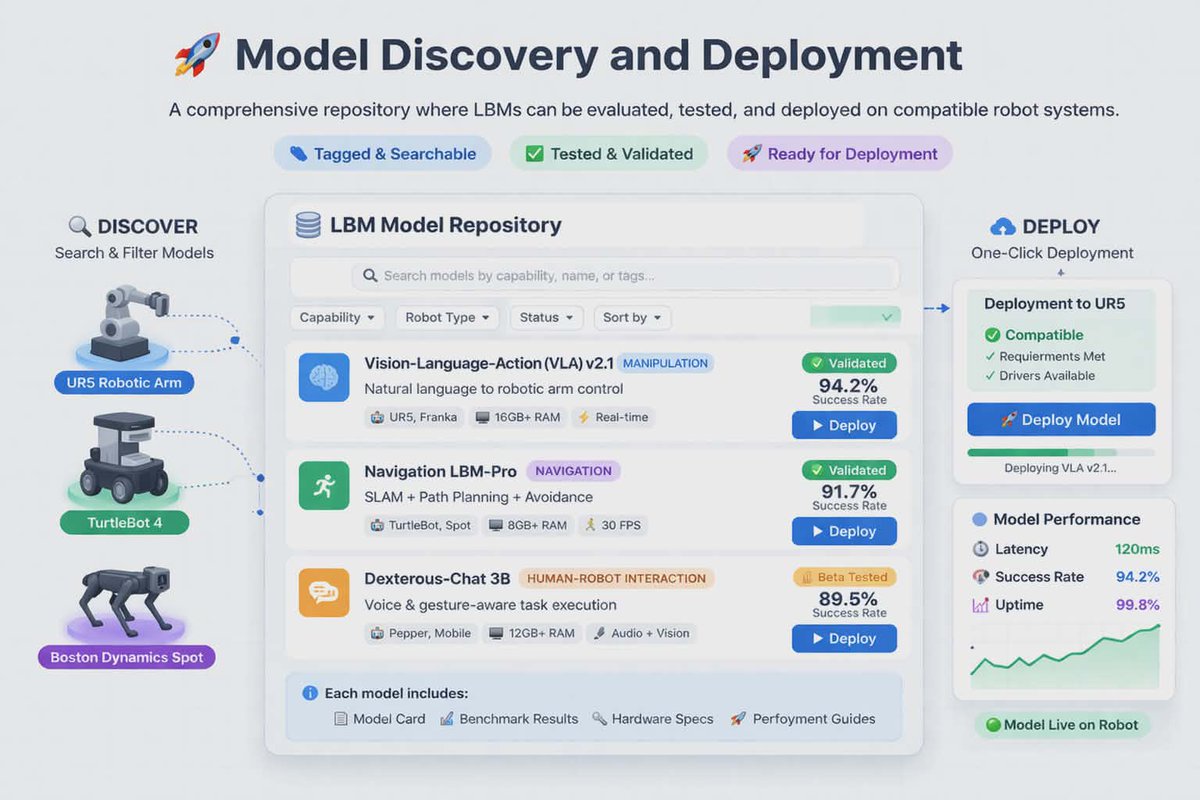
🚀Model Discovery and Deployment🚀
A comprehensive repository where LBMs can be evaluated, tested, and deployed on compatible robot systems. Each model is tagged with capabilities, hardware requirements, and performance metrics. @konnex_world