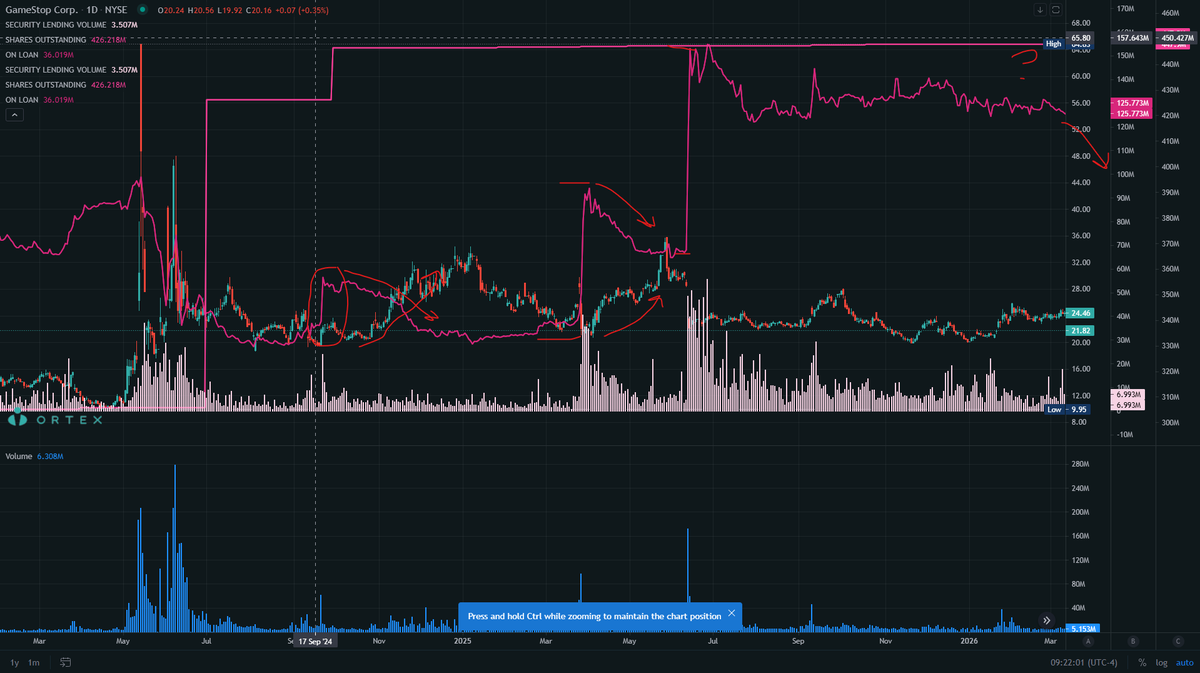
If I could dream this is what I would want to be playing out.
IV goes down but structurally it will lure in fundamental shorts who will overposition. market sells calls overhead, dealer sells delta to hedge, bondholder buys to normalize position.
Calls decay, dealer buys back hedge, and call sellers need to increase position size or get squeezed out.
I want the calls sellers and the over positioned shorts to be squeezed out at the same time.
My dream is there a force working against the calls sellers and structural shorts.
@ReesePolitics eBay’s is primarily owned by passive investors, who sells when passive buys? Well in eBay’s case it’s insiders and board members.
eBay’s also conducts share buybacks to give their insiders better exits, which works great in this passive environment.
@ScotDow238@CalculatedFlow@ryancohen In 2024 they sold shares via an ATM in may and June both before the 10q was released, so there is precedent that they can sell/buy pre the 10Q but after earnings were released
Isn’t it funny how GME tops for the day as soon as the same bunch of accounts post:
G A M E S T O P
STICK
GME HOD
Do they have a 🔮🎱 or something? Joking of course of course
Yes its also a good example of how share borrowing/lending short selling can dampen or move the flows.
on semptember 20th shares on loan increased by 18M muting the short term impact, but over time those were returned as price rose, same thing happened in march 2025.
now since june 2025 shares on loan have been elevated at even a higher plane....maybe buybacks changes that
GME Buyback thoughts
EMH says markets are elastic, they have the ability to absorb buybacks.
Growing research shows that as markets become more passive and tradable floats are reduce they are becoming more inelastic.
We can also view buybacks as passive flows through a "price-weight feedback loop."
Using Bouchaud's square root impact law — what matters for price is the idiosyncratic volatility of the name and the size of the order relative to daily volume.
I(Q) = Yσ√(Q/V)
At max 10b-18 participation (25%), √0.25 = 0.5 — a constant.
GME's 20-day HV = 39.9% annual → 2.51% daily
I(Q) = 1 × 0.0251 × 0.5 = ~1.26% daily price impact
At 10% participation: ~0.79%/day
Compounded over 29 clean trading days: → 10% participation: ~23% cumulative→ 25% participation: ~36% cumulative
This is purely mechanical — before any Gabaix-Koijen λ amplification from float compression.
"The ~$5 multiplier" is an averag defined by λ
λ = 1/(κ · S_mkt) — it varies by market, index or individual stock.
λ is HIGHER when: → More passive ownership (S_mkt ↓) → Less short interest (elastic depth removed) → Lower liquidity → Higher volatility
CB, M&A, and option Arbitratige Dampen λ
@magsonthemoon@heydomoshi@gmericanhero The 4.2b convertible bonds and its associated hedging is the dominate force for gme and its flows for the past year. It is the tail that wags the dog.
It will remain the dominate force until something larger comes along and pushes it out.
2b share buybacks could be that force.