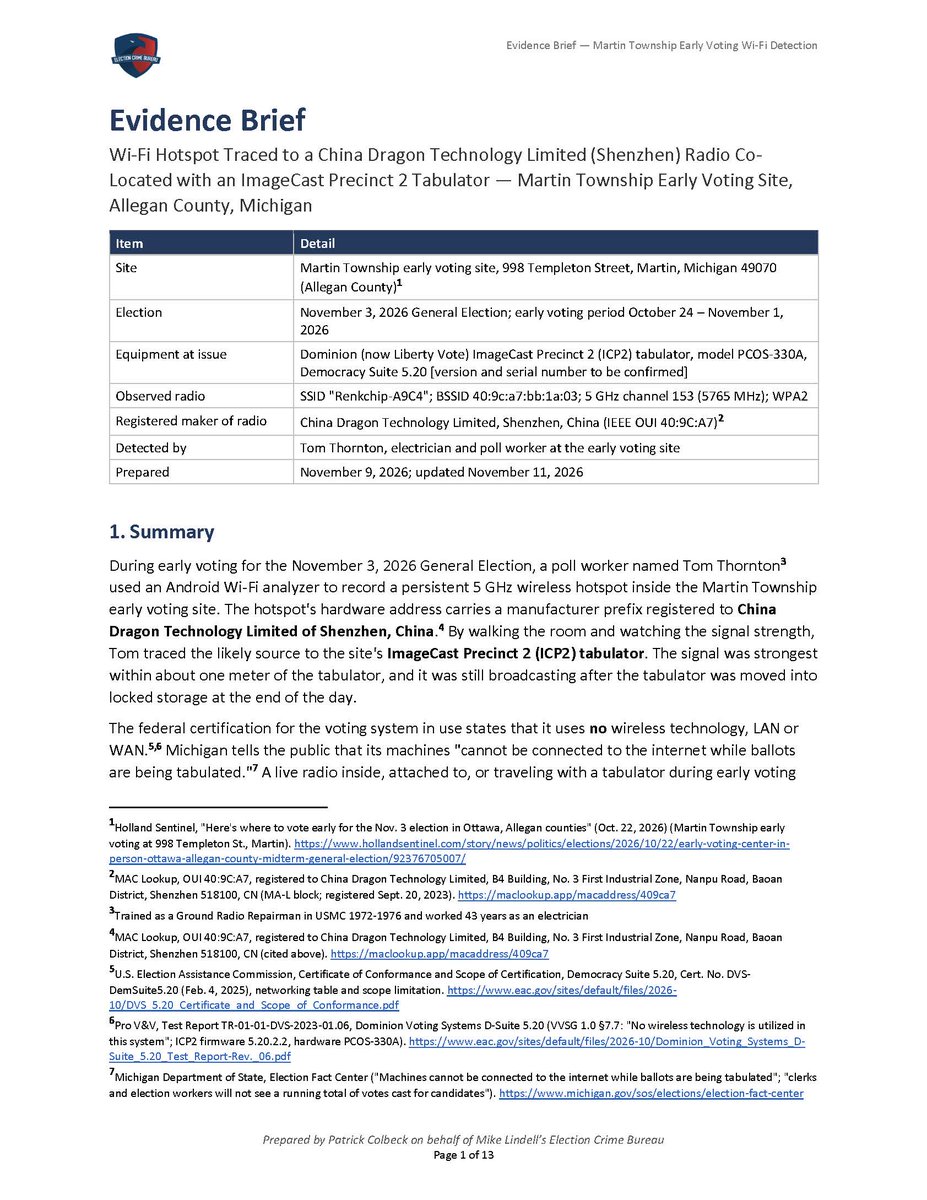
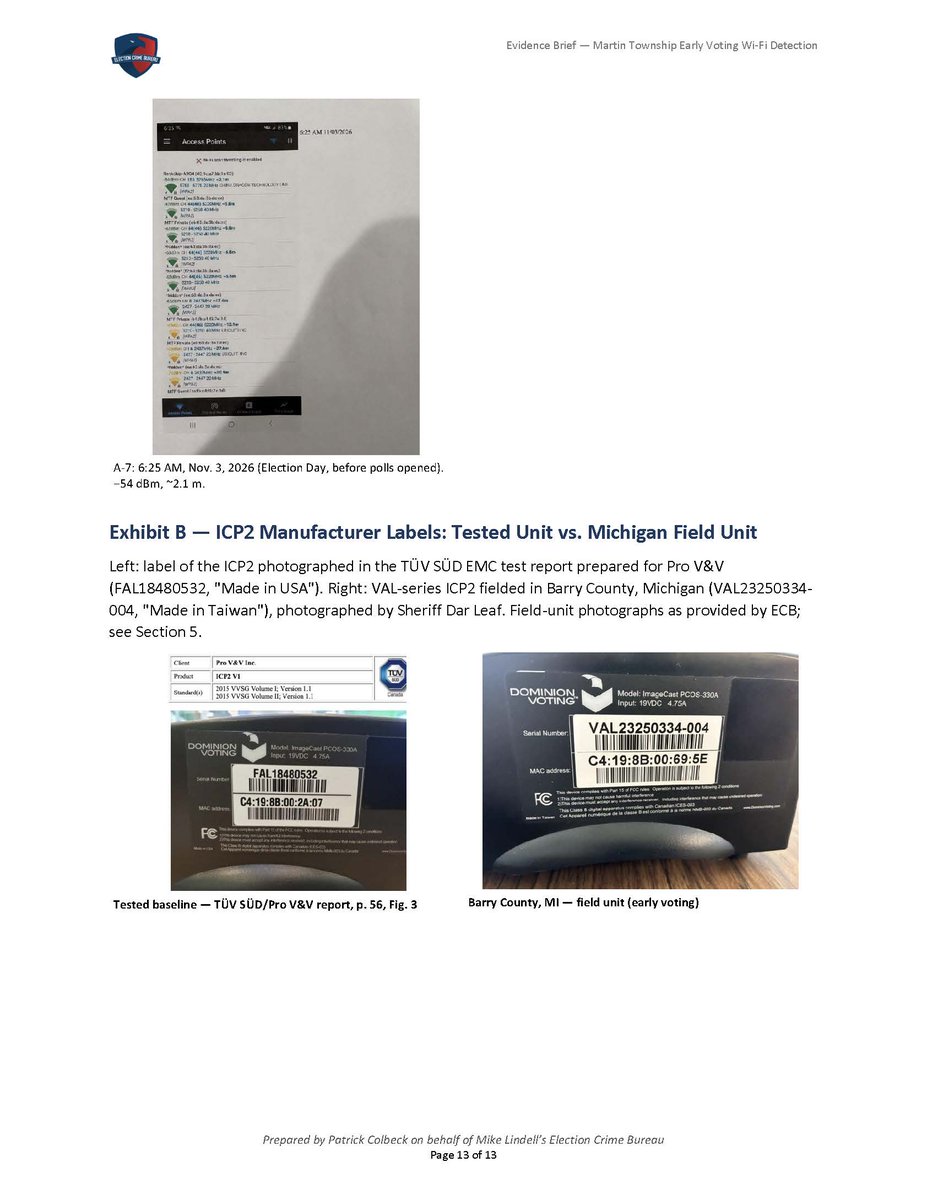
Imagine being a poll worker in Martin Township, Michigan, pulling out a Wi-Fi analyzer during early voting and finding a 5 GHz hotspot strongest right next to the Dominion ImageCast tabulator… and it keeps broadcasting after the machine is locked away for the night. The hardware prefix traces to a company in Shenzhen, China, while the federal certification says this system uses no wireless at all.
Let me explain. You are told these machines cannot be connected to the internet while ballots are being counted, and yet here is a live Chinese radio riding along with one into locked storage. How is this even a thing in 2026? I have been saying for years the machines are not the sealed little boxes they sell you.
Rep. Rachelle Smit and the clerk asked for a physical audit and the sheriff is investigating. Good. Now do every county.
@CISAgov, open the case. End stop.
PROOF: On November 3, 2026 a Michigan town's election equipment contained a secret (illegal) WiFi device communicating with Shenzhen, China (three weeks ago).
13 slides:
rtw
The Democrats just lost BIG with Jensen Huang.
Their coordinated coup of Jensen Huang has failed. They tried ousting him to use it against the A.I. industry.
Ro Khanna sold all his stock 2 weeks prior.
America wins, Democrats lose again.
The New York Times normally guards its paywall like Fort Knox, yet every single “Jensen Huang and the Chinese spy” scoop has been left completely free to read.
Nothing says ORGANIC JOURNALISM quite like unlocking an entire cinematic thriller series for zero dollars so it goes maximally viral on X right before the December 1 hearing.
Blanche, Clayton, Bessent go on TV pouring cold water on the spy narrative and admit the government has not concluded Alice Huang was a spy.
BUT intelligence-community sources magically drop a fresh NYT leak about “contacts with a China spy agency”, unlocked for the whole internet to share FOR FREE!
Imagine running a whole free-to-read intelligence leak campaign to tank a founder, only for Trump to casually tweet “bring him back, he’s brilliant” over breakfast. 🤦♂️
On the news of Jensen’s reinstatement to NVIDIA…
Positive X posts:
President Trump
Elon Musk
Negative X posts:
Elizabeth Warren
Chuck Schumer
Debbie Dingell
Ruben Gallego
John Cornyn
Don Bacon
Nikki Haley
Ron Wyden
JB Pritzker
That’s all you need to know…
Simple.
The @NYTimes' coordinated assault on Jensen Huang is astonishing. Three to five hit pieces a day. Front page. Thinly sourced. Every day for two weeks. If the NY Times spent even 1% of that energy going after Epstein's clients or Big Pharma, the world would be a better place.
Wow... Hart InterCivic Election Machine Source Code Audit finds that vulnerabilities are NOT bugs, but FEATURES of the system.
Unsecured network interfaces:
Network interfaces in the Hart system are not secured against direct attack. Voters can connect to unsecured network links in a polling place to subvert eSlates, as well as to eavesdrop on cast votes and to inject new votes. Poll workers can connect to JBCs or eScans over the management interfaces and perform back-office functions such as modifying the device software. The impact of this is that a malicious voter could potentially take over one or more eSlates in a precinct and a malicious poll worker could potentially take over all the devices in a precinct. The subverted machines could then be used to produce any results of the attacker's choice, regardless of voter input. We emphasize that these are not bugs in the Hart software, but rather features intentionally designed into the system which can be used in a fashion for which they were never intended.
Vulnerability to malicious inputs:
Because networked devices may be connected to other, potentially malicious devices, they must be prepared to accept robustly any input provided by such devices. The Hart software routinely fails to check the correctness of inputs from other components, and then proceeds to use those inputs in unsafe ways. The most damaging example of this is that SERVO, which is used to back up and verify the correctness of polling place devices can itself be compromised from those same devices. This implies that an attacker could subvert a single polling place device, through it subvert SERVO, and then use SERVO to reprogram every polling place device in the county. Although we have tested some individual components of this attack, we did not have time to confirm it in an end-to-end test.
No or insecure use of cryptography:
The standard method for securing network communication of the type in use in the Hart system is to use a cryptographic security protocol. However, we found a notable lack of such techniques in Hart's system. Instead, communications between devices generally happen in the clear, making attack far easier. Cryptography is used for MBBs, but the key management involves a single county-wide symmetric key that, if revealed, would allow an attacker to forge ballot information and election results. This key is stored insecurely in vulnerable polling-place devices, with the result that compromise of a single polling place device enables an attacker to forge election MBBs carrying election results for any device in the county.
Failure to protect ballot secrecy:
Hart's system fails to adequately protect ballot secrecy. A poll worker or election official with access to the raw ballot records can reconstruct the order in which those votes were cast. Combined with information about the order in which voters cast their votes, this can be used to reconstruct how each voter voted. In the case of the DRE, it is also possible to reconstruct, for each vote, the order in which the votes were authorized. Combined with information about the order in which voters were authorized, this can likewise be used to reconstruct how each voter voted. Furthermore, a voter who has temporary access to an eSlate device can extract and reconstruct all the votes cast on that device up to that point in time. He may be able to similarly reconstruct all votes cast on any other eSlate connected to the same JBC.
Many of these attacks can be mounted in a manner that makes them extremely hard to detect and correct.
Source Code Review of the Hart InterCivic Voting System by Srinivas Inguva, Eric Rescorla, Hovav Shacham, and Dan Wallach.
Part of California Secretary of State Debra Bowen's "Top-to-Bottom" Review of the voting machines used in California, 2007.
I've showed you countless audits from Dominion, ES&S, and now Hart InterCivic from mutiple states and over a 20 year time span and the results are all the same.
These are not bugs, they are features to steal elections. Even newer versions of the hardware, firmware, patches, updates etc., showed that these problems persisted and are still a problem today.
Why are the machines still being certified and used when we know they've been compromised for over 20 years?