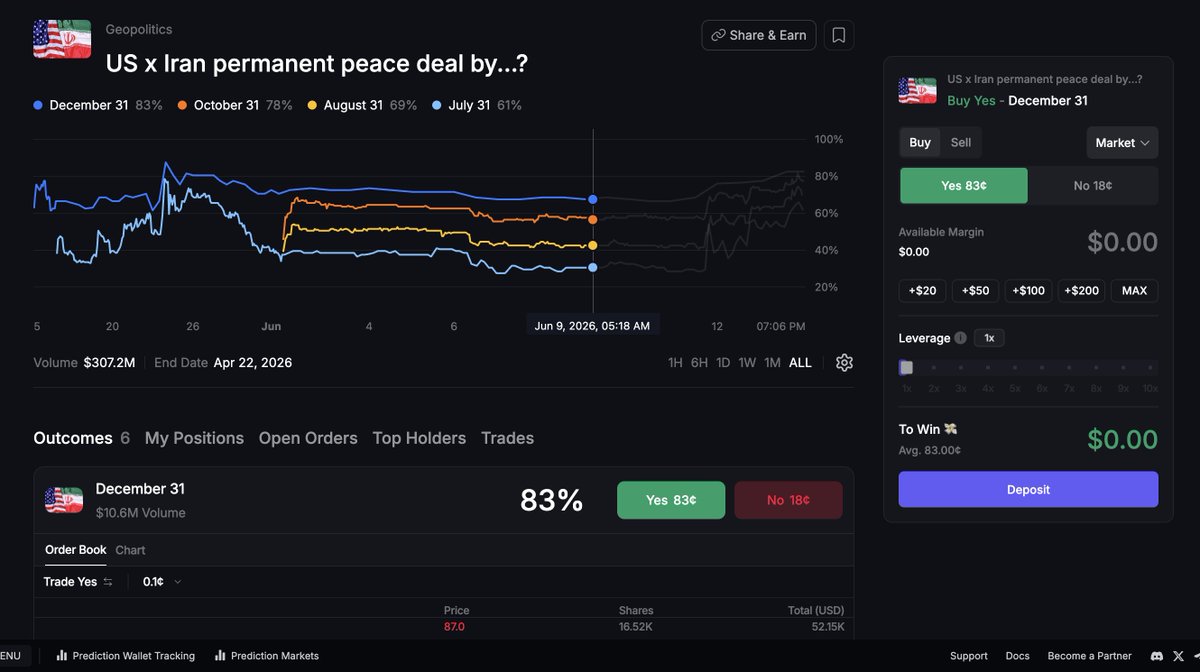
5/ @arespro is the only terminal on this list to offer leverage - up to 10X. That in of itself is a huge value add + they have very cool wallet tracking tools and a UI that reminds me a lot of Polymarket itself 📈
BAM on Solana and preconfirmations on Ethereum both aim to solve the same problem: credible, pre-execution commitments about what gets into a block.
Interestingly, if I'm reading the mechanics right, they have different WC implications.
BAM: the builder bids to win the right to assemble the block, then tries to extract value from it. So capital goes out before revenue comes in
-> Margin risk: overpaying for a block you can't profitably fill.
Preconfs: the issuer collects tips as they sign each inclusion promise through the slot. Collateral is posted but not spent, so revenue lands before the obligation settles.
-? Margin risk: slashing - multiple promises failing at once (reorg, missed slot, etc.).
In working-capital terms for block builders: BAM ties up capital, preconfs generate float.
If that's directionally right, there could be interesting credit infrastructure to build on both sides:
BAM → prime brokerage for block assemblers. Capital to bid more aggressively, underwritten against their ability to profitably fill the block.
Preconfs → a clearinghouse between issuers and slashing contracts. Portfolio-margins a book of correlated inclusion promises instead of collateralizing each one in isolation, adjusts as new promises are signed through the slot, releases collateral at settlement.
Not fully in the weeds, and market tiny atm, but an interesting CF timing difference between the two designs.
Why margin never came onchain
Most CeFi venues run spot margin on 100+ assets.
A decade into DeFi, spot margin is still unsolved for 95% of assets. Why?
Background
A margin desk at a CeFi venue runs 4 things simultaneously:
1/ a risk model that reprices collateral continuously against depth, vol, etc;
2/ a liquidation path with privileged execution inside the venue;
3/ hedging inventory across the venue's own derivatives and spot books that can net residual exposure internally;
4/ and a balance sheet that absorbs shortfalls when the other three misprice the tail.
Each one compensates for imperfections in the others.
A slower risk model is survivable if liquidation execution is fast and hedging is cheap. Thin hedging is survivable if the balance sheet is deep. And so forth.
Onchain, until recently, all four were structurally constrained at the same time for spot margin.
The risk modeling side was the most visible gap. Onchain lending protocols operate on a narrow per-asset parameter space (LTV, liquidation threshold, caps, liquidation bonus) set within a governance-ratified framework, against asset universes of typically 5 to 15 blue chips. Building a continuously-updated risk model across a wider asset base was tractable in principle, but required a real-time data pipeline and the will to stand up a broad live risk infrastructure.
The liquidation path was constrained by execution non-determinism. Onchain liquidations mainly run through third-party keeper bots competing in the public mempool, which means inclusion probability degrades under exactly the network conditions where liquidations matter most. Protocols either compensated by internalizing sequencing (Hyperliquid, dYdX v4) or by widening maintenance margins, which lowered effective leverage and pushed the product away from the regime where margin is economically useful. Recent work such as BAM on Solana and Ethereum's based-rollup preconfirmation stack begin to solve this by offering non-venue protocols guaranteed transaction inclusion, removing the dependency on third-party keeper participation at exactly the moment it matters most.
The hedging venue question is the one most people underestimate. CeFi margin books net internally because the venue hosts both the collateral market and the hedging market, and the balance sheet clears both. Onchain, a risk engine has to hedge into external venues, and until recently those venues either weren't deep enough, weren't programmatically addressable, or both.
Credit to sit behind the book is a consequence of the first three and will improve as the industry matures. Institutional lenders underwrite risk layers they can verify and size against, which requires the other three pieces to first produce an auditable layer with live operating data.
Closing thoughts
In new markets, credit usually arrives last because it requires every other piece of the stack to be legible and reliable enough to underwrite. Onchain followed that pattern. Settlement worked from day one, spot DEXs nearly a decade ago, perps once execution caught up. We believe at @dimes_fi that horizontal margin credit is next.
But once onchain spot margin works, it won't be a port of CeFi margin. A CeFi margin account is locked inside the venue that originates it. Onchain, the risk engine, liquidation path, hedging surface, and credit capital are all separately addressable, meaning margin sits horizontally across venues rather than inside any one of them. Any surface that captures trading intent, specialized terminals, wallets, agents, CLIs, can integrate the same margin layer through a simple API, an unlock that will materially expand onchain trading front-ends' volume and close one of the largest remaining feature gaps with CeFi venues.
We call this Headless Credit.
Composabilty is and will remain DeFi’s superpower.
Mexico to win at kickoff: 69c → 1 = 1.45x potential return. Biggest danger: the draw.
South Africa NOT to win: 89c → 1 = 1.12x. Cashes on a Mexico win or a draw.
At 4x leverage: 89c → 1 = 1.49x.
Higher payout. Draw danger gone.
Imagine making 50% in 2 hrs by betting that South Africa will not win.
The edge is here for those who know where to look.
Exclusively powered by @dimes_fi. Now live on @arespro
A team holding a 1-goal lead in the final 10 minutes of a soccer match wins 89% of the time, draws 10% of the time and loses less than 1% of the time.
On Polymarket, these late wining side bet trade at ~86-90c.
Enter at 5x leverage and:
- 70% run clean to settlement: +55-80% return
- 20% wobble, take a deleveraging or two, and still finish in the 30-40% range
- 10% are write-offs
TLDR: unlevered, this is pw near breakeven.
At 5x its +40% per trade.
The World Cup group stage gives you 72 shots at this setup.
All supported by Dimes via integrated front-ends.
@ikarusz26 Very few cases of front-ends having successfully expanded across produts. Often underwhelming
- Coinbase perps / nfts
- Phantom terminal / PM
- Kalshi
@BullpenFi among the only destinations driving relevant volume across categories
Why Dimes greenlights markets automatically
Polymarket lists thousands of markets, with lifecycles ranging from minutes to months.
Underwriting leverage against that universe requires knowing, in real time, which markets are hedgeable and which aren't.
We've found the best way to do this at scale is to take humans out of the loop entirely.
Three reasons:
1️⃣ In prediction markets, available leverage is a dynamic property of a market at a given moment, not a fixed property of the market itself. The same market can be cleanly hedgeable one minute and untradeable the next as flow shifts.
2️⃣ Automated decisions generate the data that improves our greenlighting model. Curator-approved samples, by contrast, are selection-biased by construction: they only ever learn from the markets curators already chose, with no system-wide counterfactuals. At scale, one approach compounds while the other converges on its own priors.
3️⃣ Leverage attracts sophisticated participants looking to make their edge more capital-efficient. A credit layer that underwrites only the largest markets concentrates that effect at the top and leaves the long tail underserved. We believe broad coverage distributes that upgrade across the long tail, deepening the entire market and making more of it efficiently underwritable over time.
Today, front-ends integrating Dimes can offer users leveraged exposure across hundreds, sometimes thousands of Polymarkets each week.
We need infinite compute.
The more compute we have, the more we'll realize how much more compute we need.
Today, we're capacity constrained at responsive code.
Tomorrow we'll be capacity constrained at:
- Real-time, not queued
- Always-on, not request-response
- One prompt, many parallel outputs
- Robots navigating the physical world
- One model per person, not per platform
- Multi-sensory inputs: text, video, audio, world
- Thousands of counterfactuals before one action
- Models that debug, retrain, and improve themselves
The forever long compute is the most obvious play in the world.
How to use leverage when trading PMs
Trading with leverage magnifies volatility and increases execution costs. In PMs specifically, it is ill-suited for most market setups.
Here are the market types I find best and least suited for levered trading:
Best (from simplest to most advanced)
1/ High conviction bet on strong favorite. A market at $0.82 with 5x turns an 18¢ move into ~80-90% return on collateral. + Because J-factor deleverages autonomously on the bear case, downside isn't symmetric.
2/Longshots on the upswing. Enter just after the inflection, not before. Book depth is expanding on your side, so leverage holds.
3/ Post-shock re-entry. A favorite drops from $0.85 to $0.60 on a news event you believe is an overreaction.
4/ Hedging an existing unlevered position. You hold a large unlevered YES at $0.70. New information makes you nervous but you don't want to sell. A small leveraged NO position acts as a cheap hedge if the market drops (levered NO pays outsized, and if it doesn't, J-factor decay limits the cost of being wrong on the hedge).
5/ Arbitrage across correlated markets. Two markets that should be linked (e.g. "Will X win the nomination" and "Will X win the general") sometimes misprice relative to each other. Leverage on the spread.
Worst
1/ Tight markets across duration. In a 50/50 to 60/40 range, each oscillation triggers partial deleveraging that doesn't rebuild when the market swings back. Three oscillations before resolution can leave you with 20% of theoretical levered PnL, even on a winning trade. Not worth the fees and exposure.
2/ Passive holds through reversal-heavy markets. Every narrative shift ratchets away collateral. Each move against you triggers deleveraging that realizes losses on the unwound portion. reducing both your leverage and your remaining collateral. When the market recovers, you're riding it with less of both. You can be right on direction and still be negative on the levered position.
In short: leverage on PMs should be used as a (i) magnifier, (ii) momentum, (iii) hedging and or (iv) dislocation amplificant instrument.
Use it wisely.
Why Dimes chose institutional credit partners over a public retail vault to fund margin capacity
1️⃣ Guaranteed liquidity for front-ends: partners need predictable capacity their users can rely on. Retail vault liquidity is highly reflexive and expands / contracts with DeFi flows, creating uncertainty when reliability matters most. With Dimes, front-ends know liquidity is here to stay.
2️⃣ Higher operating standards: institutional capital brings deeper scrutiny across our risk models, reporting, controls, and incident processes. Dimes is the only levered prediction markets providers that has withstood the scrutiny of various sophisticated partners across onchain private credit and liquid funds for direct margining operations.
3️⃣ Controlled scaling: capacity grows with live performance, front-end onboarding, and risk-system maturity.
4️⃣ Multi-product extensibility: the same credit relationships can extend across new surfaces, from single-position leverage to portfolio margining, allowing us to expand capabilities alongside our front-end partners.
5️⃣ Best-practice capture: working closely with institutional credit partners allows continuous knowledge transfer on risk management.
We’re launching this with @dimes_fi Join our Space on June 9, 1:30PM EST to learn how leveraged prediction-market trading works.
https://t.co/FHAW6y2jfG
It's been a privilege working with @morganlai and the @arespro team to bring prediction market leverage to their users.
Ares has built one of the most complete terminals in the game, and Morgan and her team are always on the lookout for new ways to give traders an edge.
They did extraordinary work integrating leverage through Dimes ahead of the World Cup. Go give it a spin if you haven't already.
Ares x @Dimes_fi