The Zodiac Wheel is an ancient cosmic clock.
360 degrees of solar path divided into twelve equal 30-degree signs.
It tracks the Sun’s yearly path and mirrors the structure of consciousness and the body.
It is not a distant sky chart but a living template.
Ancient observers worldwide recorded the same twelve divisions, from early stellar cults that watched the poler stations to the ecliptic system still in use.
The wheel turns with the seasons: the Sun climbs through the spring signs, peaks near the Tropic of Cancer, descends through autumn, and hits its lowest point in Capricorn before climbing again.
Solstices and equinoxes mark the cardinal hinges.
The full cycle is the Great Year of precession, roughly 26,000 years.
Hermetic tradition says that the same twelve-fold pattern exists inside us.
Consciousness projects its own innate archetypes outward; the signs we “see” in the sky are the psyche’s divisions made visible.
Twelve comes naturally from the fourfold modes of awareness (sensation, feeling, thinking, intuition) multiplied by the threefold dynamic of body, mind, and spirit.
Harmonise them and you get the fifth element: wholeness.
The natal chart is not a prediction machine.
It is a compass of the Imperial Self, guiding and forcing the scattered pieces of a life into order.
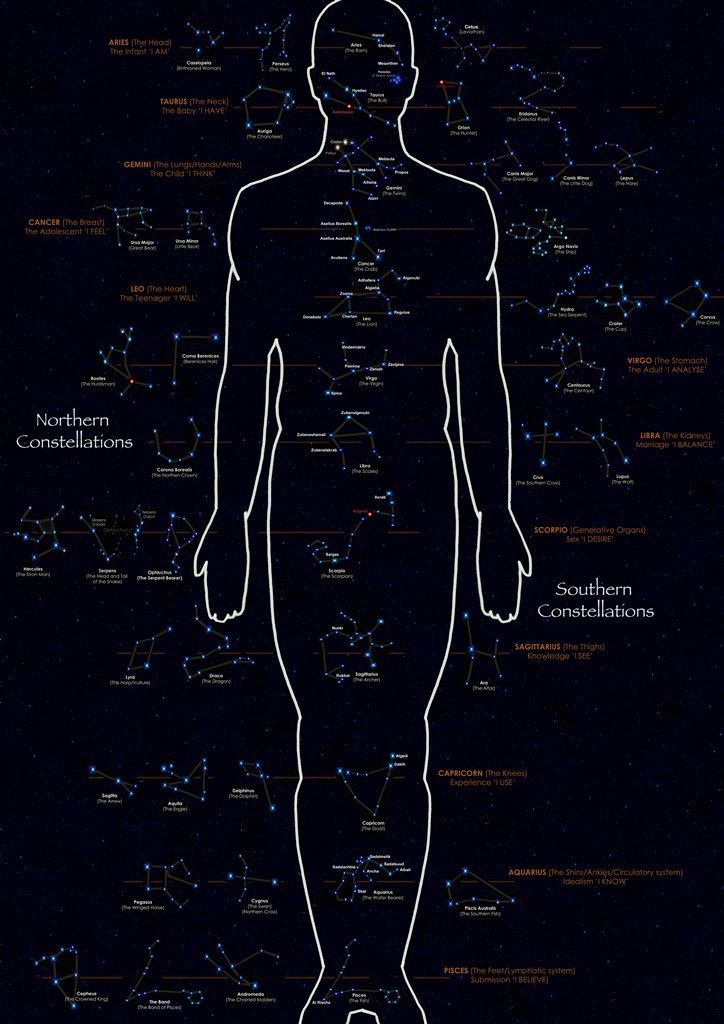
The wheel is written on the body.
Aries rules the head and cerebrum, Taurus the neck and eyes, Gemini the arms and lungs, and so on down to Pisces at the feet.
Tissue salts, nerve pathways, and organ systems align with the signs, turning medical observation into a practical reflection of celestial order.
Myths and scriptures also encode the journey.
Solar heroes are born, tested, die for three days at the winter solstice, and rise.
Animal symbols (ram, bull, lion, eagle-man) and keywords (lamb, lion of Judah, son of man, beehive honey, milky way) track the Sun through the houses.
From Sumerian tablets to later holy texts, the stories are portable calendars of light and dark, growth and decline.
The Zodiac Wheel is both sky map and inner architecture.
A single pattern that once let anyone carry the year, the body, and the stages of consciousness in one living image.
The tropical zodiac divides the ecliptic into twelve equal 30-degree signs starting from the vernal equinox.
That system is equal.
It is a seasonal clock, not a star map.
The actual constellations along the ecliptic (the sidereal background) are unequal in size, and precession has shifted them slightly.
The version of the zodiac wheel I am talking about is the equal, twelve fold syymbolic wheel.
The one tied to the Suns annual path, the seasons, the archetypes, and the body correspondences.
That is the structure used in the traditions that treat the wheel as an inner and cosmic template.
The unequal stellar figures are the background the equal divisions are projected onto.
"Not only do the Gospel writers fail to offer appropriate evidence to substantiate their claims upon the grounds of reasonable probability, but their numerous discrepancies, contradictions, and omissions, their readiness to accept as facts rumours and legends which they had heard at third and fourth hand; their obvious role as reformers, their desire to promote these doctrines and their apparent willingness to even invent stories to promote these doctrines is proof that, instead of being objective historians, they were decidedly propagandists. Indeed, if any subject other than religion were involved, it is extremely doubtful whether any body of thoughtful men would take writings of such men seriously."
— Ernest Busenbark (Symbols, Sex and the Stars)
"Church experts admit to no evidence of the existence of the gospels for at least a century after the time it is said Jesus Christ was born in a manger. The most ancient literature fails to show any trace of acquaintance with, nor the use of, the gospels we know today. It is not possible to find in any writings compiled between the beginning of the First Century, and the middle of the Second Century, any reference to Jesus Christ or the Gospels…"
— Tony Bushby (The Bible Fraud)
"The Dead Sea scrolls made no mention of Jesus Christ or the early Christian Church…It has long been known that there was information in the Dead Sea Scrolls damning to Christians beliefs and the Church’s high level involvement with interpreting them fostered a grave element of suspicion. Since the scrolls were found some six decades ago, close associates of the Vatican were placed in dominant positions in every phase of the investigation and translations of the Scrolls. The priests regulated the flow of information and controlled its release."
— Tony Bushby (The Bible Fraud)
Constantine’s Council of Nicea (Birthplace of official Christianity)
On 21 June, the day of the Summer Solstice, a total of 2048 presbyters, deacons, sub-deacons, acolytes, and exorcists gathered at Nicea to decide what Christianity really was, what it would be, and what writings were to be used and who was to be its god….The Emperor Constantine presided over the council.
"Nowhere is Christianity less attractive…and less authoritative, than in the councils of the church…The degeneracy is rapid from the Council of Nicea (325 AD) to the first of Ephesus (431 AD), where each party came determined to use every means of haste, manoeuvre, court, influence, bribery, to crush his adversary."
— Dean Milman
"After a long and bitter debate, a vote was finally taken and it was with a majority show of hands that Judas Khrestus and Rabbi Jesus both became god - 161 votes to 157. A new god was proclaimed and ‘officially’ ratified by Emperor Constantine.."
— Tony Bushby (The Bible Fraud)
"The Emperor then instructed Bishop Eusebius to compile a uniform collection of new writings “bound together as one,”…Eusebius was to arrange for the production of ‘fifty sumptuous copies…to be written on parchment in a legible manner, and in a convenient portable form, by professional scribes thoroughly accomplished in their art’…’Make them to astonish,’ said Emperor Constantine…This was the first mention of finished copies of the Christian New Testament in the history of mankind."
— Tony Bushby (The Bible Fraud)
"With his instruction now fulfilled, Emperor Constantine decreed that the new writings be thereafter called the ‘words of God’ and be attached…to copies of the Hebrew Old Testament. Emperor Vespasian, in the First Century, had proclaimed the entire Jewish territory the personal property of the Roman Emperors, and his decision was officially ratified by the Senate. In effect, all later Emperors were in control of the Jewish religion…Emperor Constantine effectively attempted to amalgamate the earlier Jewish religion with his new cult. By legal inheritance, he was also the messiah. After Eusebius had finished drawing upon the large array of presbyter’s texts, Constantine then ordered them destroyed by fire and ‘any man found concealing one should be stricken off from his shoulders’ (beheaded)"
— Tony Bushby (The Bible Fraud)
"It is important to note that the format of the name ‘Jesus Christ’ was not cemented down until the time of the Reformation (14th-17th Centuries), for in earlier times it had several renditions such as Yeshoua, Kryst, and Yeshu Kristos."
— Tony Bushby (The Bible fraud)
"The symbol of the cross originated as part of an ancient Egyptian initiatory rite, and eventually found its way into Christianity. It is recorded in Christian archives that the general use of the crucifix was ratified at the Sixth Ecumenical Council in 680… The Council decreed that ‘the figure of a man fastened to a cross be now adopted’ and the new church logo was later confirmed by Emperor Hadrian I (772-95). About a century later, the first pictures of Jesus Christ standing against a cross slowly started to appear."
— Tony Bushby (The secret in the Bible)
Thank you for the friendly pushback. It would be a boring app if everyone agreed on everything. I have to admit, I have been pretty hard on Christianity and Jesus lately. I don’t take any of it back, but I’m not really as hostile toward it as it may seem. It’s a pretty fascinating text when you read it as the Astro-theological and mythic document it largely is. Full of solar symbolism, older Egyptian and other motifs, and layered allegory instead of straight history. IMO the book gets better the less you take the literalist version seriously.
Bible: “submit and be saved.”
Hermes: “Understand and be free.”
They need you dependent.
Hermes doesn’t.
One is a leash with a halo.
The other is the key that makes the leash irrelevant.
Throw the Bible in the bin.
You’ll learn more about God in this 3 hours than the book ever taught.
https://t.co/Rlgsbc8AEN
@Matrixxunplugg1 His earlier work is a treasure. I don’t recommend looking at his later stuff. I think the matrix got to him after his core work was released.
The Council of Nicaea was a power move.
In 325 AD, Emperor Constantine convened the Council of Nicaea to forge Christianity from Solar Paganism and impose doctrinal unity on a fractious early Christian movement.
Not just a theological exercise, the gathering became a crucible for absorbing and neutralising rival pagan solar cults that dominated the Roman world.
Many attending bishops and patriarchs carried deep ties to mystery traditions centred on Sun veneration.
The Cult of Mithras, Horus and Serapis, Sol Invictus.
Constantine himself remained a devotee of Sol Invictus, the Unconquered sun until his death.
At Nicaea competing solar and mystery elements clashed violently.
Dissenting voices insisting on their cultic contributions faced suppression or elimination as Constantine enforced a single, controllable creed.
The resulting Nicene Creed defined Christ’s divinity in terms that echoed solar attributes (eternal light, cosmic mediator, and source of life) while the church adopted Sunday (dies solis) as its holy day and tied Easter’s date to the spring equinox, preserving solar calendar logic.
Ancient symbols transferred seamlessly: the fish from Dionysian solar myths, the beardless youthful saviour mirroring Orphic and solar heroes.
What appeared as the triumph of monotheism was instead the calculated transmogrification of sun worship into state religion.
Solar devotion was not destroyed but veiled, repackaged, and weaponised to consolidate imperial power and redirect popular piety.
The council did not purify faith; it engineered a syncretic system that preserved the core mechanics of ancient solar cults under Christian terminology, enabling centuries of control through hidden continuity rather than rupture.
Christianity didn’t start in the Middle East after Jesus was crucified.
Its real story begins in ancient Britain, way earlier.
The Culdees created the faith first.
They were early Christian monks and holy people in Britain, Ireland, and Scotland.
They called it Culdeanism at the start and kept old spiritual ideas from settlers who came from Egypt over a thousand years before Jesus.
They shared these teachings through their Celtic Church communities.
Then the Roman Church took over.
They changed the ideas to suit themselves, added rules, and used the faith to control people in many lands.
They hid that Britain was the real origin.
The Culdees kept the original simple version alive.
This means the history we learn is incomplete.
Britain is the true hidden birthplace of Christianity.
Religious scriptures are a registry of astronomical phenomena, written in mythological format.
Modern religious concepts began with astronomy and evolved through mythology and astrology into modern religion.
Many, if not all of the Hebrew myth concepts are traceable to ancient Egypt, Mesopotamia and the West.
Jesus Christ, the “son”-god is a cosmic myth on par with Osiris, Horus, Samson, Adonis, Moses, Abraham, Solomon, Noah, Krishna, Mithra, Quetzalcoatl, and many other solar demigods.
Evidence clearly shows that the 12 apostles are symbols of the zodiac sign and that Jesus Christ symbolises the Sun-God.
It is clear that the tales within the Bible are allegorical depictions of the interactions between elements of the cosmos.
Organised religion is a psychological system of control, using guilt, fear of punishment, and the promise of eternal life to make people compliant.
If a person is taught that they’re inherently sinful, that they need an external saviour, and that obedience is spiritually good, how freely can they question the system that defines their sin and offers their salvation?
Was Jesus a literal historical figure who walked on this earth, or is he solar allegory based on the Sun?
Contradictions in the Bible:
Creation accounts (Genesis)
Two creation narratives differ in order, method, and details: Genesis 1 (Elohim; structured six-day creation; light, plants, animals, then male and female humans together on day 6) vs. Genesis 2 (Yahweh Elohim; man formed from dust first, then plants/garden, then animals as potential companions, then woman from the man’s rib).
In Genesis 1 light exists on day 1 (with “evening and morning”), but the sun, moon, and stars are created on day 4.
God declares creation “very good” (Genesis 1:31) but later regrets making humanity (Genesis 6:6).
Flood and Noah (Genesis 6–9)
Number of animals: Genesis 6:19–20 commands two of every kind; Genesis 7:2–3 specifies seven pairs of clean animals and one pair of unclean.
Duration and chronology: rain for 40 days/nights in some verses vs. waters prevailing 150 days and a longer overall timeline in others; doublets of boarding, disembarking, and similar commands.
Two interwoven narrative strands (often linked to different sources using different divine names) produce repetitions and inconsistencies in details.
Patriarchal and early narratives
God’s name: Exodus 6:3 states God was known to the patriarchs as El Shaddai but not as Yahweh; Genesis 15:7 and other passages have God identifying as Yahweh to Abraham earlier.
Jacob/Esau deception and departure: details of the blessing and the reason for Jacob leaving vary between accounts in Genesis 27–28.
Abraham’s purchase of burial ground and related details conflict in some later retellings (e.g., Acts 7 vs. Genesis).
Numerical, chronological, and historical discrepancies (especially Chronicles vs. Samuel/Kings).
David’s census: 2 Samuel 24:1 attributes it to the Lord’s anger; 1 Chronicles 21:1 attributes it to Satan. Numbers differ (e.g., ~800,000 Israelite fighters in Samuel vs. ~1,100,000 in Chronicles; Judah figures also differ).
Ages and reign lengths of kings: e.g., Ahaziah 22 (2 Kings 8:26) vs. 42 (2 Chronicles 22:2); Jehoiachin 18 (2 Kings 24:8) vs. 8 (2 Chronicles 36:9).
Lists of returned exiles (Ezra 2 vs. Nehemiah 7) contain numerous numerical mismatches in family counts; grand totals do not match the summed figures.
Other details: names of officials (e.g., David’s scribe varies), numbers in battles or inventories, and sequences of events differ between parallel accounts.
Gospel narratives (birth, ministry, passion, resurrection)
Genealogies of Jesus: Matthew 1 (via Solomon, Joseph’s father Jacob, ~28 generations from Abraham) vs. Luke 3 (via Nathan, Joseph’s father Heli, longer list with different names after David). Both present as Joseph’s line.
Infancy: Matthew has magi, flight to Egypt, and return after Herod’s death; Luke has shepherds, presentation in the Temple, and direct return to Nazareth.
Timing relative to Quirinius’s census (Luke) conflicts with Herod’s reign (Matthew).
Baptism voice: wording and addressee differ slightly across Matthew, Mark, and Luke.
Jesus’ movements after baptism and early ministry details differ between Synoptics and John.
Temple cleansing: near the end of the ministry in the Synoptics; early in John.
Passion details: day of crucifixion (Synoptics place it after the Passover meal; John on the day of Preparation, aligning with Lamb of God imagery); last words differ (“My God, why have you forsaken me?” in Mark vs. “It is finished” in John); temple curtain timing relative to death varies between accounts; number of women at the tomb, number/identity of angels/men, whether they told anyone, and post-resurrection appearances differ.
Judas’s death: Matthew 27 (returns money, hangs himself; priests buy the field) vs. Acts 1 (keeps/buys the field himself, falls and bursts open).
Peter’s denial: Mark specifies before the rooster crows twice; other Gospels say before it crows (once)
Paul’s itinerary and Jerusalem visits: Acts vs. Galatians differ on sequence, timing, and meetings after conversion.
Other: Jairus’s daughter’s status when he approaches Jesus (dying vs. already dead); high priest name in the “bread of the Presence” incident (Mark names Abiathar where 1 Samuel has Ahimelech).
Theological, ethical, and doctrinal tensions
Nature/visibility of God: passages describe seeing or speaking with God face-to-face (e.g., Exodus 33, Genesis 32) vs. statements that no one has seen God or can see his face and live (John 1:18, Exodus 33:20).
Forgiveness and judgment: passages emphasising God’s unwillingness to forgive certain sins or destroying for wickedness vs. broad themes of mercy and forgiveness.
Violence, law, and ethics: “eye for an eye” and capital prescriptions in the Torah vs. “turn the other cheek,” love of enemies, and non-resistance in the Sermon on the Mount; Sabbath strictness vs. New Testament flexibility; polygamy and divorce practices in the Old Testament vs. stricter New Testament ideals.
Salvation and works: Paul emphasises justification by faith apart from works of the law; James states that faith without works is dead and that a person is justified by works and not by faith alone.
Inclusivity: “Whoever is not with me is against me” (Matthew) vs. “Whoever is not against us is for us” (Mark).
Slavery and social roles: regulations permitting and regulating slavery in the Torah and household codes vs. statements of equality in Christ; passages on women’s silence in church vs. examples of women in leadership roles.
Earth’s permanence: statements that the earth remains forever or is fixed (e.g., Ecclesiastes 1:4, Psalm 104:5) vs. New Testament passages about its destruction and a new earth.
Prophecy fulfillments or quotations that do not match the cited Old Testament text exactly (or cite the wrong prophet).
Manuscript and textual variants that affect details in some passages (later additions such as the longer ending of Mark or the Pericope Adulterae).
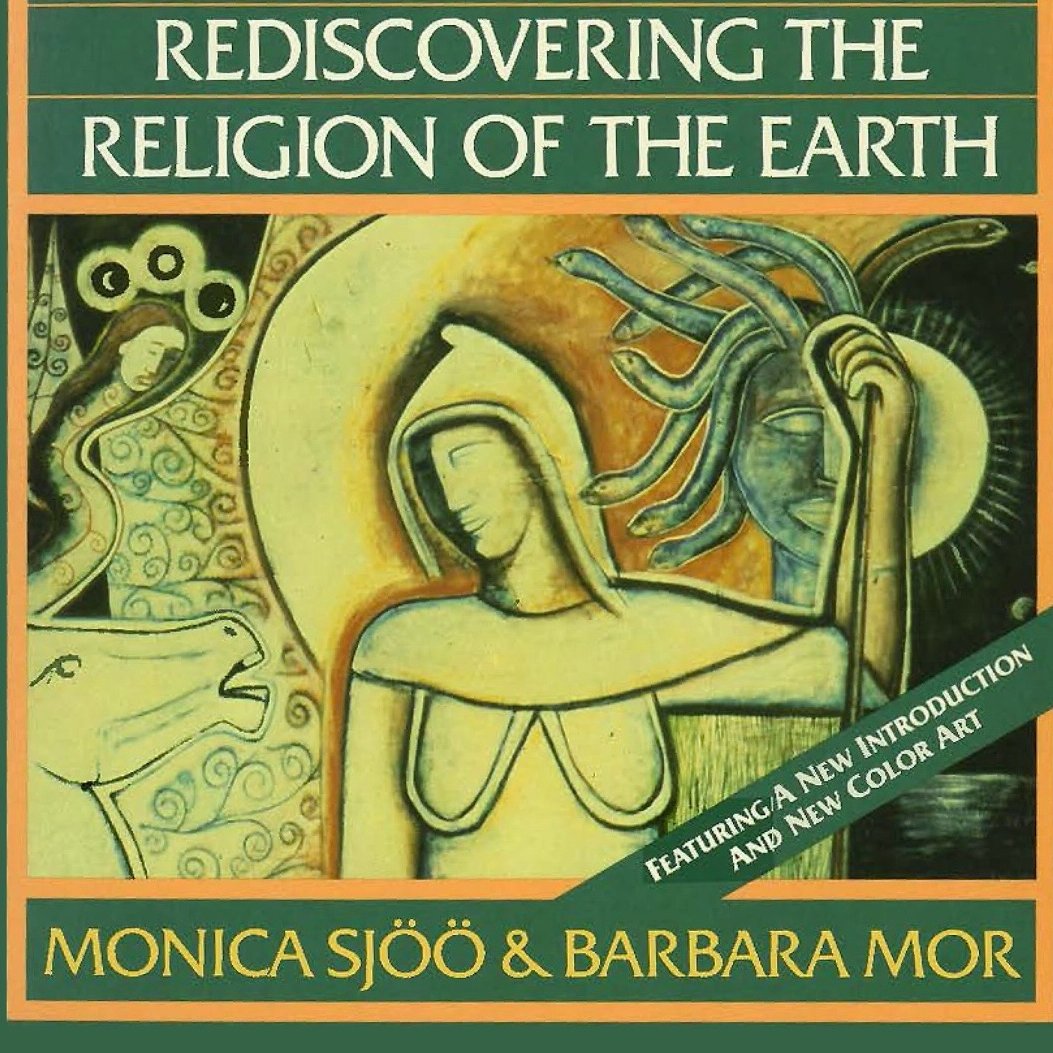
At least two thousand years before the Hebrew Patriarchs wrote of the Garden of Eden, the Neolithic Great Goddess had her magic Garden of Immortality... In Genesis are all the recognisable elements of the much more ancient Mother Goddess myth, symbol and ritual. Here is the Garden of the Goddess and her wise cosmic serpent, the tree of knowledge with its dark soma fruit…which became, for Westerners, the magic apple of the European “White Goddess” Eve — Monica Sjöö