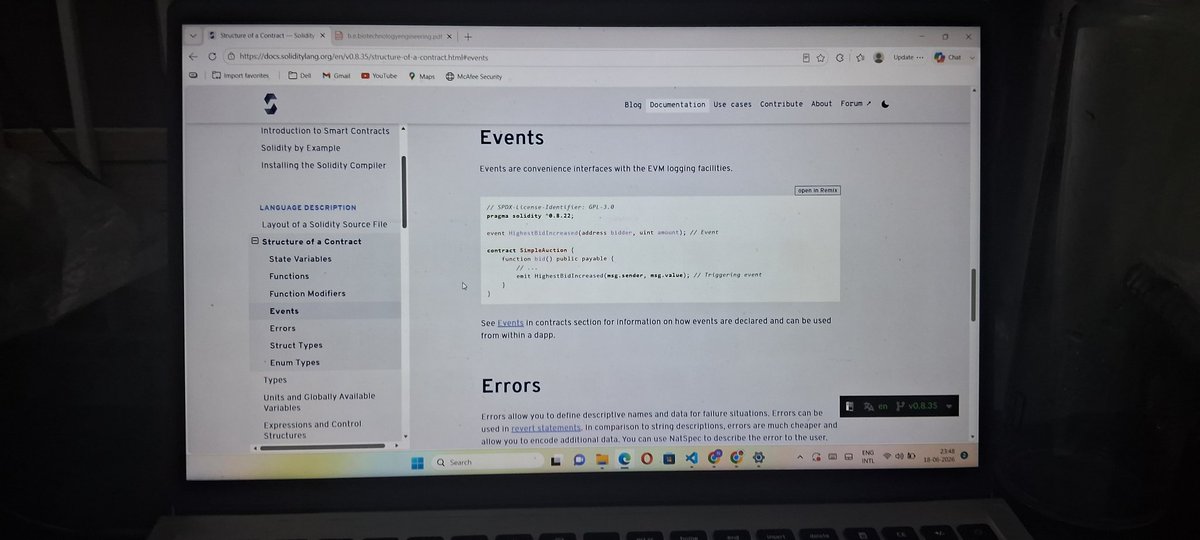
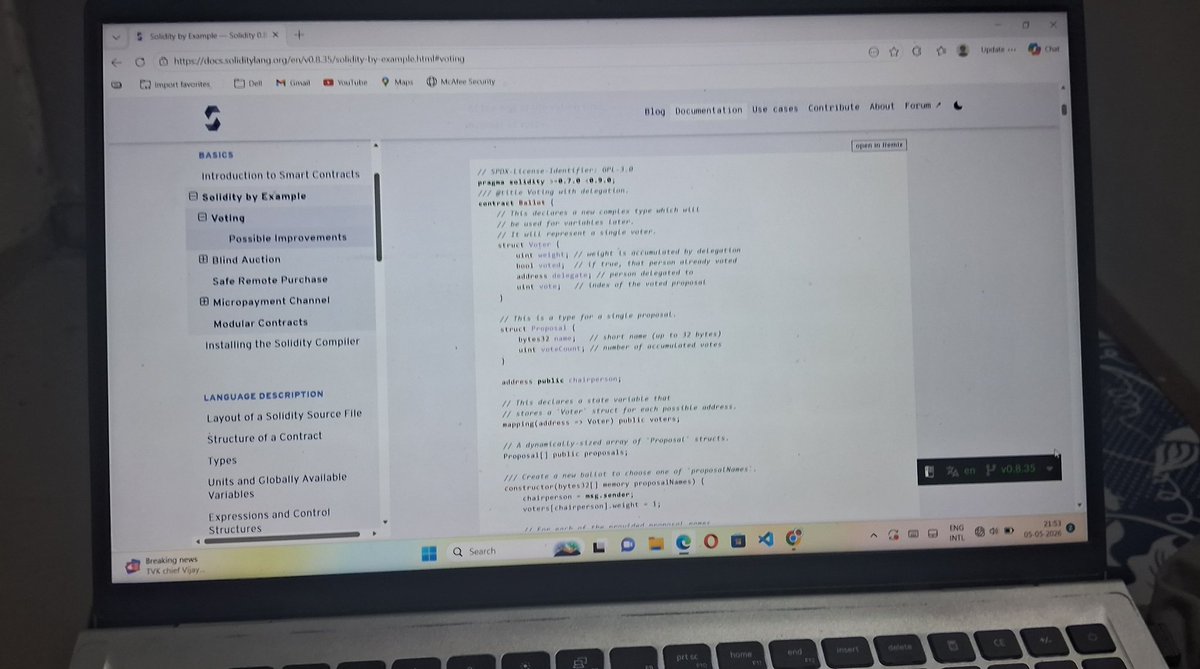
The Solidity contract is much more than just functions. It combines state variables, modifiers, events, errors, structs, and enums to define how a smart contract stores data and behaves on-chain.
Every new concept is making contract architecture easier to understand.
#Web3
Day21:- Today learned how structs help organize related data into a single custom type, while enums make it easier to manage contract states using a fixed set of predefined values.Understanding these building blocks makes smart contracts more structured and easy to manage
#Web3
Day 20:- Today’s focus was on Events and Custom Errors.
Learned how events help record important contract activity for off-chain applications, and how custom errors provide a gas-efficient way to handle failures while making debugging easier.
#solidity#Blockchain#Web3
Day 19:- Today’s focus was on State Variables, Functions, and Function Modifiers.
Learned how state variables store contract data, how functions execute contract logic, and how modifiers add conditions and access control to make contracts more secure and organized.
#Blockchain
Day 18:- Learned different ways to import contracts and libraries, how Solidity resolves import paths, and why modular code improves maintainability. Also explored single-line, multi-line, and NatSpec comments used for documentation and code readability.
#Web3#Blockchain
Day 17:- Experimental Pragmas in Solidity.
Learned how experimental features can be enabled, explored the transition from ABIEncoderV2 to ABI Coder v2, and understood the role of SMTChecker in detecting potential issues during smart contract development.
#Web3#Blockchain
Day 16:- Today I explored SPDX License Identifiers, Pragmas, Version Pragmas and ABI Coders.
Understood how SPDX helps define licensing, how pragmas control compiler behavior, why version ranges matter, and how ABI Coder v2 improves support for complex data structures.
#Web3
Day 15:- Things which I explored today is Solidity compiler setup on Linux and macOS.
Learned about standalone binaries, snap packages, Homebrew installation, and different ways developers manage Solidity versions for smart contract development.
#web3#Blockchain#Solidity
Day 14:- There are different ways to install and use the Solidity compiler.
Learned how solcjs works with npm and Node.js for compiling Solidity in JavaScript projects.
Also Docker-based Solidity setup for portable and consistent smart contract development environments.
#Web3
Day13:-Today I Learned about Modular Contracts in Solidity and how libraries help make smart contracts cleaner, reusable, and easier to manage.
Also learned about Solidity versioning, stable compiler releases, and Remix IDE for testing and deploying contracts efficiently
#Web3
Day 12:- Today I explored how Simple Payment Channels enable fast and gas-efficient Ether transfers using cryptographic signatures.
Explored channel opening, off-chain payments, signature verification, channel expiration, and payment validation in Solidity.
#Web3#Blockchain
Day11:- Learned about Micropayment Channels and off-chain payments using cryptographic signatures.
Explored signature verification, nonces, replay attack prevention, and ecrecover in Solidity.
Understanding fast and low-cost Ethereum payments.
Learning step by step.
#Blockchain
Day 10:- Learned about the Safe Remote Purchase smart contract in Solidity.
Explored escrow and secure Ether transfers between buyer and seller.
Understanding how trustless transactions work on-chain.
Learning step by step and staying consistent.
#Web3#Solidity#Blockchain
Day9:-Learned how auction smart contracts work in Solidity.
Explored examples like SimpleAuction (open bidding) and BlindAuction (hidden bids using hashing).
Understanding how real-world logic is implemented securely on-chain.
Learning step by step and staying consistent.
#Web3
Day 8:- Learned how to build a Voting Smart Contract using Solidity.
Explored concepts like structs, mappings, delegation, and vote counting logic.
Understanding how real-world use cases are implemented on-chain.
Learning step by step and staying consistent.
#Web3#Blockchain
Day 7:- Learned about logs (events), contract creation, and selfdestruct behavior in Solidity.
Also explored precompiled contracts and their role in the EVM.
Understanding more about how contracts behave at a deeper level.
Learning step by step and staying consistent.
#Web3
Day 6:- Learned about calldata, returndata, and how contract code runs in the EVM.
Explored message calls and delegatecall for contract interactions.
Understanding how smart contracts communicate internally
Learning step by step and staying consistent.
#web3#Blockchain#solidity
Day 5:- Learned how Gas works in Ethereum and why every transaction has a cost. Explored EVM data areas like storage, memory, stack and transient storage. Understanding how efficiency and cost are managed on-chain. Learning step by step and staying consistent.
#Web3#Blockchain
Day :- 4 Learned about the Ethereum Virtual Machine (EVM) and how it runs smart contracts in a secure environment.
Explored account types (EOAs & contract accounts) and how transactions trigger execution.
Understanding what happens behind the scenes on Ethereum.
#web3#Blockchain
Day 3:- Learned the basics of Blockchain and how it works as a global database.
Explored key concepts like Transactions (secure & atomic changes) and Blocks (ordering & storing data on-chain).
Building strong fundamentals and learning step by step.
#Web3#Blockchain#solidity