@18Echo0321 I really think the best option is for the Malian government to stop wasting men and resources trying to control a remote region that is both vast and lightly populated (Kidal) and instead reallocate them to consolidating the rest of the country.
@RyanKeehn949@souljagoyteller The understanding I had was that post-Roman Britian was practically apocalyptic while other regions (namely Italy) pulled through in much better shape, but that there was still a decline in living standards and social organization everywhere in the empire.
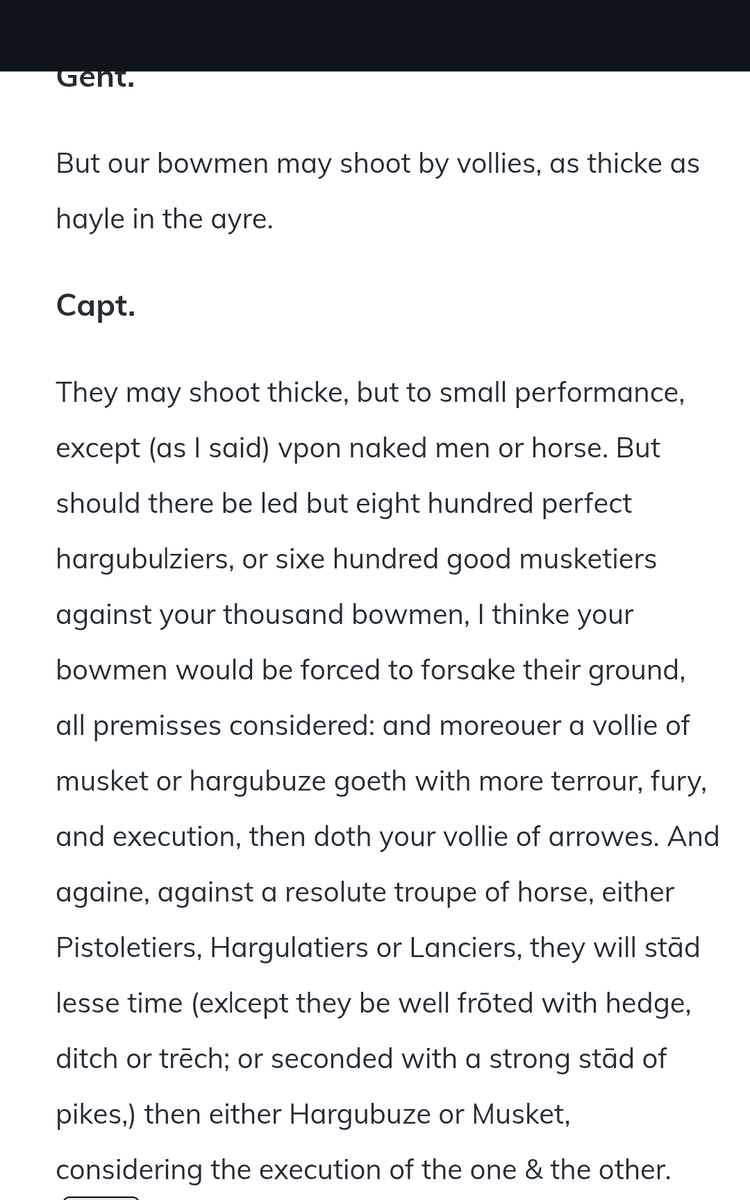
@_qwertygrl Early rifles did have slow rates of fire, but here is military theorist Rob Barnet explaining in 1600 that a rifle's greater penetration power and range easily compensates. He says 1000 archers would lose to a force of 600 or 800 riflemen.
This tweet is highly incorrect. Firearms effortlessly outclassed bows by the time the colonization of North America started and tribes gladly discarded bows for guns whenever possible.
imagine being a malnourished european meticulously powdering your muzzleloader after every shot while your 6’ tall chiseled opp just nocks another arrow that could split a young tree. there’s a reason colonization took centuries to even begin in earnest, let alone complete!
@_qwertygrl Champlain explicitly explains in his account how the Iroquois soldiers were shocked to see the men taken down by the gunshots because they were equipped with shields capable of blocking arrows! It's an example of bows being outclassed in concrete terms!
@_qwertygrl This is an account of an arquebus, not even a proper musket, being used in warfare by Samuel de Champlain in North America in 1609. Note that two shots win a battle for the equipped side and that the firearm's greater penetrating power compared to bows is remarked upon:
@_qwertygrl This is a common misconception, but bows (even high-end ones like English longbows) were inferior by the early 16th century. Just study the example of the Imjin War in the 1590s, a half-century before you claim firearm superiority became "close to true."
@nikicaga Acknowledging all the caveats that must be considered when discussing IQ, a 135 puts someone in the 99th percentile for intelligence. I don't see the how that is anything other than impressive.
@the_sigh_op2@Halalcoholism The saying that being born in a stable doesn't make you a horse was famously used to refer to the Duke of Wellington (who was Anglo-Irish). There are several different versions of the saying.
@nikicaga Simandou 2040 is the name of a mining project. Nobody actually knows when the next presidential election will be (one government spokesperson says this year, the other said not before 2026).
Maybe we will find meaning in going outside and smelling the roses? Athletics? But how many people will actually do that compared to how many will just consume the endless quantity of content AI will generate for them on demand?
Seriously, how do I cope with this? It's not just the art; AI will automate our jobs and the average account on social media will also be a bot. Are we all just going to turn into Wall-E humans eating slop at the trough?
@emollick While I hate the idea of "AI creative writing" and genuinely do not understand why it would be developed, I I have toyed with Grok and Claude found that they can write mostly-coherent stories with distinct narrative arcs and characters.
@MrsTad Woah, this was unexpected. Thanks for the inside scoop.
I also just finished The Last King of Osten Ard, and I'll take advantage of this moment to let you and Tad know that he has another happy reader!