So this happened: the interesting flight path was dropped earlier.
Then another chimed in with Starry Starry night.
All the feels right now.
I don’t take credit for this dot connect it’s just that some of my anon friends are not on X.
**MAJOR U.S. BANKING DISRUPTIONS — ANOTHER ADDITION TO THE GROWING INFRASTRUCTURE NARRATIVE **
November 16, 2026
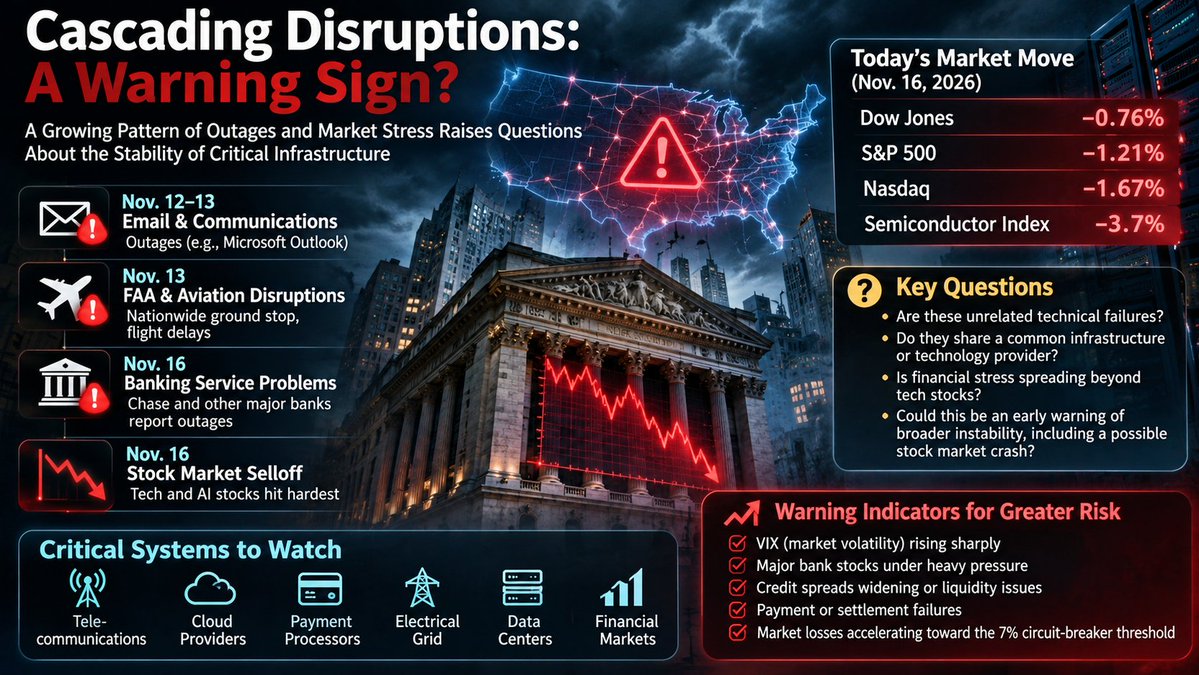
Just days after the massive Microsoft outage and the unprecedented FAA nationwide ground stop, we’re now seeing widespread reports of disruptions involving America’s largest financial institutions.
According to Reuters, AP and CBS News, customers reported problems involving:
🔴 JPMorgan Chase — Nearly 4,800 outage reports at one point, with confirmed transaction-processing problems.
🔴 Bank of America — Significant customer-reported service disruptions.
🔴 Wells Fargo — Online banking problems reported.
🔴 U.S. Bank — Customer complaints and potential payment delays.
🔴 Capital One, PNC, Truist and Citigroup — Additional customer reports across the banking sector.
🔴 Zelle — Customers reported delayed transfers, although Zelle says its network remained operational.
Chase attributes the disruption to an internal software bug, NOT a cyberattack. Other banks have not confirmed independent systemwide failures.
NOW LOOK AT THE BIGGER PICTURE:
▪️ Nov. 12 — Microsoft global communications outage
▪️ Nov. 13 — FAA nationwide aviation ground stop
▪️ Nov. 13 — New Orleans tanker/riverboat collision following steering failure
▪️ Nov. 16 — Major U.S. banking transaction disruptions
▪️ Nov. 16 — United Airlines technology outage
▪️ Nov. 17 — Scheduled nationwide U.S. Emergency Alert System test
▪️ Nov. 18 — Scheduled nationwide Canadian emergency-alert test
And all of this follows confirmed cyberattacks against European refrigeration infrastructure.
Communications. Aviation. Maritime transportation. Banking. Emergency preparedness.
One sector after another is appearing in the headlines.
ortation. Banking. Emergency preparedness.
One sector after another is appearing in the headlines…
Eyes 👀 On…
Over the past several days, America has experienced reported disruptions involving Microsoft services, FAA aviation systems, and major banking institutions, including Chase and Wells Fargo. At the same time, financial markets have experienced significant selling pressure, particularly in technology and AI-related stocks. While there is currently no verified evidence connecting these events, their proximity raises legitimate questions about the resilience of our critical infrastructure.
Modern communications, aviation, banking, and financial markets increasingly depend on interconnected networks, cloud services, data centers, telecommunications providers, and electrical infrastructure. This interconnectedness creates efficiencies, but it also introduces vulnerabilities when multiple institutions rely on the same technology providers or supporting systems. Are our backup systems genuinely independent, or do they share the same potential points of failure? Who controls these dependencies, and how quickly could essential services be restored during a widespread disruption?
The larger concern is not whether these incidents prove a coordinated event, because the evidence does not establish that. The concern is whether we have adequately examined the consequences of concentrating essential national functions within increasingly interconnected systems. If communications, transportation, banking, and financial markets were disrupted simultaneously, how much independent operational capability would remain?
These are questions worth investigating before a crisis forces us to find the answers.
Everything is going to be alright...
Whether something happens or not... things will get a bit worse before better...
[They] still have some air left to fight... just understand, we're 5 noves ahead of [them]... the infinite player controls the board...
Are we spotlighting Scientology via Tom Cruise? Scientology is facing mounting legal pressure in 2026, including RICO and trafficking!
Convictions already on the books:
• Danny Masterson — convicted of 2 counts of forcible rape, 30 years to life (appeal denied Oct 2026)
• Justin Craig (Lafayette Ronald Hubbard / “LRH 2.0”) — pleaded guilty to aggravated assault, 17-year sentence
Ongoing:
• Aaron Matthes (OT Scientologist) — charged with child sexual assault (potential life sentences)
• Leah Remini — harassment & defamation case proceeding after anti-SLAPP partial loss
• Baxter et al. — human trafficking / forced labor claims (stuck in church-controlled “religious arbitration”)
• Bixler et al. — harassment + attempted RICO claims against the church over Masterson cover-up allegations
• Jane Doe 1 — sexual abuse & forced marriage case, trial set for Jan 2028
• Valerie Haney — unlawful imprisonment claims also forced into arbitration
The church’s main defensive play remains the same: force former members into internal “religious arbitration” and push confidentiality/NDA-style agreements. These contracts (sometimes signed as children) have repeatedly delayed or redirected civil cases. Criminal prosecutions remain public.
Church response: all allegations are fabrications or anti-religious attacks.
Implications: reputational damage is compounding, legal costs are high, and if any of the larger civil cases (especially RICO or trafficking) survive to trial and verdict, the organization faces deeper structural and financial exposure. Outcomes still pending.
🚨 THE 17TH PERSPECTIVE | SPECIAL INVESTIGATIVE REPORT
THE GLOBAL CONVERGENCE: FINANCIAL RESTRUCTURING, CRIMINAL NETWORK TAKEDOWNS & THE QUESTION OF CONTINUITY
November 15, 2026 | Investigative Journalism & Strategic Intelligence Analysis
The central question: Are we witnessing a series of independent international operations, or the early stages of a more fundamental restructuring of global financial and institutional power?
Over the past twenty-four hours, I have been reviewing an extraordinary convergence of developments involving international banking, cybercrime networks, federal enforcement operations, critical infrastructure, and government preparedness.
The volume of information deserves serious attention.
However, connecting events across multiple sectors requires more than identifying patterns. It requires documented evidence, independent corroboration, and the discipline to distinguish established facts from emerging hypotheses.
Our investigation examined 15 principal claims, drawing upon public records, official agency statements, financial-sector reporting, and approximately 80 social-media posts published between October 17 and November 14.
Our findings:
2 claims supported.
3 partially supported.
9 unsupported or contradicted.
1 not independently checkable.
The result reveals something important: The international enforcement operations are real. The financial modernization is real. The existence of a single coordinated global endgame remains unproven.
I. THE FINANCIAL FRONT: A SYSTEM UNDERGOING TRANSFORMATION
A major transition is occurring within international payment infrastructure, although its nature is frequently misunderstood.
On November 22, 2025, SWIFT completed a significant migration to ISO 20022 financial messaging standards. The Federal Reserve’s Fedwire Funds Service implemented its corresponding changes on July 14, 2025.
These developments modernize the information exchanged between financial institutions, improve payment transparency, and create opportunities for more efficient cross-border transactions.
Meanwhile, the Bank for International Settlements continues advancing Project Agorá, which investigates tokenized commercial-bank deposits and central-bank money in wholesale cross-border payments.
Central banks have also increased their gold holdings, with the World Gold Council reporting approximately 321 metric tons of purchases during the third quarter of 2026.
Intelligence assessment: These are meaningful structural developments. They do not, however, establish that fiat currencies are being replaced by an asset-backed monetary system or that an undisclosed quantum financial network has become operational.
Modernization should not be confused with monetary replacement.
II. FOLLOW THE MONEY: INTERNATIONAL CRIMINAL NETWORKS UNDER PRESSURE
One of the strongest findings from our research concerns the intensification of international enforcement activity.
On November 12, Operation Endgame targeted cybercriminal infrastructure associated with Gootloader, CastleRAT, and StealC. According to the research, the operation involved 235 servers and 257 domains.
Separately, U.S. financial authorities moved against MEXC Global over alleged illicit financial flows, while international law enforcement operations continued targeting drug-trafficking, money-laundering, and organized-crime networks.
Other developments documented in our research include cartel prosecutions, international extraditions, and multinational arrests.
These cases reveal the increasing importance of targeting the financial and technological infrastructure that enables organized crime.
Rather than concentrating exclusively on individual offenders, authorities are pursuing the payment channels, service providers, communications systems, and organizational structures that make criminal enterprises operational.