https://t.co/3aEtuE9avz
Somewhere between Sagittarius and Scorpio, a whole sign got erased. Because the sun spends about 18 days passing through Ophiuchus, some astronomers argue it deserves a spot in the zodiac just as much as the
https://t.co/rQ5zXC4i7Q
I captured this magical scene of the Milky Way and Zodiacal light ✨rising above a stunning lagoon in a remote salar deep in the Atacama Desert in Chile. When I was taking the image the silence was absolute and the whole atmosphere felt utterly unearthly ! These fragile ecosystems are incredibly precious and must be protected 🙏
NASA shares clearest image ever captured of hexgonal storm raging on Jupiter's South Pole.
How this configuration remains stable is a mystery to this day and scientists are still looking for answers.
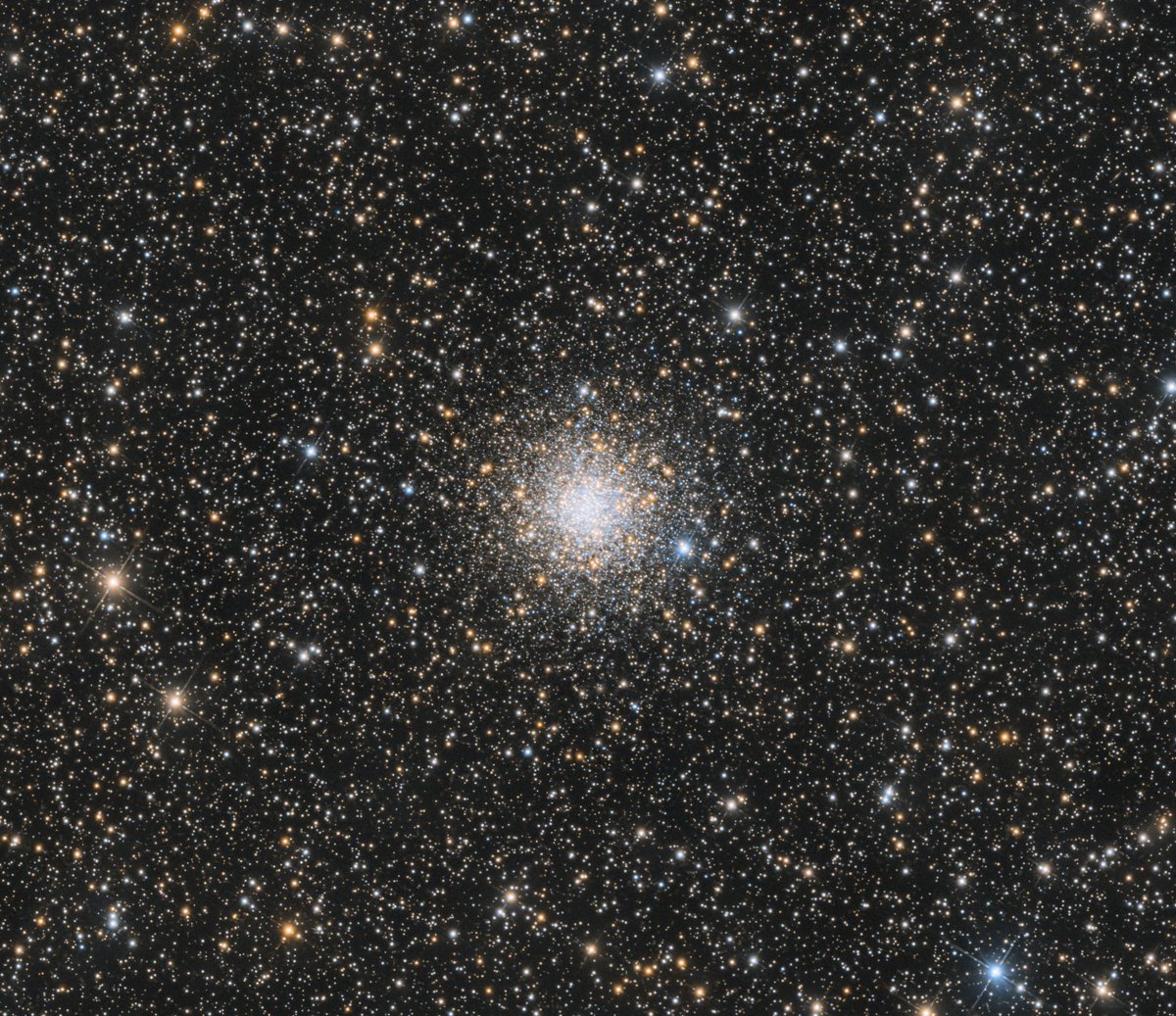
My latest - M56. It's an ancient globular star cluster located approximately 32,900 light-years away from Earth in the constellation Lyra. I used my Celestron RASA telescope and ZWO ASI533MC color camera.
In the heart of the Lagoon Nebula are young, massive stars illuminating the gas and dust around them. These younglings blast enough radiation and particles to sculpt this eye-catching landscape. #MondayMotivation
Is this what will become of our Sun?
Quite possibly. The first hint of our Sun's future was discovered inadvertently in 1764.
At that time, Charles Messier was compiling a list of diffuse objects not to be confused with comets.
The 27th object on Messier's list, now known as M27 or the Dumbbell Nebula, is a planetary nebula, one of the brightest planetary nebulas on the sky and visible with binoculars toward the constellation of the Fox (Vulpecula).
It takes light about 1000 years to reach us from M27, featured here in colors enhanced by red for hydrogen and blue for oxygen.
We now know that in about 6 billion years, our Sun will shed its outer gases into a planetary nebula like M27, while its remaining center will become an X-ray hot white dwarf star.
Understanding the physics and significance of M27 was well beyond 18th century science, though. Even today, many things remain mysterious about planetary nebulas, including how their intricate shapes are created.
Image Credit & Copyright: Francesco Antonucci