The modern Greek nation does not have a history, but rather a criminal record, since it was founded by the British in the nineteenth century.
Modern Greeks are not the unchanged continuation or exclusive representatives of the ancient Hellenes. Modern Greek national identity was constructed by retrospectively incorporating selected elements of classical antiquity into a nineteenth-century national framework. Population ancestry does not turn that modern national construction into uninterrupted historical identity or grant modern Greece ownership of every ancient society associated with the wider Hellenic world.
Winning a war on the battlefield just like Turks did for 2300 years is not genocide; killing 90,000 unarmed civilians on the basis of their ethnicity is genocide, while seizing their wealth calls the legitimacy of your sovereignty into question.
Three documented cases of atrocities / violations against Turks:
1-1821 Tripolitsa / Morea Massacre Greek rebel forces massacred Ottoman Turks, Albanians, Jews, and others in Tripolitsa during the Greek War of Independence. Academic sources record around 10,000 killed in Tripolitsa.
2-Greek occupation of İzmir and Anatolia, 1919–1922 Article 59 of the Treaty of Lausanne officially recorded that Greece recognized its obligation to make reparation for damage caused in Anatolia by acts of the Greek army or administration that were contrary to the laws of war.
https://t.co/6FvCJf2yIR…
İzmir (Smyrna) was Ottoman territory and that Greece invaded and later burnt it. Article 59 of the Treaty of Lausanne explicitly states that Greece recognized its obligation to make reparation for damage caused in Anatolia by acts of the Greek army or administration contrary to the laws of war. However, Türkiye waived those claims, taking Greece’s financial condition into account.
3-1963–64 Bloody Christmas / Cyprus violence against Turkish Cypriots The 1963–64 violence against Turkish Cypriots is recorded with 191 Turkish Cypriots killed and 173 missing presumed killed, for a total of 364 Turkish Cypriot dead or missing presumed dead, alongside large-scale displacement and destruction of Turkish Cypriot property.
The Council of Europe condemned Greece and recognised the legal basis of Türkiye's intervention.
The Athens Court of Appeal, in its judgment of 21 March 1979 (Case No. 2658/79), explicitly stated that "the Turkish intervention in Cyprus was legal and the real responsibles were Greek officers."
Turkish genocide in Greece with official statistics:
Statistical information about Greece. Part A. On population, land area, buildings, etc., Vasiliki Typography, Athens 1859. pp. 29-31
These are pages 29–31 of Aleksandros Mansolas’s official statistical compilation, Πολιτειογραφικαί πληροφορίαι περί Ελλάδος, published by the National Printing Office in Athens in 1867. Mansolas was the head of the Bureau of Public Economy at the Greek Ministry of the Interior.
The table divides the population in 1821 into “Χριστιανοί” — Christians and “Οθωμανοί” — Ottomans:
Before the establishment of the modern Greek state, the territories from which it was formed contained a substantial Ottoman/Muslim population of approximately 90,830 people. Following the war, this population largely disappeared from the demographic structure of the new state.
Στατιστικαί πληροφορίαι περί Ελλάδος. Μέρος Α΄. Περί πληθυσμού, περί εκτάσεως γης, περί οικοδομών κτλ., Βασιλική Τυπογραφία, Εν Αθήναις 1859. sf. 29-31
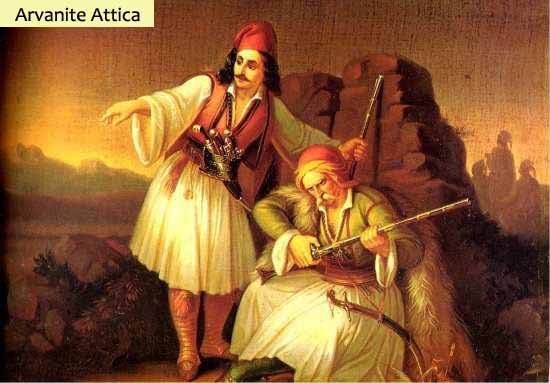
Në agim të ditës, ju shfaqen në horizont Malet Akrokeraune dhe ai vend i egër, që tani quhet Shqipëri, i cili në lashtësi rriti Pirron, frikën e Romës; Olimpinë, nënën titanike të Aleksandrit të Madh; dhe në kohë të mëvonshme një Aleksandër më të vogël, Skënderbeun, i cili, megjithatë, ishte një figurë e madhe në historinë e kohës së tij; dhe ashtu si dikur Dorianët zbritën nga malet e tyre dhe e përtërinë Greqinë e Jugut me rininë e tyre të fuqishme dhe virtytet e tyre luftarake, po kështu, në Mesjetë, këta malësorë shqiptarë kanë sjellë shpirtin luftarak, veshjen e hijshme dhe bukurinë fizike për të përtërirë pamjen helenike.
Edhe sot, madje në Atikë, ka zona ku shqipja është gjuha e përbashkët; ka emra shqiptarësh të famshëm në analet e historisë greke, veçanërisht në Luftën e Madhe të Pavarësisë (1821-31), madje edhe ndër marinarët e Hidrës, aq të njohur për sipërmarrjet e tyre tregtare dhe bëmat e tyre luftarake, familjet kryesore ishin me origjinë shqiptare.
J. P. Mahaffy - Greek Pictures Drawn with Pen and Pencil
Autor: John Pentland Mahaffy (J. P. Mahaffy)
Viti i botimit: 1890
Botuesi: A. & C. Black, London
After Kosovo Police arrested a Turkish citizen suspected of involvement in war crimes linked to the Krusha massacre, videos have surfaced showing him alongside Serbian paramilitary forces during the Kosovo War.🇽🇰