250 years ago, America declared independence. A year earlier, the Spanish founded Presidio San Agustín del Tucsón—a fort that would become Tucson, AZ.
Join the @1912Institute for a panel discussion on America's founding & AZ's role in the Union: https://t.co/LUUqR8IFCz
250 years ago, America declared independence. A year earlier, the Spanish founded Presidio San Agustín del Tucsón—a fort that would become Tucson, AZ.
Join the @1912Institute for a panel discussion on America's founding & AZ's role in the Union: https://t.co/LUUqR8IFCz
Join us on Friday, June 26, 2026 at 6pm.
AZ Supreme Court Justice Clint Bolick & @ASU_SCETL professor Sean Beienburg will discuss the foundings of Arizona and America w/ members of the 1912 board.
Followed by reception w/ drinks & hors d'oeuvres.
RSVP: https://t.co/CmBvEZjxzX
Join the @1912Institute as we kick off our America250 series on Friday, June 26 @ 6pm in Scottsdale, AZ.
Justice Clint Bolick and @ASU_SCETL's Dr. Sean Beienburg will join us to discuss the US and AZ foundings.
Followed by reception w/ drinks & hors d'oeuvres.
RSVP in replies.
“Conservatives need a new way of doing local politics”
That’s my first essay for the 1912 Institute. I’ve been thinking a lot recently about how we do advocacy - and why we adopt progressive models so often
The SRP election tells us we can’t be looking at it like a turnout game
AZ conservatives outspent progressive groups 10-to-1 in the @SRPconnect election and still lost the majority.
@1912Institute Fellow @CraigARuiz on why viewing local contests the way progressives do only plays into their hands.
LINK:
https://t.co/EkCMi1ccBv
New from the @1912Institute: Not enough attention has been paid to the Sun Belt. Our national consciousness remains mired in nostalgia and continues to under-index the incredibly bright trajectory of states like Arizona, Nevada, Texas, Georgia, and Florida. @joepitts
Our contemporary politics is coming to be shaped by two certifiably American worldviews.
Rust Belters have experienced American decline firsthand. They grew up in towns with hollowed out factories, declining populations, and a general air of pessimism. Every day, they are reminded of what was—they mourn a world lost. Their grievances are not without basis.
Sun Belters grew up in places built yesterday: new suburban developments, exurbs, and skyrises. Every day they are reminded of what can be—they anticipate a world to come. If they have grievances, they are with Rust Belters, who, to them, are mired in a past that can never be restored.
These worldviews cut across party lines. Ezra Klein and Doug Ducey are both Sun Belters, preferencing growth and believing that decline can be averted by embracing innovation and the wave of the future.
JD Vance and Bernie Sanders are both Rust Belters, seeing the world through the lens of scarcity and believing that decline can be averted by restoring the past, or at least elements thereof (higher rates of unionization, reshored manufacturing, etc.).
(A brief aside: Sanders does not hail from a Rust Belt state. The Sun Belt and Rust Belt attitudes are regionally sourced but nationally distributed.)
If the Sun Belt’s sunny trajectory continues apace—signs are good, but far from certain—Sun Belters will exercise an increasingly large role in our politics. Does this mean that Sun Belt policies will gain traction? Not necessarily. Sufficient backlash to streamlined regulation, improved state capacity, and elevated but perhaps inequitably distributed economic growth could put the Rust Belters back in the driver’s seat.
The emerging dominant paradigm in our politics—Sun Belt vs. Rust Belt—cuts across party lines. It could be the fulcrum upon which 21st century American politics turns.
In a brief for the @1912Institute, I analyze the Sun Belt's growth trajectory.
"Our national consciousness remains mired in nostalgia and continues to under-index the incredibly bright trajectory of states like Arizona, Nevada, Texas, Georgia, and Florida."
🧵
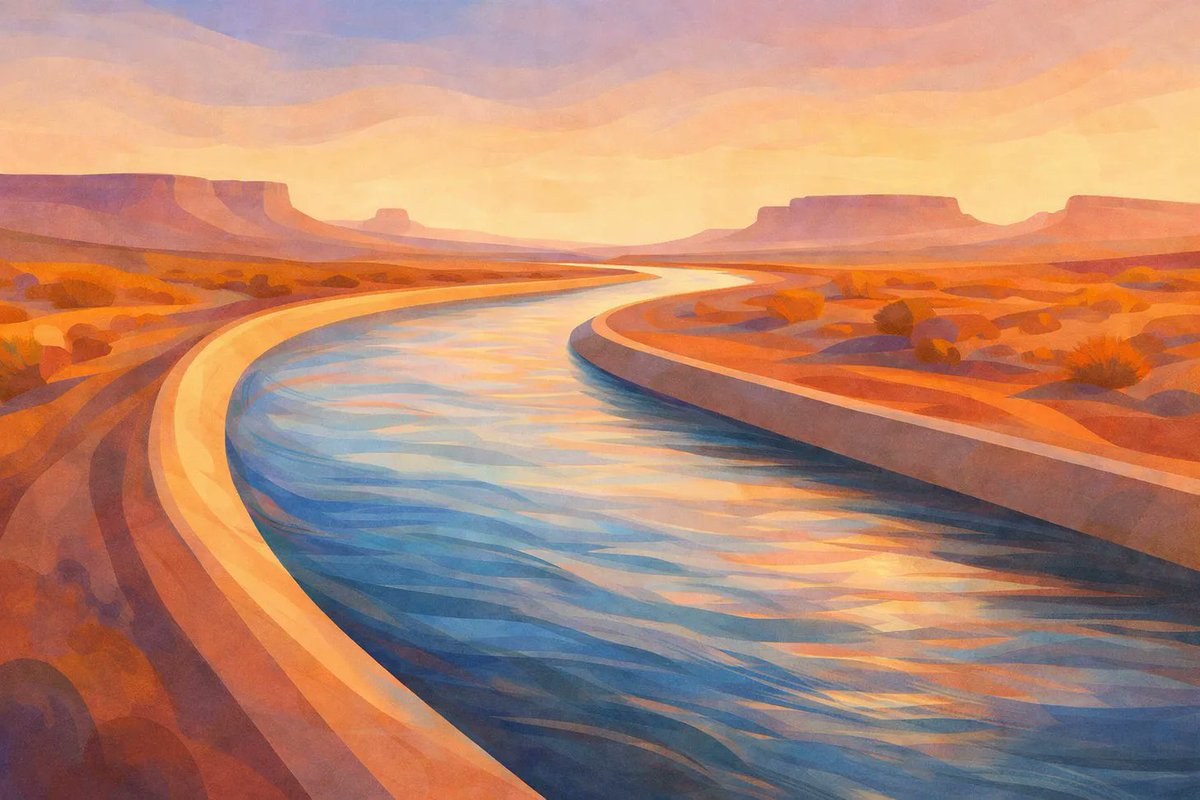
"Life does not come easy here; our droughts are enough to tell us that. But this danger—the risk of calamity—is precisely her appeal. Civilization was not built by those who cherished comfort or managed decline."
My ode to the American West for @thedispatch's TheNext250 series:
"The West is a land of hope. Yes, a land of hopes dashed, expectations exceeding reality, booms and busts, all of that. But a land of hope nonetheless." --@joepitts |TheNext250
https://t.co/GqVw9ULDun
For all of our development, for all of our laudable innovations, . . . the spirit of the American West still pulses. The same old hopes that inspired our ancestors, and the same old challenges that sometimes brought them low, remain with us today.
https://t.co/Ww0qqQ1kRT
Join some special guests and myself for networking, discussion, & information-sharing about a new @afsaalumni chapter for ASU alum, & about the state of the university today.
Wednesday, Nov. 13, 3:30-4:30pm | Rooftop of the Canopy Hotel - Tempe, Arizona
https://t.co/WdlnWKoJGO
RUNNING ON EMPTY: Arizona faces challenges in energy and education as Western leaders push back on oil regulations and the teacher retention crisis deepens.
Read more in the latest Round Up from @JCichoke43: